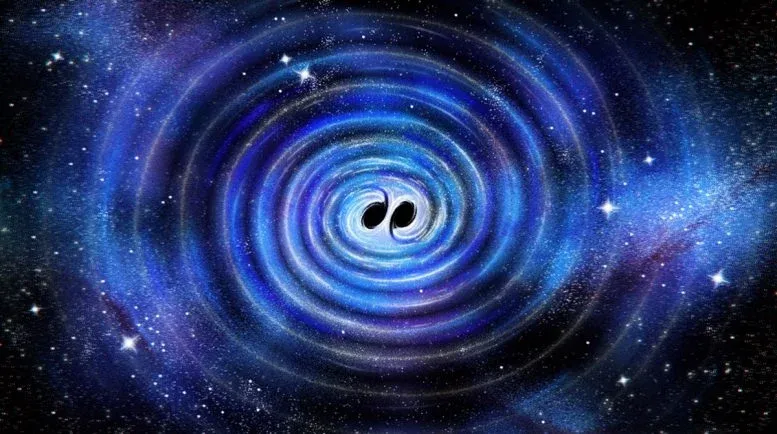
When two black holes decide to get together, they don't just quietly merge. Oh no. They throw a party so epic it literally warps the fabric of space and time, sending out ripples we call gravitational waves. And for a while now, scientists have been picking up these cosmic echoes, using them like a celestial sonogram to figure out how big and how fast these behemoths are spinning.
But now, it turns out, the post-merger after-party is even more interesting. Researchers have figured out a new way to listen to the faint ringing of a newly formed black hole as it settles down. Think of it as the universe's most dramatic tuning fork.
The Echoes of a Cosmic Crash
After two black holes become one, the new, super-sized entity doesn't just immediately chill out. It vibrates. It rings. Not with sound, obviously, because space is a vacuum and nobody can hear you scream, or sing, out there. These are gravitational waves, just like the initial collision, predicted by one Albert Einstein, who clearly had an ear for the dramatic.
We're a new kind of news feed.
Regular news is designed to drain you. We're a non-profit built to restore you. Every story we publish is scored for impact, progress, and hope.
Start Your News DetoxThe speed of these vibrations is like a black hole's unique fingerprint, telling scientists about its final mass and spin. Measuring these specific vibrations, known as quasinormal modes, helps us test Einstein's theory of general relativity under the most extreme conditions imaginable. Because apparently, that's where the fun really begins.
Researchers at the University of Cambridge decided it was time to get a better handle on these cosmic tunes. They developed a new technique to precisely identify and catalog these vibrations, digging into computer simulations of black hole mergers. What they found wasn't just the main "note" of the ringdown, but also weaker, rapidly fading "overtones." It's like finding the hidden harmonies in a symphony of destruction.
Richard Dyer, the lead author, explained that while the loudest mode is often picked up, those quieter ones have been notoriously tricky to pin down. This new method offers a clear, data-driven approach to map out which modes exist and when they appear. Essentially, they're giving future black hole listeners a much better score sheet.
Listening for the Fainter, Stranger Notes
The team didn't stop at overtones. They also uncovered some truly unusual "nonlinear modes" in their simulations. These happen when two or more main frequencies interact, creating complex, distorted signals—kind of like an electric guitar solo that's gone wonderfully, chaotically wrong. To find these signals, you need incredibly high-quality data and some serious analytical chops to filter them from the cosmic background noise.
Dyer noted that while the ringdown is one of our best windows into black hole physics, extracting all the information from it is a monumental task. Their goal was a clear, data-driven path through the noise.
Dyer and Dr. Christopher Moore put their new method to the test using a public catalog of super-precise simulations, meticulously recording which modes showed up and when. These findings are set to be a game-changer for current gravitational wave detectors like LIGO and Virgo, and will be invaluable for the next generation of instruments.
Knowing which frequencies are likely to appear in a merger means we can test general relativity with unprecedented accuracy. It means checking if the final, ringing black hole actually matches what Einstein's equations predicted. Which, if you think about it, is both impressive and slightly terrifying. Let's hope his math holds up.