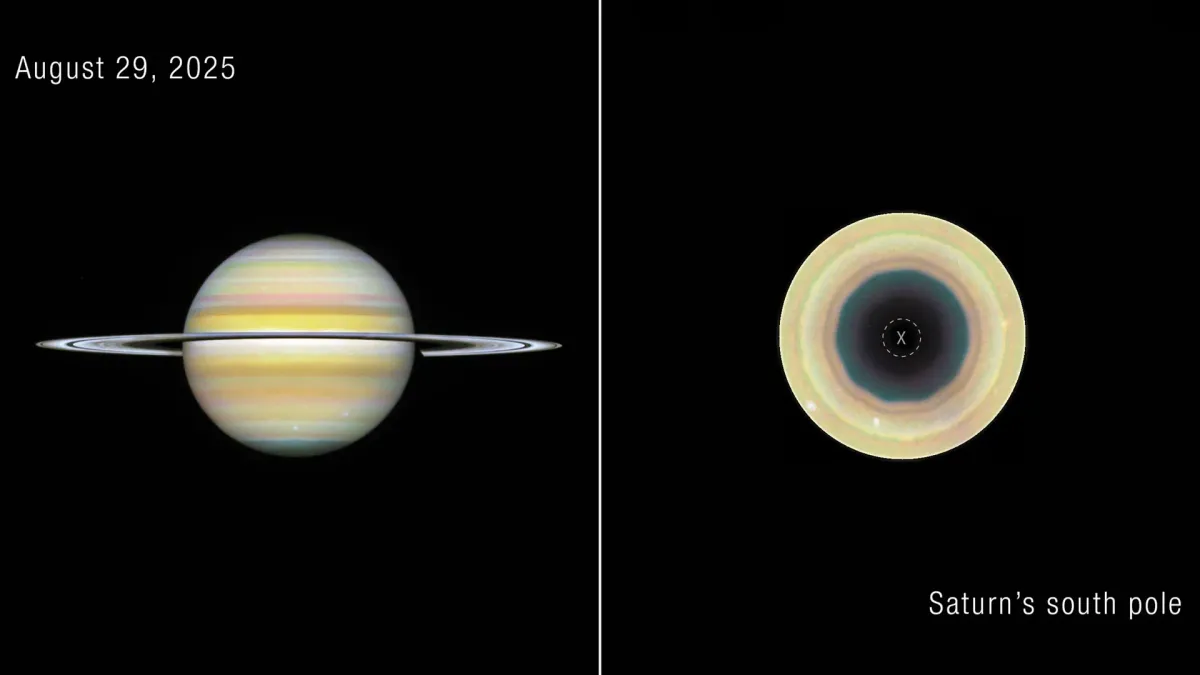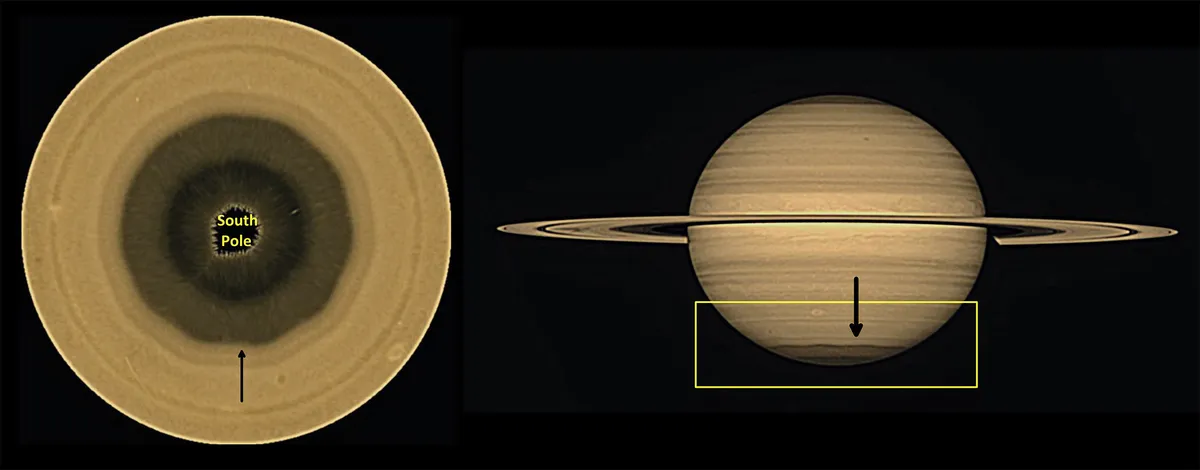
A giant, 10-sided atmospheric wave has appeared near Saturn's south pole. This "decagon" is the first large, stable, regular pattern seen in Saturn's southern hemisphere.
Researchers compared observations over several years. They found the pattern has become clearer since 2023. This suggests a new atmospheric event is happening on the gas giant. The Hubble Space Telescope's Wide Field Camera 3 captured these images as part of the Outer Planet Atmosphere's Legacy (OPAL) program. This program has watched Jupiter, Saturn, Uranus, and Neptune for over 10 years.
Saturn's New Mystery
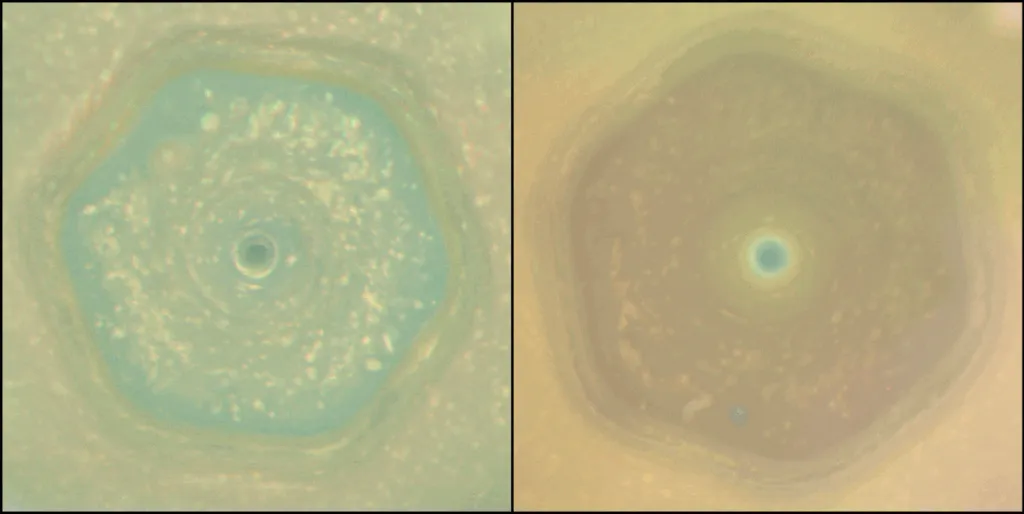
Since 1980, scientists have been puzzled by the hexagonal jet stream around Saturn's north pole. This six-sided wave has been recreated in labs using spinning liquid tanks. However, why it forms on Saturn and why its color changes from blue to gold is still debated.
We're a new kind of news feed.
Regular news is designed to drain you. We're a non-profit built to restore you. Every story we publish is scored for impact, progress, and hope.
Start Your News DetoxNow, OPAL program scientists have found another mystery. A blue decagon has recently formed around Saturn's south pole.
In a new paper, scientists from UC Berkeley Space Sciences Laboratory (SSL), NASA’s Goddard Space Flight Center, and the University of the Basque Country described tracking this 10-sided jet stream. They looked at Hubble Space Telescope images from 2023 onward. Features like Jupiter's Great Red Spot, which has lasted for nearly 200 years, can make planets seem unchanging.
Saturn's decagon shows how much these planets can change.
"A few years ago, this feature wasn't there," said Michael Wong, a study co-author and SSL researcher. "It shows how important it is to regularly observe the outer planets."
After the northern hexagon was found, scientists were surprised not to find a southern one. In 2004, NASA's Cassini spacecraft imaged Saturn's southern hemisphere. It didn't find a hexagon. But it did find a circular band of jet currents at 60.5°S with a polygonal look. This feature only lasted a few days and was never seen again before Cassini ended its mission in 2017.
With Cassini gone, there was a gap in Saturn observations. The OPAL project stepped in to fill it.
The OPAL project started in 2009. Michael Wong was a visiting scientist at the Space Telescope Science Institute. He was helping calibrate Hubble's new Wide Field Camera 3 (WFC3).
That year, a large impact happened on Jupiter. Wong used the WFC3 to capture the first science images of the planet. But then there were long gaps in Hubble's outer planet observations. No images of Jupiter were taken in 2011 and 2013. These gaps led Amy Simon, OPAL's principal investigator and a planetary scientist at NASA Goddard, to push for yearly WFC3 surveys of the four outer planets: Jupiter, Saturn, Uranus, and Neptune.
The project was approved. Saturn observations began in 2018 after the Cassini mission ended.
OPAL's yearly observations started showing results. In 2021, the OPAL team, including Wong, Simon, and Glenn Orton, found that wind speeds in Jupiter's Great Red Spot were increasing.
In 2023, they found that Uranus' northern polar hood was getting brighter. In July, they published observations on the full life cycle of one of Neptune's dark spot cyclones.
Unraveling the Decagon
Agustín Sánchez-Lavega, the study's lead author and a researcher at the University of the Basque Country, first noticed Saturn's decagon. His Planetary Virtual Observatory Laboratory (PVOL) accepts ground-based images from contributors. An image received by PVOL in 2024 showed a disturbance similar to what Cassini saw 20 years earlier. Sánchez-Lavega contacted the OPAL team to study Hubble's higher-resolution images of the southern hemisphere.
When Hubble's images from 2024 and 2025 were put into a polar view, the decagon was clearly visible at about 63°S.
Looking at the images through different filters showed the decagon wave has a 3D structure. The part visible to the eye is in Saturn's upper troposphere. The winds creating it move at about 400 kilometers per hour.
Sánchez-Lavega created a shallow water equation model. It showed how a decagon could form in turbulent liquid. But most aspects of Saturn's decagon are still unknown. The makeup of the aerosols that give the wave its blue color is not known. Neither is the wave's structure as it goes deeper into the atmosphere.
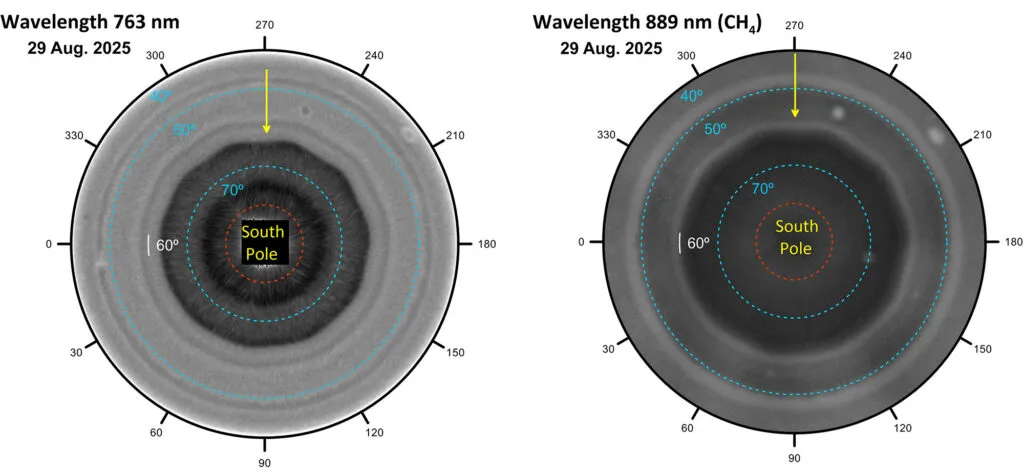
The study authors might be closer to understanding how the decagon formed. They noted it is just south of an anticyclone vortex at about 55°S. This compact vortex was first seen in 2023. But it darkened sharply in 2025, just before the decagon appeared.
"Perhaps the vortex caused the initial disturbance, and then the balance of forces caused the persistent decagon," Wong said. "We really need more detailed simulations of its 3D structure to know for sure."
Deep Dive & References
Decagon wave emerges near Saturn’s south pole - Science Advances, 2024
Polygonal appearance of Saturn's south polar vortex - Journal of Geophysical Research: Planets, 2006
Hubble Shows Winds in Jupiter’s Great Red Spot Are Speeding Up - NASA, 2021
Uranus’ northern polar hood was brightening over time - Journal of Geophysical Research: Planets, 2023
Observations on a complete lifecycle of one of the dark spot cyclones on Neptune - Geophysical Research Letters, 2024