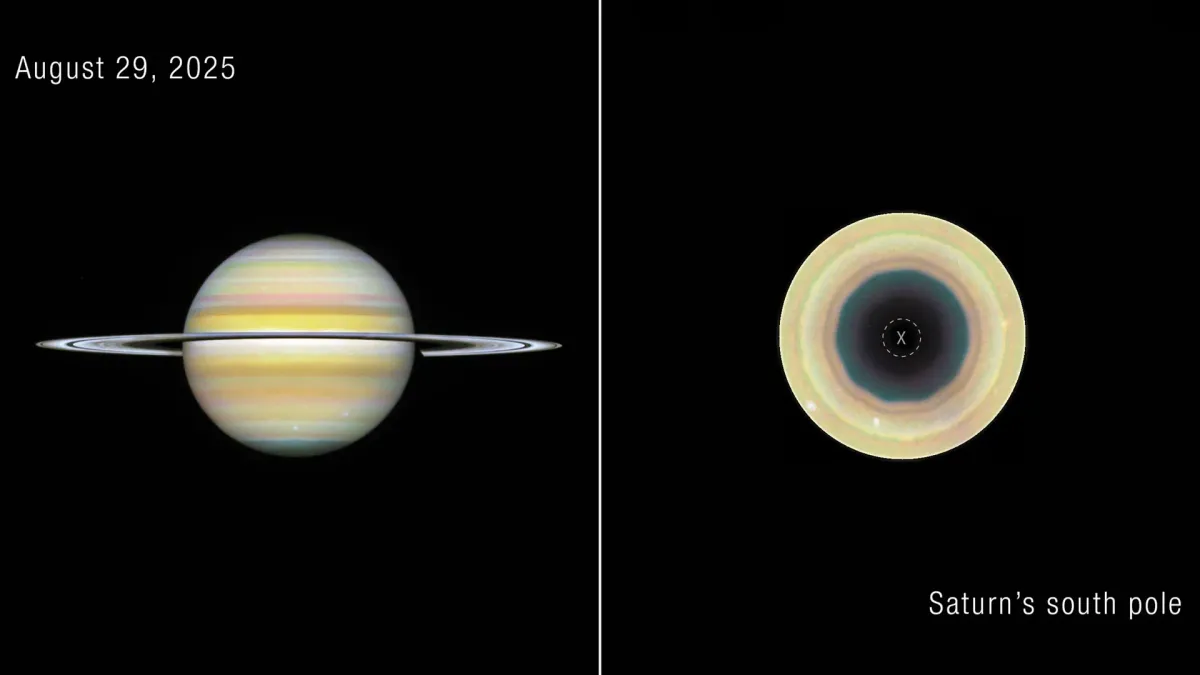
Just when you thought Saturn's northern hexagon had cornered the market on geometric atmospheric anomalies, the ringed planet decided to get a new party trick. Scientists have just confirmed a massive, evolving 10-sided pattern — a decagon — has appeared around Saturn’s south pole.
Think of it as the planet's unexpected southern counterpart to its famous, decades-old northern hexagon. And according to data from NASA's Hubble Space Telescope, this strange new shape only started emerging in the last few years and is still getting stronger. Because apparently, that's where we are now: planets just spontaneously manifesting new shapes.
The Planet's New Face
Hubble's Outer Planet Atmospheres Legacy (OPAL) program, which has been diligently snapping annual portraits of the outer planets for over a decade, provided the crucial long-term observations. Researchers pieced together years of data, tracing the decagon's faint beginnings in 2023 to its current, much clearer form.
We're a new kind of news feed.
Regular news is designed to drain you. We're a non-profit built to restore you. Every story we publish is scored for impact, progress, and hope.
Start Your News Detox"We've never seen anything quite like this in Saturn's southern hemisphere," said Amy Simon, a study co-author and OPAL principal investigator at NASA's Goddard Space Flight Center. "The northern hexagon has been there every time we've looked for more than 40 years. This feature is different -- it appears to be strengthening, giving us the rare opportunity to watch a giant atmospheric pattern develop."
Part of the reason we're only seeing it now? Saturn's changing seasons. As the planet slowly tilted, its south pole finally became visible from Earth again, revealing this new atmospheric artwork.
Amateur Eyes, Professional Discoveries
The initial whispers of the decagon didn't come from a supercomputer, but from sharp-eyed amateur astronomers. Agustín Sánchez-Lavega, a lead author from the University of the Basque Country in Spain, along with amateur observers Trevor Barry and Jean-Paul Oger, first spotted a faint, wavy band near the south pole in 2024 images. By 2025, ground-based observations strongly suggested it had solidified into a decagon.
Hubble then stepped in for the close-up, providing the kind of crisp, atmospheric-blur-free images only a space telescope can deliver. This allowed scientists to confirm the decagon's presence as far back as 2023.
"Given Saturn's symmetry in its north-south jet stream system, we have been searching for a counterpart to Saturn's northern hexagon on the south pole in Hubble images since 1990," Sánchez-Lavega noted. "Images from NASA's Cassini spacecraft, which orbited Saturn between 2004 and 2017, showed no inkling of a long-lived formation, either. The Hubble data confirmed the feature's presence back to 2023."
This isn't just a surface-level phenomenon either. The new wave is nestled within one of Saturn's powerful jet streams and extends through multiple layers of the atmosphere, making it a truly deep, vertically integrated structure. It even shifts slightly depending on the wavelength Hubble uses, as different wavelengths peer into different atmospheric altitudes.
Scientists are now scratching their heads, wondering why it formed now, after all these years of nothing. Was it always brewing, or is Saturn just feeling a bit more… angular these days? More observations from Hubble and the James Webb Space Telescope, along with some serious computer modeling, will be needed to figure out this sudden geometric shift. Here's hoping it doesn't decide to become an icosahedron next.