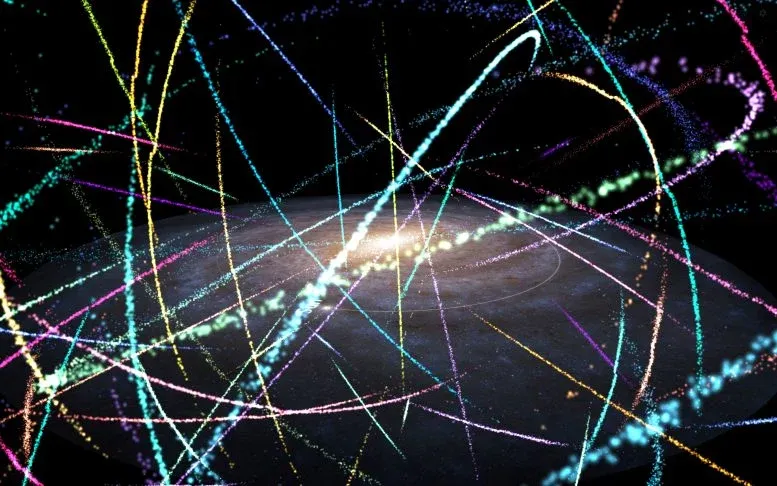
Astronomers have been staring intently at the wispy, distorted shapes of stellar streams around the Milky Way, convinced they were seeing the subtle fingerprints of dark matter. Turns out, the galaxy itself might just be a bit of a messy eater. New research suggests many of those cosmic kinks and wiggles aren't mysterious dark matter clumps at all, but just regular galactic drama.
Basically, we've been looking for ghosts, and the house itself is just creaking.
Researchers at the University of Washington ran about 15,000 simulations of these stellar streams – long, thin bands of stars that get stretched out by a galaxy's gravity. They modeled these streams orbiting four galaxies similar to our own, without adding any dark matter subhalos (those theoretical tiny clumps of dark matter everyone's so keen to find).
After five billion simulated years (because science never rushes), almost every single stream was a hot mess. Only 70 remained perfectly smooth. Let that satisfyingly small number sink in. This strongly suggests that the host galaxy alone can create the exact same types of distortions we've been attributing to dark matter.
We're a new kind of news feed.
Regular news is designed to drain you. We're a non-profit built to restore you. Every story we publish is scored for impact, progress, and hope.
Start Your News DetoxThe Galaxy's Own Gravity Is the Culprit
So, what's causing all this galactic chaos? It's the galaxy's own structure. Stars aren't perfectly evenly spread out. You get denser patches, less dense patches, like a cosmic lumpy mattress. As a stellar stream drifts through these uneven gravitational fields, it gets pulled, stretched, and generally roughed up.
Lead author Arpit Arora admitted he was surprised by the sheer number of irregularities. He expected some, sure, but not that nearly all streams would show structural changes. Which, if you think about it, is both impressive and slightly terrifying for anyone trying to map invisible stuff.
The simulations revealed all sorts of havoc: wiggles, kinks, spurs, branches, gaps, and clumps. Some streams were even completely torn apart. The closer a stream orbited to the galactic center, the more irregularities it developed, because it was constantly running into these lumpy gravitational patches.
This makes the hunt for dark matter's direct influence a bit trickier. We know dark matter makes up most of the universe's mass and helps form galaxies, but we still have no idea what it actually is. Stellar streams were supposed to be our cosmic magnifying glass.
Now, astronomers have to first account for all the drama caused by the galaxy itself before they can even begin to look for dark matter's unique fingerprint. Arora plans to add dark matter clumps to future simulations to see if they create patterns distinct enough to be separated from the galaxy's own gravitational shenanigans. New telescopes, like the Simonyi Survey Telescope, are expected to find even more stellar streams, which should give scientists plenty of new cosmic puzzles to solve. Because apparently that's where we are now: solving for galactic interference before we can solve for the universe's biggest mystery.