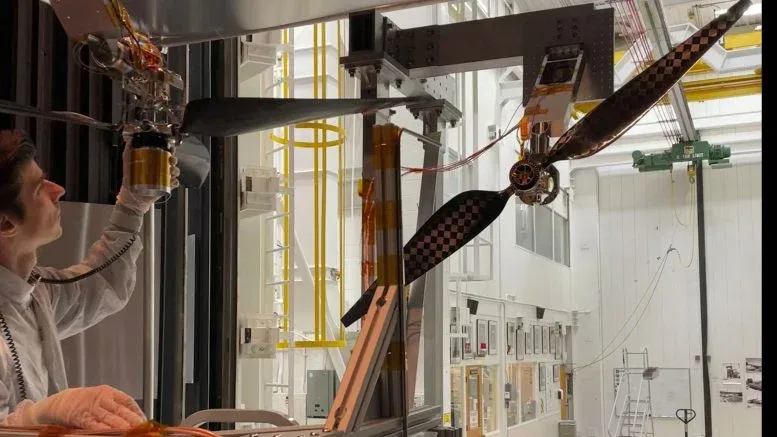
NASA engineers have successfully tested new helicopter rotor blades that can break the sound barrier on Mars. These tests, done at NASA's Jet Propulsion Laboratory (JPL), show that rotor tips can safely go faster than Mach 1 in Mars-like conditions.
This breakthrough could lead to future Mars helicopters that are much more capable. They could carry heavier scientific tools and fly for longer periods.
Pushing the Limits of Martian Flight
The Ingenuity Mars Helicopter made history in 2021 as the first aircraft to fly on another planet. However, it was a technology demonstration and didn't carry scientific instruments. Future Mars aircraft, like those for the SkyFall project, need to do more.
We're a new kind of news feed.
Regular news is designed to drain you. We're a non-profit built to restore you. Every story we publish is scored for impact, progress, and hope.
Start Your News DetoxAl Chen, Mars Exploration Program manager at JPL, explained that flying on Mars is very difficult. The atmosphere is extremely thin, making it hard to get enough lift, even though Mars has significant gravity.
To generate more thrust, helicopters typically need faster rotation speeds or larger rotors. On Mars, with its thin atmosphere (only about 1% as dense as Earth's), rotor blades must spin very close to the speed of sound to lift off.
During Ingenuity's 72 flights, its rotor blades stayed below 2,700 rpm. This was to avoid unpredictable effects near the sound barrier and prevent wind gusts from pushing the tips to supersonic speeds.
Jaakko Karras, JPL's rotor test lead, noted that things can get "squirrely" around Mach 1. Ingenuity's flights were planned to keep rotor tips at Mach 0.7 without wind. This ensured they wouldn't go supersonic even with a Martian headwind. But for the next generation, more speed was needed.
On Earth, Mach 1 is about 760 mph (1,223 kph) at sea level. On Mars, due to its thin, cold, carbon dioxide-rich atmosphere, the speed of sound is much lower, around 540 mph (869 kph).
Supersonic Success in a Mars Chamber
Karras and his team tested a new three-bladed rotor from AeroVironment. They used JPL's 25-Foot Space Simulator, a chamber that can mimic Mars' atmosphere. Air was removed and replaced with carbon dioxide at Mars-like pressure. The rotor then spun faster and faster while exposed to increasing wind speeds.
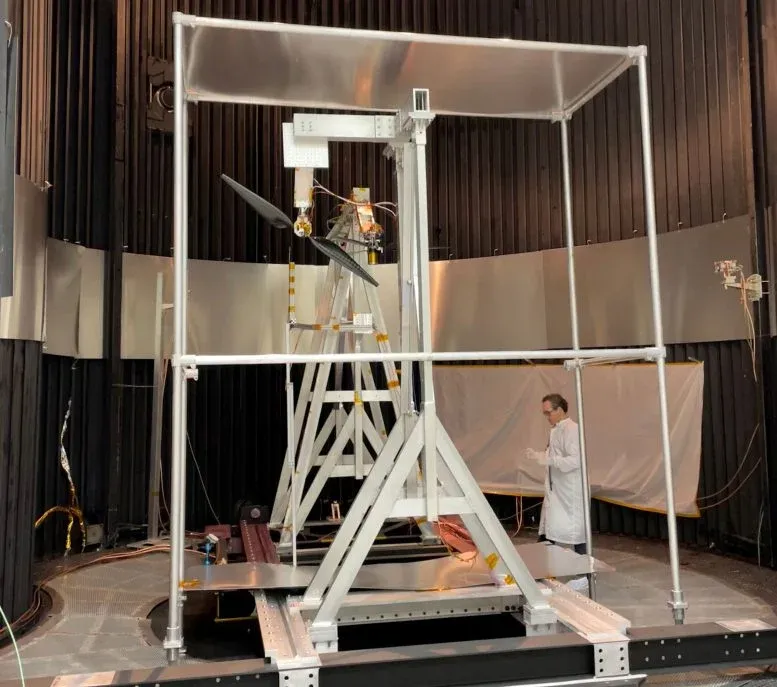
Engineers watched from a control room as the rotor reached 3,750 rpm, with blade tips at Mach 0.98. Then, strong headwinds were introduced, pushing the rotor tips to Mach 1.08. This increased the aircraft's lifting ability by 30%.
This 30% boost means future Mars helicopters could carry larger scientific payloads, more advanced sensors, and bigger batteries for longer flights. The team also tested a two-bladed rotor for the SkyFall mission concept, which achieved similar near-supersonic speeds.
Shannah Withrow-Maser, an aerodynamicist from NASA's Ames Research Center, said they were lucky to hit Mach 1.05 but reached Mach 1.08. She believes there might be even more thrust possible.
The SkyFall mission team has already used these test results in their designs. They plan to send three next-generation Mars helicopters to the Red Planet in December 2028, building on Ingenuity's legacy.