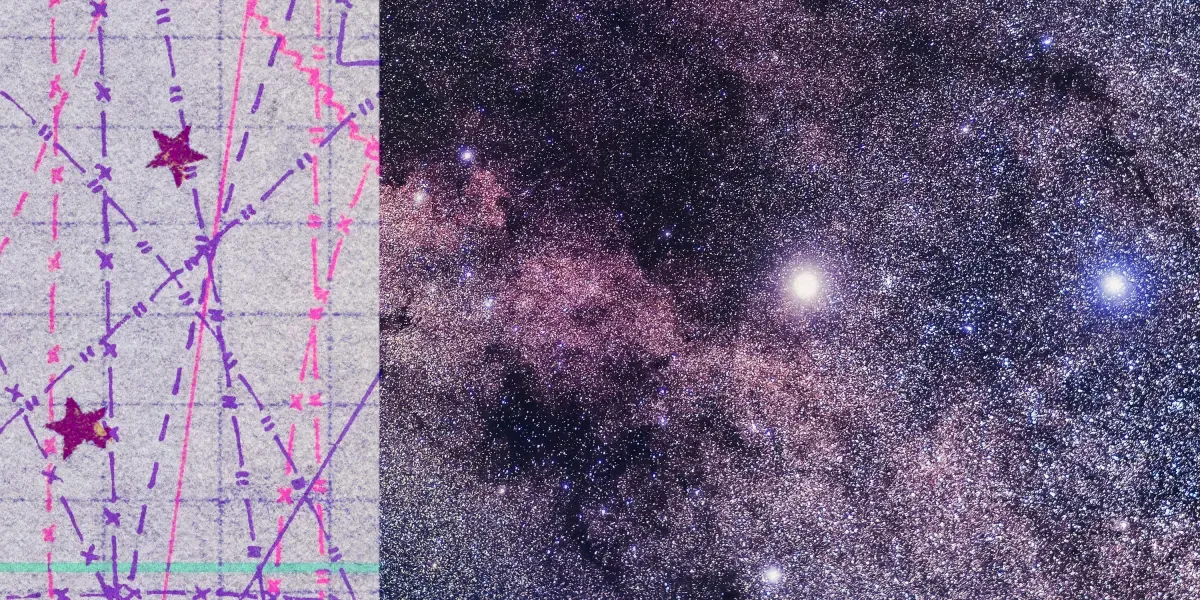
Sending anything to another star is, to put it mildly, a bit of a trek. Voyager 1, humanity's fastest long-distance traveler, has been zipping through space for decades and has barely cleared our cosmic driveway. At its current speed, a trip to Alpha Centauri – our nearest stellar neighbor, a mere 4.4 light-years away – would take roughly 70,000 years. Which, if you think about it, is both impressive and slightly terrifying.
Enter the Fermi Explorer Mission, a plucky new endeavor with $58 million in funding (led by Bill Gates's Breakthrough Energy, no less) and an audacious goal: to send a small, solar-powered spacecraft to Alpha Centauri. The catch? The mission team had a budget of just $15 million and a problem: how to power a tiny probe for a multi-millennia journey without making it too heavy.
The AI That Said, "Hold My Stardust"
Philip Johnston and his team at Fermi Explorer had spent a year banging their heads against this particular celestial wall. Then, Johnston mentioned his predicament on a podcast, catching the ear of Alex Wissner-Gross, a physicist and co-founder of Physical Superintelligence (PSI). Wissner-Gross offered up PSI's AI system, 'Get Physics Done,' a piece of open-source software that breaks down complex physics problems and runs simulations using advanced AI models.
We're a new kind of news feed.
Regular news is designed to drain you. We're a non-profit built to restore you. Every story we publish is scored for impact, progress, and hope.
Start Your News DetoxA week later, the AI delivered. It had concocted a completely novel trajectory, a ballet of orbital maneuvers the human team hadn't even considered. The AI's genius? It suggested the spacecraft slow down first, swinging perilously close to the sun – closer than Mercury, in fact.
During each scorching close pass, the spacecraft would fire its engine. Why then? Because at that proximity, the solar panels would get four times more sunlight, providing a massive burst of energy. Firing the engine at high speed also delivers a disproportionately larger thrust. This neat trick meant the solar panels could stay small and light, keeping the overall spacecraft lean enough for its epic journey.
Matt Pines, PSI's co-founder, noted that the AI largely worked unsupervised for three days, with an astrophysicist occasionally nudging it in the right direction. While the AI's ability to invent an entirely new mission profile was a genuine surprise, Pines also dryly observed that it still lacks human judgment and often wanders down cosmic dead ends. So, not quite Skynet yet, but give it time.
The Great Filter, and Other Existential Thoughts
Beyond the engineering marvel, the Fermi Explorer Mission aims to poke at one of physics' most enduring headaches: the Fermi paradox. Coined by Enrico Fermi in 1950, it asks: if the universe is teeming with billions of stars and potentially habitable planets, where is everybody?
The paradox offers two rather unsettling possibilities: either interstellar travel is simply too hard, or intelligent life tends to fizzle out before it can spread. If humanity launches this probe, we'll prove we can, and want to, reach other stars. This might then lean into the more unsettling ideas – perhaps life like ours is exceedingly rare, or intelligent civilizations often hit a 'great filter' that wipes them out before they can become galactic tourists.
Johnston muses that this filter could be something we face in the next 50 years. A charming thought, that. Even if the Fermi probe launches, Johnston doesn't expect it to be first to Alpha Centauri. Future tech, even if only 20% faster, could launch a probe a thousand years from now and still beat our plucky AI-designed craft by ten millennia. Because apparently, even an 80,000-year shortcut still has faster lanes.