You know how microwaves heat your leftovers? Turns out, they're also a secret weapon for making advanced materials faster, like the stuff in your phone battery or solar panels. Engineers have known this for ages, but why it works has been a bit of a head-scratcher. Until now.
New research from Carnegie Mellon University just dropped a bombshell, challenging what scientists thought they knew about microwave-assisted manufacturing. And it's not what anyone expected.
The Great Microwave Mystery Solved
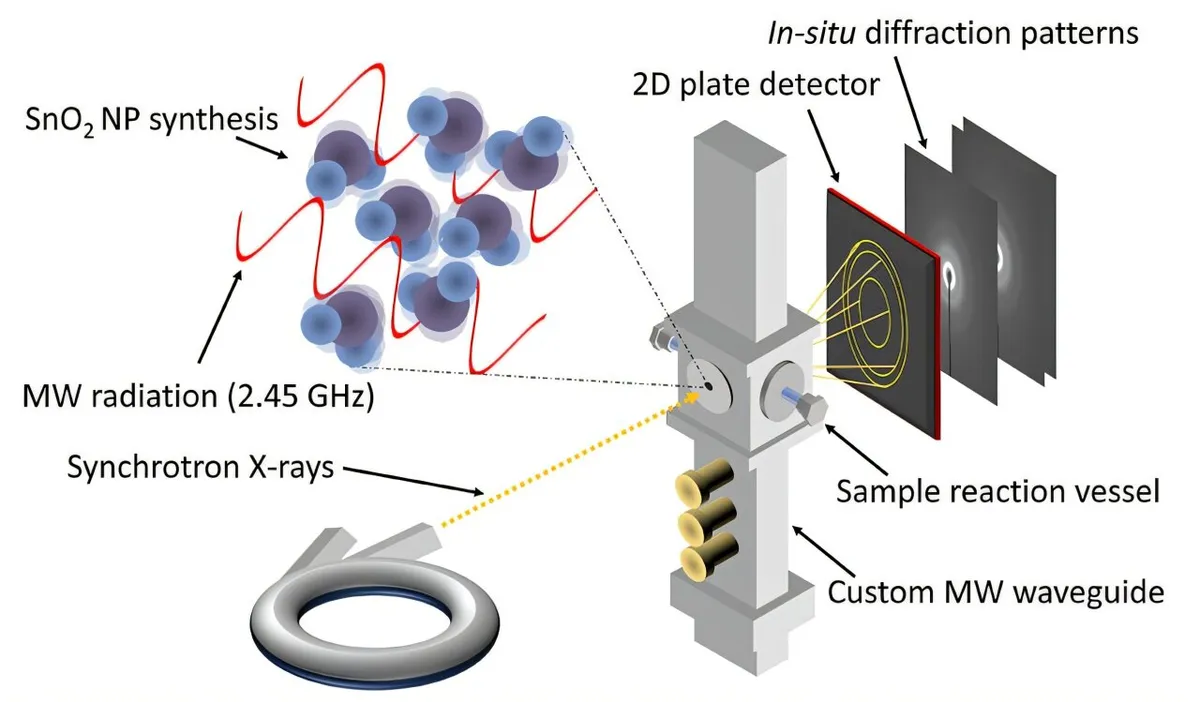
Professor Reeja Jayan and alumnus Morgan Chen dove into the microscopic world of tin oxide nanoparticles — tiny powerhouses used in everything from batteries to catalysts. They wanted to see, in excruciating real-time detail, how these particles form under both conventional heat and, crucially, microwave zaps.
We're a new kind of news feed.
Regular news is designed to drain you. We're a non-profit built to restore you. Every story we publish is scored for impact, progress, and hope.
Start Your News DetoxThey didn't just peek; they used high-energy X-rays like a microscopic slow-motion camera, capturing atomic structures changing as the reactions unfolded. What they found upended the prevailing theory.
Scientists previously thought microwaves lowered the energy needed for reactions. But Jayan and Chen's data, backed by some serious mathematical modeling, said "nope." Instead, microwaves are like a molecular wingman, making it way more likely that molecules will successfully link up and form new materials. Think of it as increasing the chances of a perfect handshake rather than making the handshake easier.
This means materials crystallize faster, which is a huge deal for efficiency. The findings, published in the Journal of Materials Chemistry A, reveal what Jayan calls a "missing link" mechanism. And this isn't just for industrial giants; it applies to anyone using a microwave, from your leftover pizza to advanced material fabrication.
A New Lens for Looking at Materials
Beyond solving a long-standing mystery, this study also unveiled a powerful new way to actually watch materials form. Instead of just examining the finished product, the team's in-situ synchrotron X-ray scattering and atomic-scale analysis let them see the chemical ballet as it happened.
Which, if you think about it, is both impressive and slightly terrifying. It's like being able to watch a cake bake, ingredient by ingredient, at a molecular level. This new method isn't just for tin oxide, either; it's a blueprint for understanding how all sorts of materials come to be, paving the way for faster, greener manufacturing processes.
So, the next time you nuke your dinner, just remember: that same technology is secretly revolutionizing how we build the future, one perfectly aligned molecule at a time.