You know how some things just are? Like, magnets are magnetic, and they stop being magnetic if you heat them up past a certain point. Simple, right? Well, scientists at the University of Washington just decided to flip that script, accidentally creating a new material that basically says, "Hold my beer," to conventional magnetism.
They were cooking up some new "spinel" materials — think of spinels as tiny atomic LEGO structures crucial for things like fiber optics and quantum computing. These structures typically have three different atom types. The UW team swapped out one of those atoms for silver, a rare move for the crucial "A" slot in the spinel's atomic arrangement.
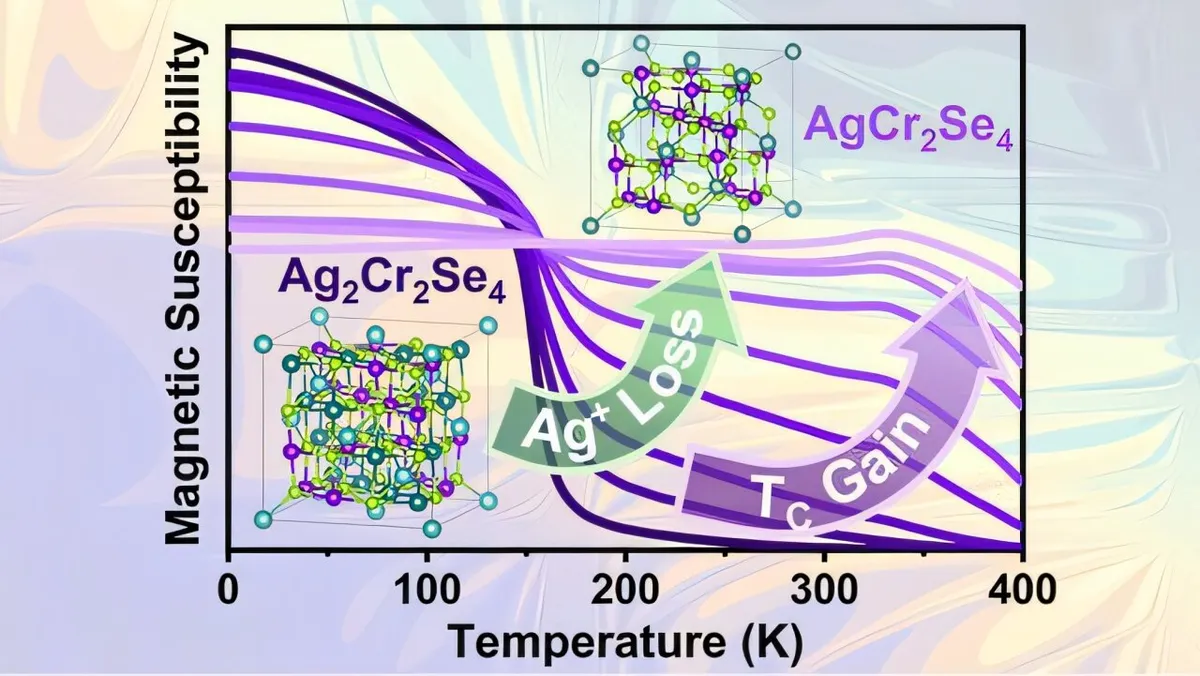
Now, here's where it gets weird. When their first silver-infused spinel was just chilling, minding its own business, and exposed to air, something wild happened. It started losing some of its silver ions, transforming into an entirely different spinel right before their very eyes.
We're a new kind of news feed.
Regular news is designed to drain you. We're a non-profit built to restore you. Every story we publish is scored for impact, progress, and hope.
Start Your News DetoxThe original material was magnetic, but only down to a frosty -185 degrees Fahrenheit. Not exactly practical for your average fridge magnet. But its air-transformed sibling? That one decided to stay magnetic up to a scorching 260 degrees Fahrenheit. Let that satisfying number sink in.
That's the largest jump in "Curie temperature" — the point at which a material loses its magnetism — ever recorded. Basically, they made a material more magnetic just by letting it breathe. Which, if you think about it, is both impressive and slightly terrifying. Imagine your car keys spontaneously becoming a compass because you left them outside.
This isn't just a parlor trick. Understanding how a material can fundamentally alter its magnetic properties simply by interacting with the atmosphere could unlock all sorts of doors for new technologies. The researchers are now digging deeper, trying to figure out the exact mechanics behind this unexpected, air-activated superpower.