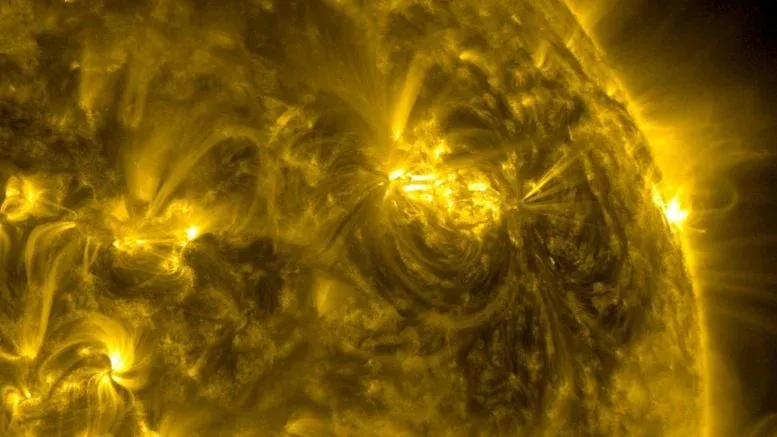
Before sunspots appear on the Sun's surface, magnetic activity is already brewing underneath. These early changes are tiny, but new research shows that artificial intelligence (AI) can spot them hours before they become visible.
A new AI model called EarlyDetect can find signs of emerging active regions about nine hours before they show up. This system was created by a research team led by the New Jersey Institute of Technology (NJIT). Their findings were published on August 14 in the Journal of Geophysical Research: Machine Learning and Computation.
How EarlyDetect Works
EarlyDetect looks for early patterns in the Sun's sound waves and magnetic field. Scientists have found these signals hard to identify reliably until now.
We're a new kind of news feed.
Regular news is designed to drain you. We're a non-profit built to restore you. Every story we publish is scored for impact, progress, and hope.
Start Your News DetoxJonas Tirona, an NJIT undergraduate researcher, developed the model. He worked with computer scientists and solar physicists from NJIT, Princeton University, and NASA's Ames Research Center. They used observations from NASA's Solar Dynamics Observatory (SDO).
Tirona explained that this work shows machine learning can predict when solar active regions will emerge. This early warning could help satellite communication companies or power grid operators prepare for and reduce damage from solar storms.
Faint Vibrations Reveal Hidden Activity
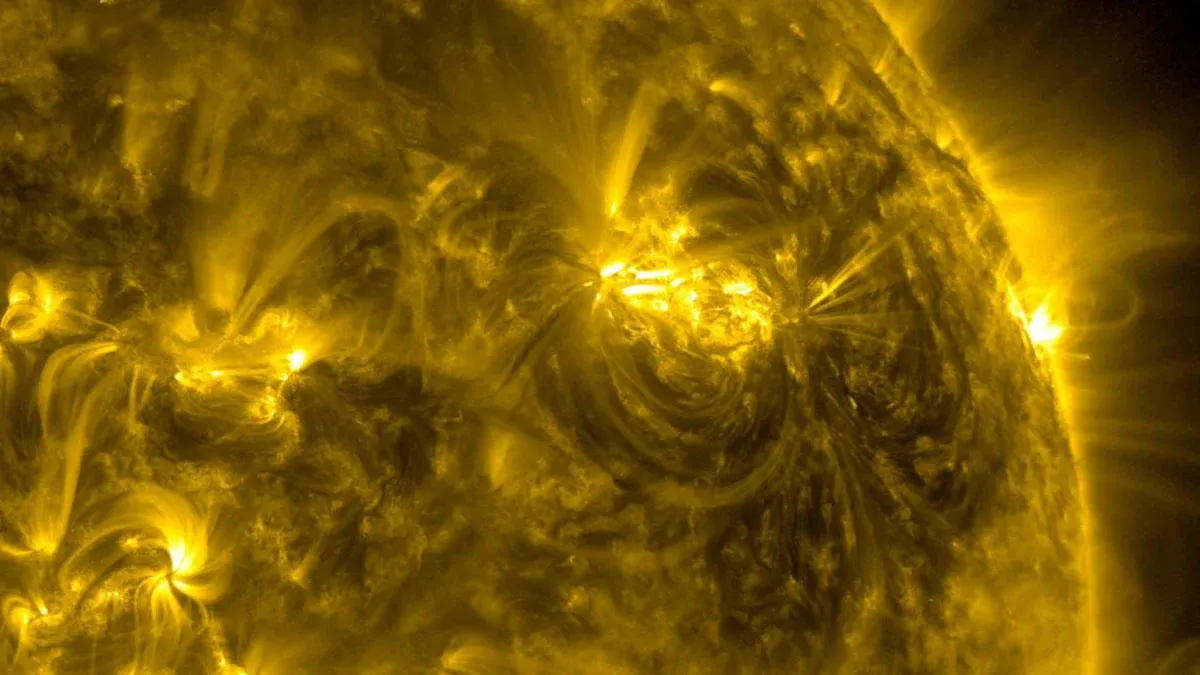
Active regions are areas with strong magnetic activity where sunspots form. They take several hours to emerge and can take days to fully develop.
Before these regions reach the surface, rising magnetic fields slightly change the sound waves moving through the Sun. Scientists use helioseismology to study these vibrations. This helps them learn about processes inside the Sun that can't be seen directly.
EarlyDetect analyzes hourly maps of acoustic power and measurements of the solar magnetic field from NASA's Solar Dynamics Observatory. The acoustic maps come from sound wave measurements taken every 45 seconds by the Helioseismic and Magnetic Imager (HMI) on SDO.
Alexander Kosovichev, an NJIT distinguished professor of physics, noted that the main challenge is that active regions start developing below the Sun's visible surface. This means direct observation of the magnetic structure isn't possible. Instead, researchers look for tiny changes in the magnetic field and the pattern of acoustic waves. He compared it to finding a slight rhythm change in a very noisy orchestra.
Unexpected Discovery Improves Forecasts
EarlyDetect uses a Transformer architecture, similar to the AI technology in large language models like ChatGPT. However, this model looks for patterns in solar measurements that come before changes in the Sun's activity.
When Tirona joined the project, the team used a filtering method to make solar patterns easier for the model to recognize. But tests showed the opposite: filtering actually made the forecasts worse.
Kosovichev found this surprising. He expected filtering to help isolate useful short-term patterns. Instead, it removed the very faint fluctuations that gave the earliest warnings. Tirona explained that it was like noise canceling, which usually removes loud noises to show the overall trend. But for this project, the signals removed by the filter were crucial for predicting when an active region would emerge.
EarlyDetect's Performance and Future
After training EarlyDetect with SDO/HMI measurements, researchers tested it with active regions not included in its training data. The best version of the model detected precursor patterns an average of 9.24 hours before the active regions became visible. This was better than both a standard Transformer model and an older method.
Mengjia Xu, an NJIT assistant professor of data science, said that machine learning hasn't been widely used for solar activity forecasting yet. This work shows that advanced machine learning models can open new possibilities for predicting space weather.
The research was one of the first projects supported by NJIT's Grace Hopper AI Research Institute, which started in 2025 to support interdisciplinary AI research. NASA also provided support through heliophysics and space weather research grants.
The researchers also made their data public. They released the Solar Active Region Emergence Dataset (SolARED) and the Solar Active Region (SAR) Portal. These resources allow other researchers to develop and test new prediction methods.
Tirona cautioned that EarlyDetect is not yet ready for real-time forecasting. It was trained using known events and can still give false alarms or late predictions. Also, detecting an emerging active region doesn't guarantee a solar flare or coronal mass ejection. Many active regions don't cause major eruptions, and the model needs to be tested with many more solar events.
Tirona hopes this project will raise awareness about how machine learning can help heliophysics. He believes a model like this could someday help predict solar weather events, calling it an exciting step forward.
Deep Dive & References
Forecasting Continuum Intensity for Solar Active Region Emergence Prediction Using Transformers - Journal of Geophysical Research: Machine Learning and Computation, 2026