Greenland has a long history of human settlement. Various cultures, including Paleo-Inuit, Vikings, and early modern Danes, have lived there since about 2,500 BCE. These groups left behind ancient rubbish heaps, called middens. These middens contain waste like animal bones, human waste, shells, and artifacts. They are valuable for archaeologists.
Scientists are now studying these middens to learn about past diseases and the animals people kept. They also want to know if thawing middens, due to the Arctic warming quickly, could release old infectious diseases.
Dr. Frank Møller Aarestrup, a professor at the National Food Institute of Denmark Technical University, said the risk of ancient pathogens being released from Greenland's middens is currently low. He noted that these cold Arctic middens act like natural experiments. They preserve bacterial signals from humans and animals, including bacteria that can cause illness and those with antibiotic resistance genes. These signals show the history of human activity, like livestock farming by the ancient Norse.
We're a new kind of news feed.
Regular news is designed to drain you. We're a non-profit built to restore you. Every story we publish is scored for impact, progress, and hope.
Start Your News DetoxStudying Historical Waste
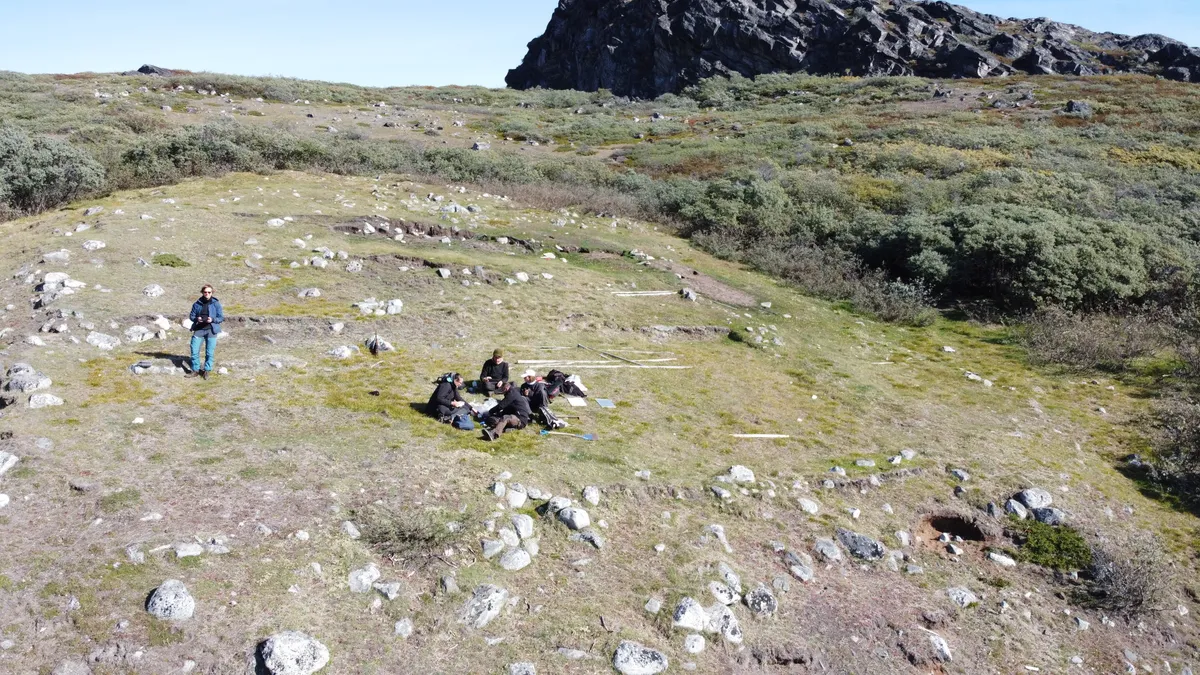
In 2020 and 2021, Aarestrup and his team collected samples from several middens in West and South Greenland. These middens were frozen in permafrost and cover 4,500 years of human life. The Greenland National Museum and Archives identified these sites. At old Norse sites, like Kapisilit and Narsarsuaq, they also took soil samples from areas where livestock were kept in winter and grazed in summer.
The researchers used DNA sequencing to understand the full bacterial communities. They compared these findings with 143 soil samples from permafrost areas far from any historical settlements.
The sequencing showed between nine and 202 bacterial species in each midden, totaling 1,207 species. Many of these species were new to science and could only be broadly categorized. This shows how little is known about Arctic soils and archaeological sites.
Middens had more diverse bacterial communities than the surrounding untouched soils. This confirms that they hold the biological history of human activity. Middens from the Paleo-Inuit had the most soil-like bacterial communities, suggesting that the microbial traces from humans and animals fade over time.
Most middens contained many bacteria known to live on or inside animals and humans. These included harmless bacteria from human feces, as well as bacteria that can cause serious diseases like botulism, toxic shock syndrome, sepsis, and gas gangrene.
The types of bacteria varied depending on the waste in each midden. For example, middens from early colonial-era Nuuk, which contained decomposing seal skins, had a lot of Clostridium perfringens, a common cause of food poisoning.
Romboutsia species and Paraclostridium sordellii, found in the guts of many animals, were common in middens with animal carcasses. Early Norse middens with decomposing bones had many unknown species of Proteobacteria and Clostridiaceae.
No Immediate Concern
The researchers also found many genes linked to antimicrobial resistance in the bacteria from middens. The presence of these same genes in old and new soil layers indicates that resistant microbes can survive in permafrost for centuries.
However, the scientists found that these pathogens do not spread far from thawing middens. This suggests they pose little risk to public health for now.
Co-author Dr. Saria Otani, an associate professor at the National Food Institute, noted that the microbiome in thawing permafrost quickly gets replaced by local environmental microbes once it runs off.
Dr. Anders Priemé, a professor at the University of Copenhagen, added that it's unclear if the risk of pathogen release will grow with rising temperatures, or if it might be higher in other Arctic regions. He suggested that studying the microbiome should be a regular part of archaeological monitoring.
Deep Dive & References
Microbial composition of archaeological middens: Tracing Human Footprints Through Centuries in Greenland's Ancient Settlements - Frontiers in Microbiology, 2026