Cross-coupling reactions are key for making complex medicines and plastics. These reactions often start with a step called oxidative addition. This step usually needs transition metals like palladium or nickel.
However, using more common main-group elements for this reaction has been tough, especially for important substances called aryl halides. Main-group elements are found in groups 1–2 and 13–18 of the periodic table.
A New Way to Break Bonds
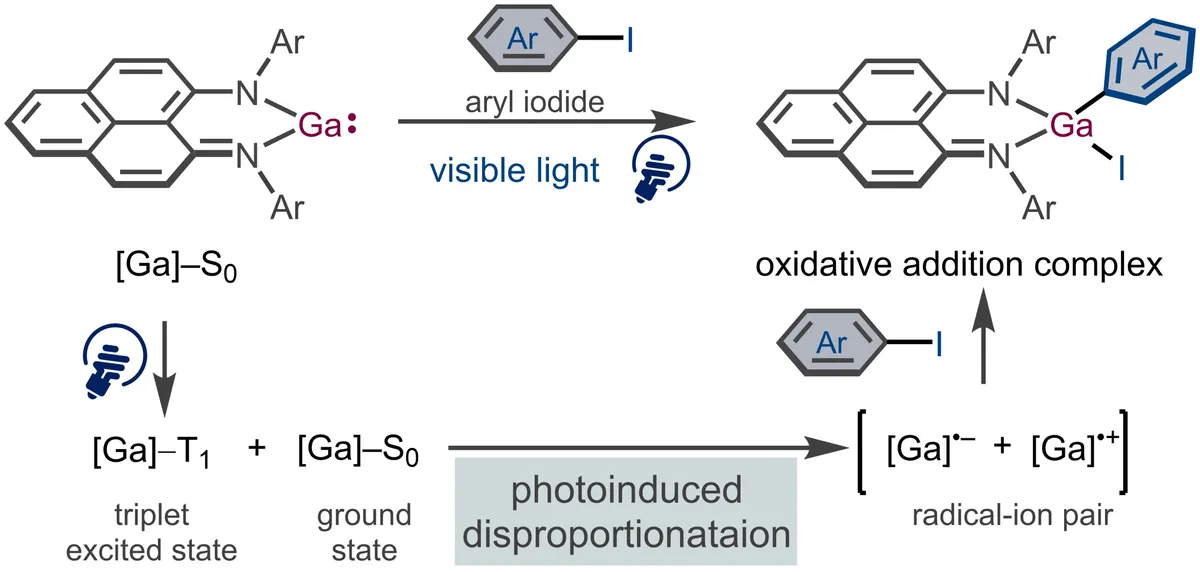
Researchers at the University of Osaka found a way to use visible light to make gallium, a group 13 element, perform oxidative addition on aryl halides. Their findings were published in the Journal of the American Chemical Society.
We're a new kind of news feed.
Regular news is designed to drain you. We're a non-profit built to restore you. Every story we publish is scored for impact, progress, and hope.
Start Your News DetoxOxidative addition is when a metal inserts itself into a chemical bond, creating two new bonds. Transition metals have been the usual choice for this because they are good at it. But these metals are rare and costly.
Main-group elements are plentiful, but using them instead of transition metals isn't always easy. While progress has been made with main-group elements, reactions with aryl halides—organic compounds with a carbon-halogen bond—have remained difficult, especially for group 13 elements.
Lead author Nijito Mukai explained that the only known case of oxidative addition with a group 13 element was with aryl fluoride. His team, however, managed to do it with an aryl iodide, which is very useful in making chemicals.
How Visible Light Helps
The team found that visible light could trigger the oxidative addition of aryl iodides at a gallium center.
This reaction works through a new process called photoinduced disproportionation. In this type of reaction, an element in the starting material changes into both higher and lower oxidation states. The resulting product can then be used in other organic reactions.
Senior author Takuya Kodama noted that their method involves photoexcited gallium exchanging electrons with ground-state gallium to create a radical ion pair. He believes photoinduced disproportionation could be a new way to achieve transition-metal-like oxidative addition using main-group elements.
This discovery could lead to new, sustainable ways to perform chemical reactions using common main-group elements. This could reduce the need for rare and expensive transition metals.
Deep Dive & References
Photoinduced Disproportionation Enables Oxidative Addition of Aryl Iodides at a Gallium(I) Center - Journal of the American Chemical Society, 2026