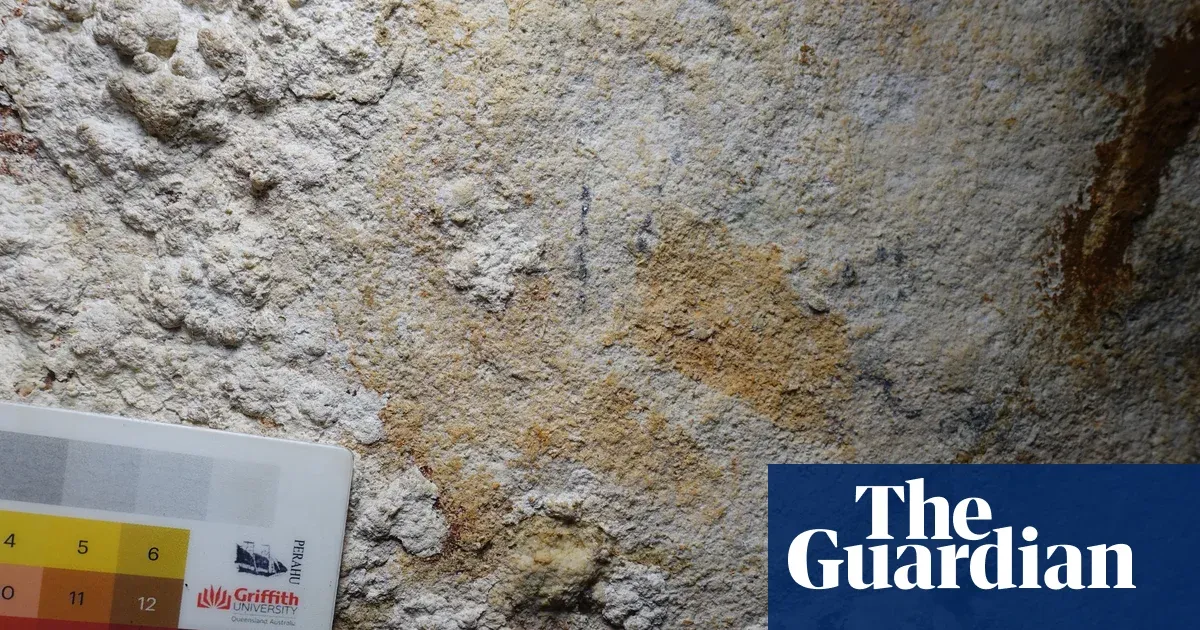
A faded handprint on a limestone cave wall in Indonesia might be the oldest known rock art in the world. Archaeologists say someone pressed their hand against stone and blew ochre paint over it at least 67,800 years ago—long before the pyramids, long before agriculture, long before writing. The hand was found at Liang Metanduno, a cave on Muna Island in southeastern Sulawesi that tourists walk through today without knowing they're passing one of humanity's oldest known creative acts.
The discovery matters because it's a moment frozen in time. Someone stood in that cave, placed their hand on the wall, and decided to leave a mark. We don't know their name, their language, or what they were thinking. But we know they were there.
A Trail of Handprints Across Time
The hand stencil had been sitting on the cave wall unnoticed, partially hidden behind more recent animal paintings. It took a team led by archaeologists Maxime Aubert and Adam Brumm from Griffith University to spot it and figure out its age. They did this by dating the tiny calcite deposits—basically mineral crusts—that had formed over the top of the paint over thousands of years. It's like finding a time capsule that sealed itself.
We're a new kind of news feed.
Regular news is designed to drain you. We're a non-profit built to restore you. Every story we publish is scored for impact, progress, and hope.
Start Your News DetoxThis isn't an isolated find. The same team has been mapping a rich history of cave art across Sulawesi's southwestern peninsula. In another cave, they found a narrative scene with three human-like figures and a wild pig, dated to at least 51,200 years ago. Humans have been painting in these caves continuously for at least 35,000 years. That's not a one-off moment—that's a tradition.
What makes the Liang Metanduno hand especially intriguing is its shape. The fingers are unusually narrow and pointed, almost like claws. Researchers believe this was intentional—someone deliberately altered how they presented their hand. Whether it was meant to look like an animal, some mythical creature, or something else entirely, we can only guess. But the modification suggests symbolic thinking, the kind of abstraction that marks complex human culture.
Following the First Journey
The hand also tells us something about where humans came from and how they spread across the world. At the time this hand was made, sea levels were much lower than today. Land bridges connected some islands, but reaching Sulawesi and beyond still required island-hopping across open water. This hand stencil is evidence that humans took a northern migration route from Southeast Asia toward Australia and New Guinea, rather than going only through the south.
Archaeologist Adam Brumm believes the rock art supports evidence that northern Australia was settled at least 65,000 years ago. That pushes back the timeline for human arrival in Australia and reshapes our understanding of when and how people first spread across the globe.
It's worth noting that hand stencils aren't unique to Indonesia. Spanish caves contain hand markings dated to at least 64,000 years ago, likely made by Neanderthals. Other human species like Denisovans also occupied vast areas of Asia. So this isn't necessarily proof that modern humans were the first to leave handprints. But the pointed-finger modification at Liang Metanduno suggests intentional symbolic expression, which points toward the kind of creative thinking we associate with Homo sapiens.
What happens next is more fieldwork. Researchers are still piecing together the full map of human migration and settlement. Each hand stencil, each animal painting, each ochre mark adds another thread to the story of where we came from and how we got here.