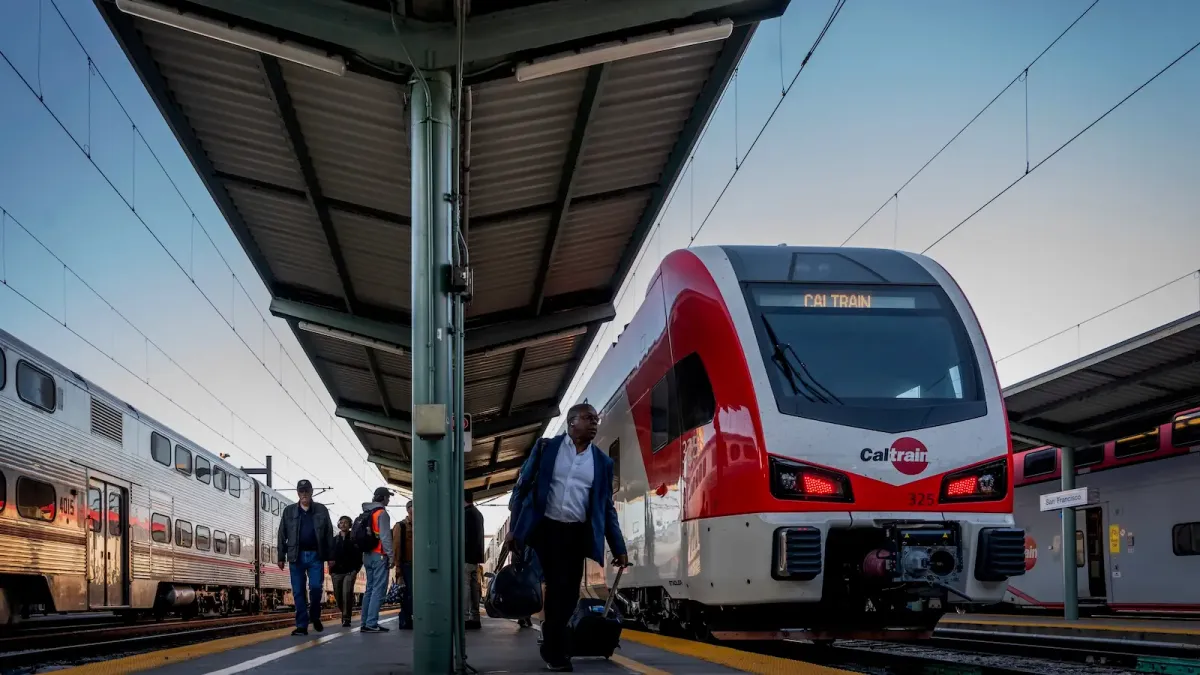
Adina Levin caught a Caltrain home from San Francisco to Menlo Park one recent evening — a 40-minute ride that would have felt unremarkable a year ago. But that journey now represents something quietly significant: a $2.4 billion bet that upgrading existing rail infrastructure, rather than building new lines, can reshape how a region moves.
In 2024, Caltrain completed the electrification of 51 miles of its busiest corridor, removing diesel trains from the segment linking San Francisco to Silicon Valley. The shift has proven immediate and tangible. Electric trains accelerate so much faster that the agency shaved as much as 23 minutes off the San Francisco-to-San Jose trip. That speed gain allowed Caltrain to add stops without lengthening overall travel times — increasing the number of stations served each weekday by roughly 20 percent.
The practical outcome: trains now run every half hour until 10 p.m. on weeknights, a massive improvement for anyone with an evening commute. "Before electrification, coming home at 10 o'clock at night, the trains were once an hour," Levin, who leads the transit advocacy group Seamless Bay Area, said. "If you missed the train, that's a very miserable experience." Weekend ridership has more than doubled since the change.
We're a new kind of news feed.
Regular news is designed to drain you. We're a non-profit built to restore you. Every story we publish is scored for impact, progress, and hope.
Start Your News DetoxThe Numbers Behind the Shift
Ridership jumped 60 percent in the first year after electrification — a striking gain in a region where most transit agencies are still struggling to recover from pandemic losses. The appeal goes beyond convenience. A UC Berkeley study found that riders on electric trains are exposed to 89 percent less carcinogenic black carbon compared to diesel service, a reduction equivalent to what California cities achieved over three decades of clean-air regulation. Caltrain estimates the shift will eliminate roughly 250,000 metric tons of carbon emissions annually.
But here's what makes this story worth attention: Caltrain's success arrives at a moment when rail investment in America is increasingly fragile. The Bay Area's 27 transit agencies remain well below pre-pandemic ridership levels. Caltrain itself is still at roughly 60 percent of its pre-COVID numbers, despite the electrification gains. The state had to approve a $590 million emergency loan to four local agencies just to preserve service levels.
The electrification wasn't cheap — the project faced $462 million in cost overruns due to pandemic delays, federal funding gaps during the first Trump administration, and legal challenges. Yet it happened. And that matters because it demonstrates something researchers have been arguing for years: you don't need to build high-speed rail from scratch to transform regional transportation. Sometimes the smarter move is to modernize what's already there.
Yonah Freemark, a transportation researcher at the Urban Institute, notes that railway electrification was once common in America before diesel took over as cities dismantled electric streetcars and gas prices fell. The Northeast Corridor offers a proof point: when Amtrak fully electrified that line, the faster Acela service captured market share from New York to Washington, D.C., jumping from 37 percent to 83 percent between 2000 and 2021.
Caltrain's project also signals a broader shift in how transportation gets funded. With shrinking federal support for transit, states and localities are increasingly stepping up to fund their own improvements. California continues pursuing its high-speed rail dream, and that system will eventually share track with the corridor Caltrain just upgraded — a potential synergy that could amplify both projects' impact.
For now, Caltrain plans to roll out battery-powered trains on the remaining southern stretch to Gilroy by 2028, with full system electrification targeted for 2035. The line has already proven its appeal extends beyond traditional commuters: ridership spiked 11 percent in the week before Super Bowl LIX at Levi's Stadium, and the stadium will host six FIFA World Cup matches this summer.
Levin sees the electrification as foundational to building transit that works for everyone, not just office workers. "It's a bread-and-butter piece of the transportation system," she said. "You can use it to go to an office job. You can use it to go visit a friend. You can use it for whatever it is that you're doing." That flexibility — the ability to plan a trip without checking a schedule — might be the most underrated benefit of all.