The universe isn't going anywhere soon—at least not for trillions of years. That's the strange comfort of modern cosmology: we have an almost incomprehensibly long future ahead, even as the distant one grows quieter and darker.
We know this because we can read the universe's past in the light reaching us now. By studying distant galaxies and the way stars age, astrophysicists can sketch the broad strokes of what's coming. Not with certainty—the universe has surprised us before—but with enough confidence to paint a picture of deep time.
Stars Will Burn Out, But Not Soon
Our sun is middle-aged. It's been shining for about 5 billion years and has roughly 5 billion more to go before it expands into a red giant and swallows the inner planets. That's a comfortable buffer—long enough for whatever comes after humanity to evolve, flourish, and fade on its own timeline.
We're a new kind of news feed.
Regular news is designed to drain you. We're a non-profit built to restore you. Every story we publish is scored for impact, progress, and hope.
Start Your News DetoxBut the sun is just one star among billions in the Milky Way, and the Milky Way is just one galaxy among billions more. The universe's stellar population is staggered. The biggest, hottest stars burn out in millions of years. The smallest, coolest red dwarfs will glow for trillions of years—far longer than the universe has existed so far. So for an almost unimaginable stretch of time, starlight will fill the cosmos.
Eventually, though, all star formation will cease. The gas clouds that birth new stars will be exhausted. The remaining red dwarfs will slowly fade, their light reddening and dimming over eons. In the end, after hundreds of times the current age of the universe has passed, even these will wink out.
Galaxies Will Merge Into Giants
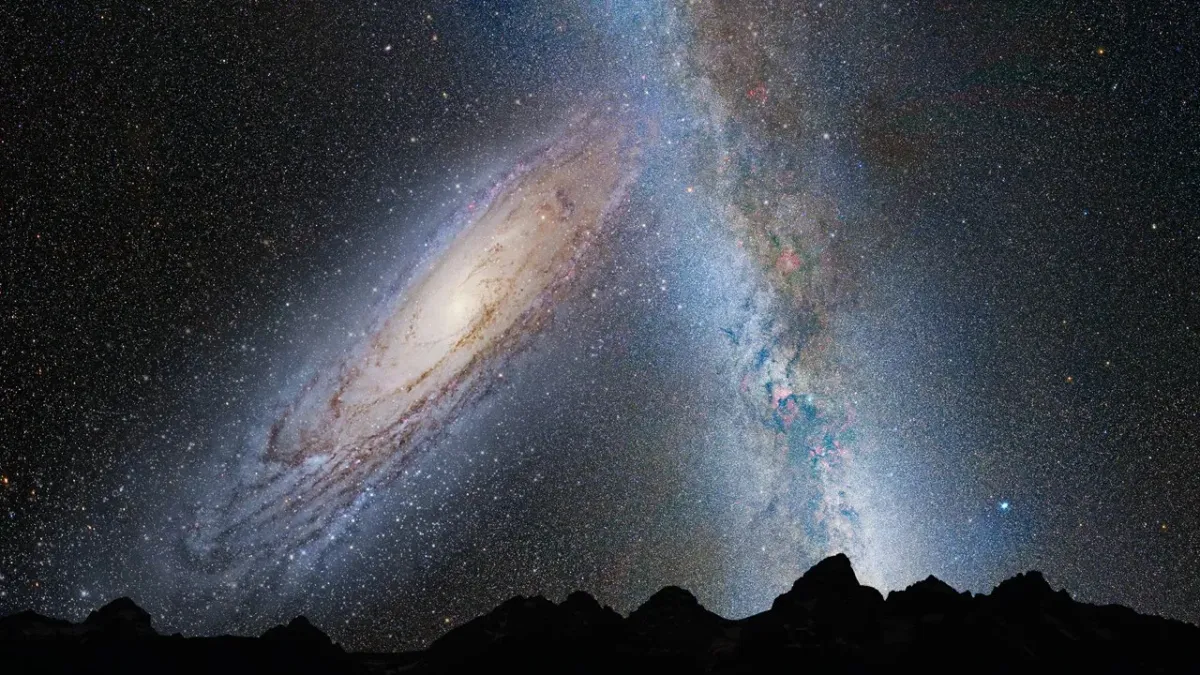
Meanwhile, galaxies are on a collision course—literally. Galaxies grow by merging with smaller neighbors, and this process will continue. The Milky Way and Andromeda, our nearest large galactic neighbor, are already drifting toward each other. In a few billion years, they'll collide in a slow-motion cosmic dance. The stars themselves won't crash into each other—space is vast enough that they'll sail past unharmed—but the two galaxies will eventually fuse into one enormous elliptical blob.
This will happen across the universe. Galaxy clusters, where hundreds of galaxies orbit a shared center, will continue to merge and consolidate. The orderly spiral galaxies we see today will be churned into shapeless giants.
Then Comes the Long Darkness
Here's where the story gets strange. The universe is expanding, and evidence suggests something called dark energy is actually speeding up that expansion. Over trillions of years, this means other galaxies will drift so far away they'll become impossible to see, even with perfect instruments. From Earth—or whatever survives here—the night sky would eventually show only one galaxy: a single red elliptical blob, all that remains of countless merged systems.
After that, the universe enters what we might call its final chapter: a dark eternity where nothing much changes, where the few remaining stars gradually fade to black, where time stretches on but brings no new events. It's a sobering vision, but also one that's remarkably distant. The universe will be vastly older than it is now, and whatever intelligence or life exists then will have had an almost infinite runway.
That said, this isn't written in stone. New observations could reveal something we've missed—a hidden force, a cyclical process, something entirely unexpected. The universe has surprised us before. What feels inevitable now might look quaint in light of tomorrow's data.