Scientists are making progress in unlocking regeneration in mammals. They believe the ability to regrow body parts might not be lost, but simply "switched off."
Researchers used a two-stage treatment to change how the body heals. Instead of forming scar tissue, the body started to regrow bone, joints, ligaments, and tendons after amputations in animal studies.
For a long time, scientists thought humans and other mammals couldn't regrow lost body parts. Animals like salamanders can regrow entire limbs, but humans usually form scar tissue when injured.
We're a new kind of news feed.
Regular news is designed to drain you. We're a non-profit built to restore you. Every story we publish is scored for impact, progress, and hope.
Start Your News DetoxHowever, new research from Texas A&M University suggests that mammals might still have some regenerative abilities. These abilities could be hidden within the body's normal healing process, waiting for the right conditions to be activated.
Dr. Ken Muneoka, a professor at Texas A&M, has spent his career trying to understand why some animals can regenerate and humans cannot.
In a study published in Nature Communications, Muneoka and his team described a new two-step treatment. This treatment allowed the regeneration of bone, joint structures, and ligaments. The regrown tissues weren't perfect copies, but the researchers think this method could help reduce scarring and improve tissue repair after injuries.
Guiding Healing Away From Scars
When mammals get hurt, the body usually responds by forming scar tissue. This process, called fibrosis, involves fibroblast cells quickly closing the wound. While this helps prevent infection, it also stops the body from rebuilding lost parts.
Animals that can regenerate heal differently. For example, in salamanders, similar cells form a structure called a blastema. This blastema then becomes the base for new tissue growth.
Muneoka explained that these cells can either create a scar or a blastema. His team focused on changing how fibroblasts at the injury site behave.
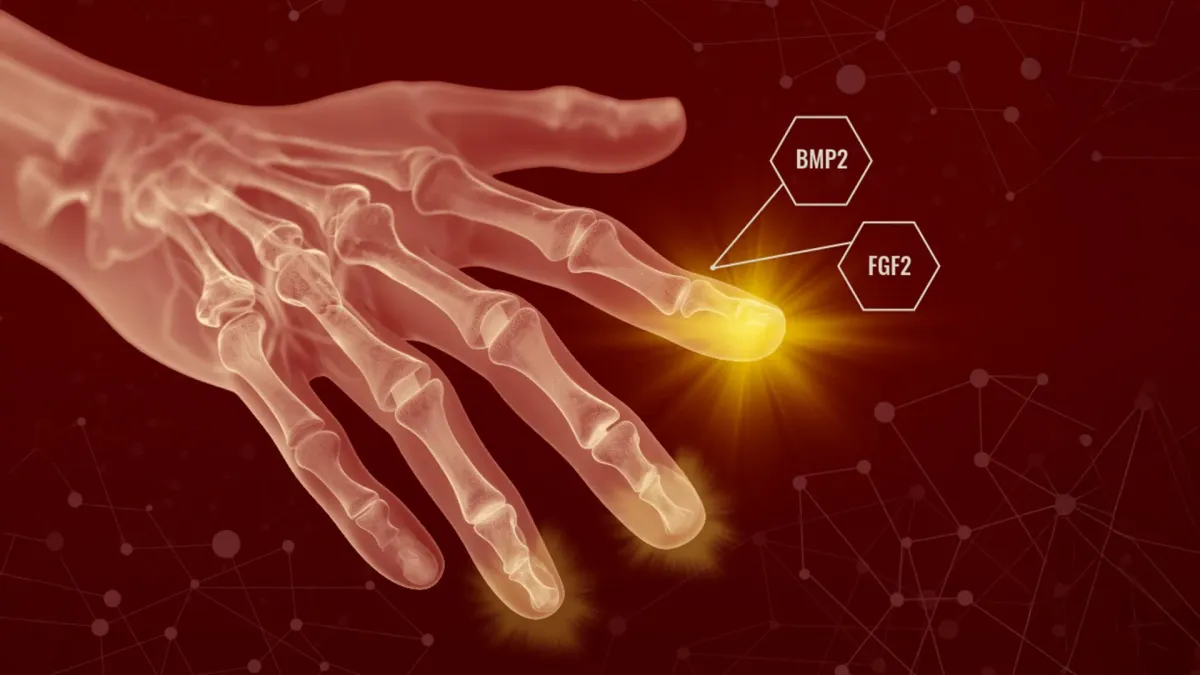
To see if mammalian healing could be directed toward regeneration, the team developed a treatment. It uses two well-known growth factors in a specific order.
First, they applied fibroblast growth factor 2 (FGF2) after the wound had already healed. By waiting, they allowed the body's normal healing process to start before they intervened.
Muneoka said the team then "changed what happens next." FGF2 helped create a blastema-like structure, which usually doesn't happen in mammals after this type of injury. A few days later, they applied a second growth factor, bone morphogenetic protein 2 (BMP2). This prompted the cells to start building new tissues.
Muneoka noted that this is a two-step process. First, you stop the cells from scarring. Then, you give them signals to tell them what to build.
New Ideas About Stem Cells
One key finding from the study is that regeneration might not need stem cells from outside the body. This is a common approach in regenerative medicine.
Muneoka said you don't have to add stem cells. They are already there; you just need to learn how to make them act the way you want.
Dr. Larry Suva, another professor involved in the study, said the results challenge old ideas about what mammalian cells can do.
Suva explained that cells thought to be unprogrammable actually are. The ability to regenerate isn't missing; it's just hidden.
The researchers also found that cells can be directed to create structures in new places. This process, called positional re-specification, is important for development. This means cells that would normally form one type of tissue can be told to rebuild a different structure after an injury.
Regrowing Body Parts
Even though the regenerated tissues weren't exact copies, the researchers successfully restored all major structures removed during amputation. This included bone, tendon, ligament, and joint tissue.
The regenerated areas had both skeletal parts and connective tissues. These were arranged in ways that looked like natural anatomy.
Muneoka said they regenerated what you would expect to see at that injury level. The structures are there, just not in a perfect form.
The findings also suggest that regeneration involves many biological pathways working together. Rebuilding tissue seems much more complex than just activating one mechanism.
Benefits for Healing
This research is still new, but the scientists believe it could have practical uses soon. It might help improve healing by reducing scars and repairing tissues better, even before full regeneration is possible.
Muneoka suggested that people should consider using these signals during healing. Even a small shift away from scarring could be very helpful.
Getting this treatment to clinical trials might also be easier than with many new therapies. BMP2 is already approved by the FDA for some medical uses. FGF2 is also being tested in several clinical trials.
A New Look at Mammalian Regeneration
This study adds to the idea that mammals might not have completely lost the ability to regenerate. Instead, it could be a dormant ability that usually stays inactive during healing.
Suva said this changes how we think about what's possible. Showing that regeneration can be activated opens the door to entirely new questions.
For Muneoka, these questions have driven decades of research. Now, there's a promising new way to explore them.
He concluded that regenerative failure in mammals can be fixed. Now, they have a model to start figuring out how.
Deep Dive & References
- Digit regeneration in mice is stimulated by sequential treatment with FGF2 and BMP2 - Nature Communications, 2026