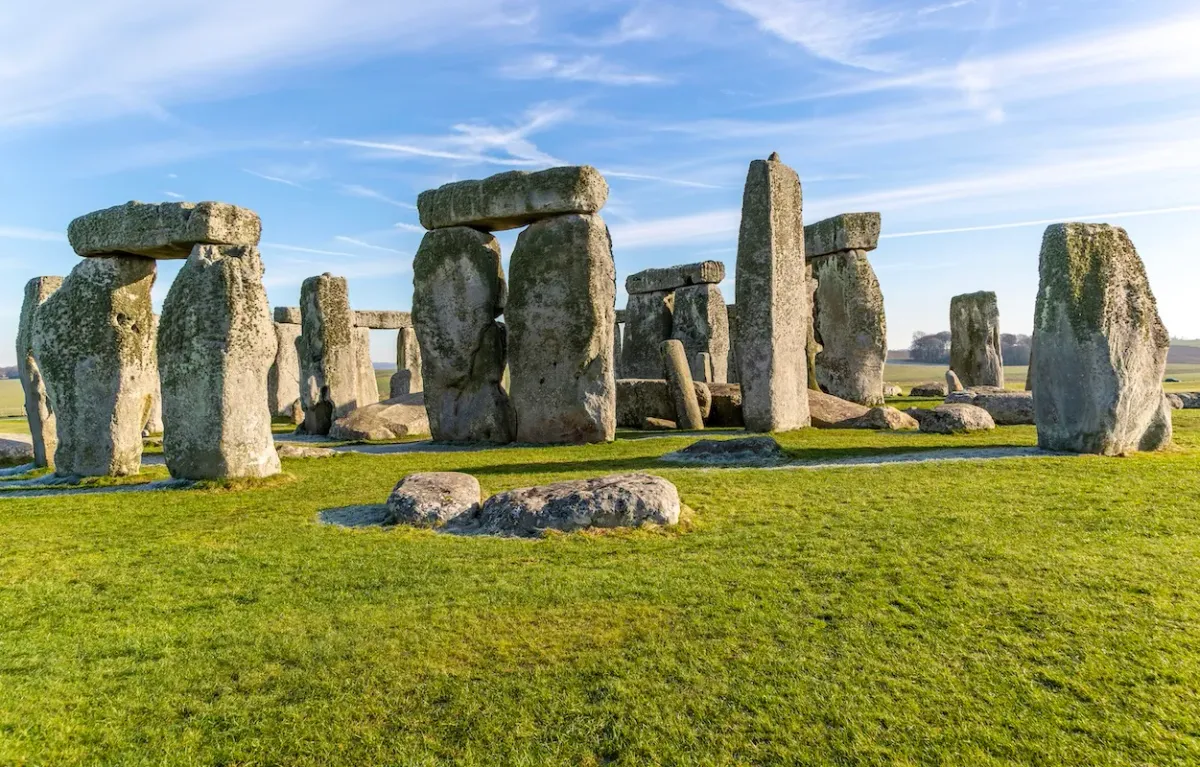
For decades, archaeologists debated how ancient people hauled massive stones across Britain to build Stonehenge — or whether they'd even needed to. Maybe glaciers did the heavy lifting during the Ice Age, the theory went. Now researchers at Curtin University in Australia have settled the argument: humans moved them.
The evidence comes from sediment samples collected from streams around Stonehenge on Salisbury Plain in southern England. Scientists found no trace of glacial activity in the area during the Pleistocene, making it nearly impossible that ice sheets transported the megaliths there. The findings, published in January in Communications Earth and Environment, close a chapter on one of archaeology's longest-running mysteries.
The Monument and Its Stones
Stonehenge was built in stages between roughly 3000 BC and 1500 BC by Neolithic and Bronze Age peoples. The outer circle and inner horseshoe consist of massive sarsen sandstones — each averaging 25 tons — sourced from the Marlborough Downs 20 miles away. The smaller bluestones, weighing between 2 and 5 tons on average (with the largest at 40 tons), came from the Preseli Hills in southwest Wales, 180 miles to the northwest. The Altar Stone, a six-ton slab, originated in Scotland.
We're a new kind of news feed.
Regular news is designed to drain you. We're a non-profit built to restore you. Every story we publish is scored for impact, progress, and hope.
Start Your News DetoxTransporting these rocks over such distances without modern machinery seems almost impossible. For centuries, people wondered if nature had done the work. But the Curtin team's geological analysis suggests otherwise. "What we do know is ice almost certainly didn't move them," said Dr. Anthony Clarke, the study's lead author.
That leaves the human explanation: rolling logs, sea routes, or some combination of methods we may never fully reconstruct. The fact that Neolithic and Bronze Age communities possessed the organization, knowledge, and determination to move stones across 180 miles of landscape — whether overland or by water — speaks to something often overlooked in debates about ancient capability. These weren't accidents of geology. They were choices, made by people who understood what they wanted to build and how to get there.
The question of how now gives way to the deeper one: why. What drove these communities to move such massive stones such vast distances, generation after generation, to create a monument that has endured five thousand years. That mystery remains.