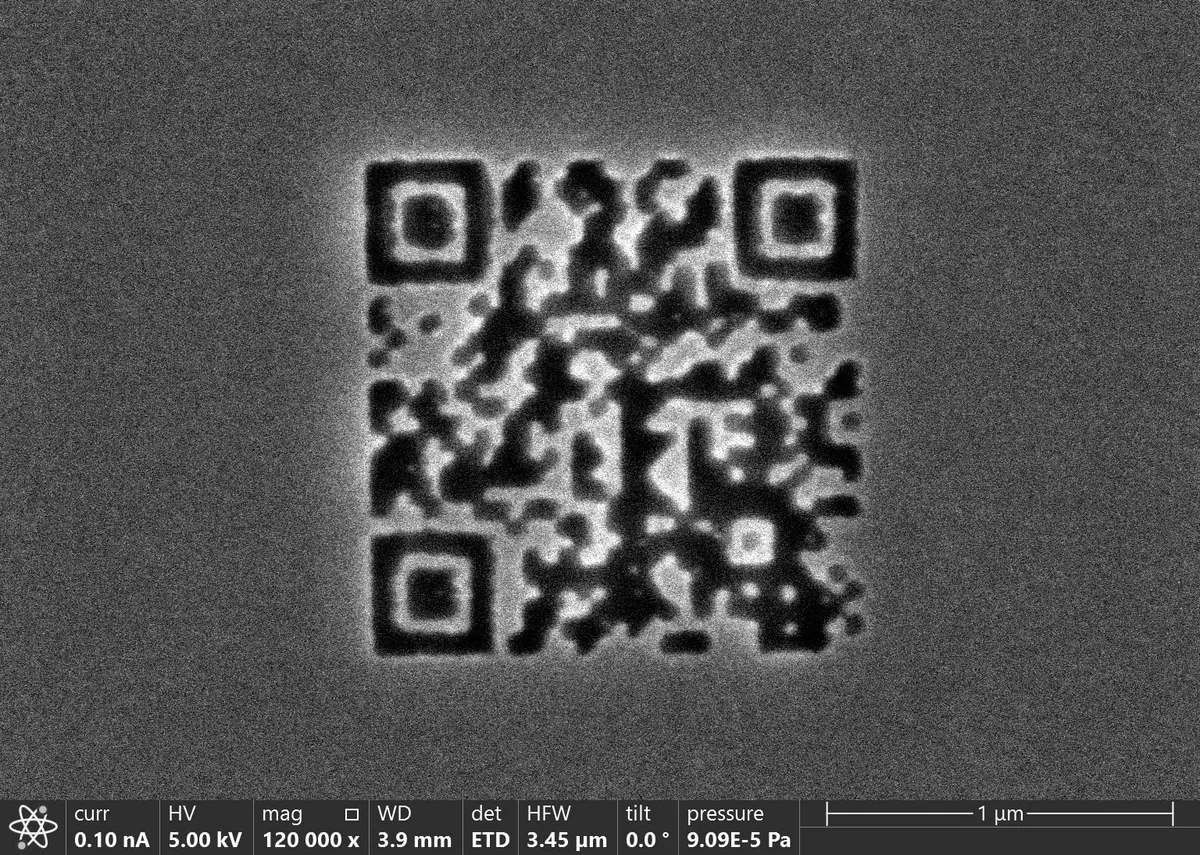
Researchers at TU Wien have created a QR code so small it can only be seen through an electron microscope. At just 1.98 square micrometers—smaller than most bacteria—it's now officially the world's smallest, measuring 37 percent of the previous record holder's size.
But the size itself isn't the real breakthrough. The real problem they solved is this: at microscopic scales, atoms shift position and blur into neighboring spaces, gradually erasing whatever you've stored. Previous attempts at ultra-dense encoding failed because the data simply degraded. TU Wien's team cracked it by encoding information directly into ceramic materials—creating a code that stays stable, stays readable, and could survive for centuries or millennia without power or maintenance.
Why This Matters More Than It Sounds
We live in an age of infinite digital information, yet we store it on devices that degrade within years. A hard drive fails. A data center loses power. Without constant electricity, cooling, and regular transfers to newer systems, vast amounts of knowledge simply vanishes. Ancient civilizations faced the opposite problem: they carved records into stone and those messages endured for thousands of years.
We're a new kind of news feed.
Regular news is designed to drain you. We're a non-profit built to restore you. Every story we publish is scored for impact, progress, and hope.
Start Your News Detox"With ceramic storage media, we are pursuing a similar approach to that of ancient cultures," says Alexander Kirnbauer, one of the researchers. "We write information into stable, inert materials that can withstand the passage of time."
The practical implications are substantial. Each pixel in the ceramic QR code measures 49 nanometers—about ten times smaller than visible light. This density means more than two terabytes of information could theoretically fit onto a single sheet of A4 paper. More importantly, ceramic storage requires no electricity, no cooling systems, no ongoing maintenance. Modern data centers consume staggering amounts of power and generate significant CO₂ emissions. Energy-free archival changes that equation entirely.
How They Actually Did It
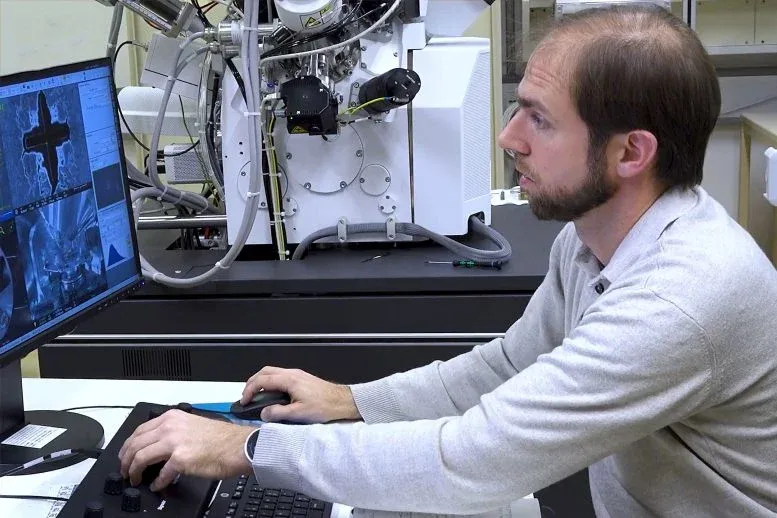
Material selection was everything. The team works with thin ceramic films—the same materials used to coat high-performance cutting tools because they remain stable under extreme conditions. Using focused ion beams, they carved the QR code into these ceramic layers with such precision that optical microscopes can't detect it (imagine trying to read Braille through an elephant's foot sole). Under an electron microscope, however, the pattern reads clearly and reliably, every time.
The breakthrough wasn't just making it small. It was making it small and stable. At atomic scales, structures tend to shift and blur. The TU Wien team engineered a code that doesn't. That distinction—stable, repeatedly readable, permanently encoded—sets their work apart from previous attempts at ultra-dense data encoding.
The record-setting demonstration was conducted jointly with data storage company Cerabyte in front of witnesses and independently verified by the University of Vienna, using electron microscopes at USTEM, the university's microscopy center.
What's Next
Kirnbauer and his team are already planning the next steps: testing other materials, increasing writing speeds, and developing manufacturing processes that could move this from laboratory curiosity to industrial application. They're also investigating how to encode far more complex data structures—not just simple QR codes—into ceramic films with the same reliability.
The implication is clear: in a future where data centers consume less power and archives can survive without electricity, ceramic storage could become the standard for anything we actually want to preserve.