Japanese researchers have figured out something counterintuitive: the cars moving through your city's streets are already doing computational work. They're just doing it invisibly.
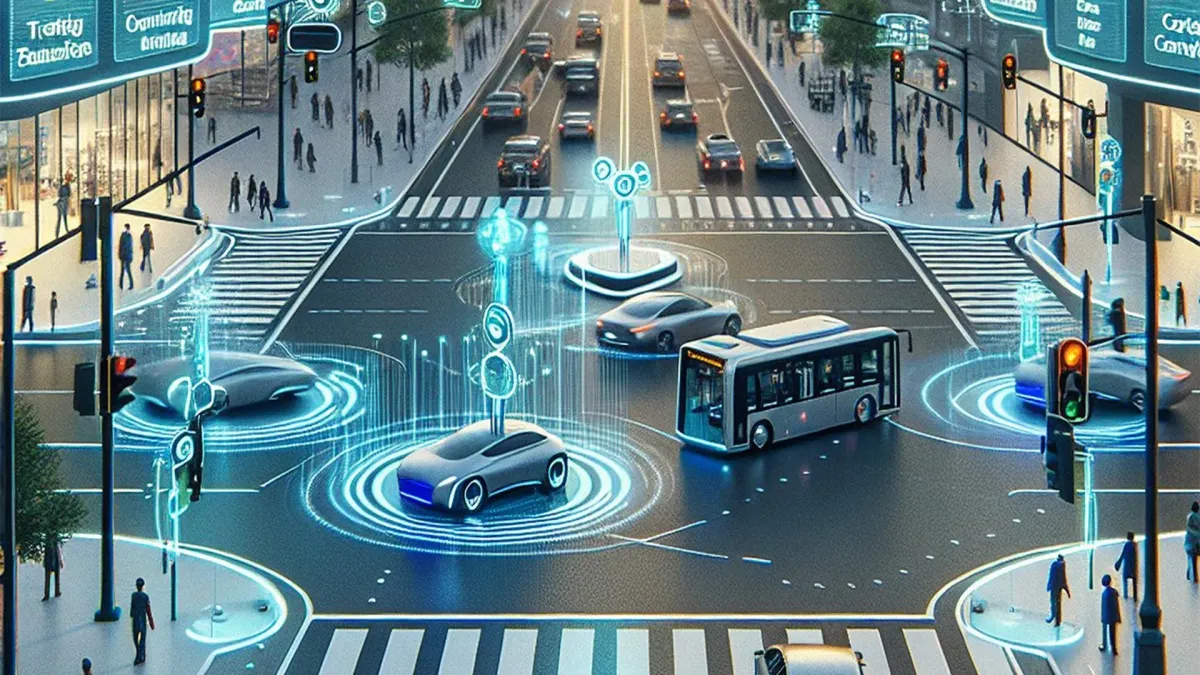
Scientists at Tohoku University's WPI Advanced Institute for Materials Research developed a method called Harvested Reservoir Computing that treats traffic flow itself as a working AI system. Instead of building dedicated hardware to process data, they realized that the natural dynamics of vehicles interacting on a road network — speeding up, slowing down, changing lanes — contains the patterns needed to forecast future traffic conditions.
The breakthrough came from recognizing that this works best not during smooth, free-flowing traffic or gridlock, but at a sweet spot of medium density. When roads are moderately crowded, the interactions between vehicles become most informative. At that critical point, the system can predict what's coming next with high accuracy, using almost no additional energy.
We're a new kind of news feed.
Regular news is designed to drain you. We're a non-profit built to restore you. Every story we publish is scored for impact, progress, and hope.
Start Your News DetoxTo test the concept, the team ran controlled experiments with 1/27-scale autonomous cars in a lab and ran numerical simulations of grid-shaped urban road networks. The results were clear: the existing sensors already embedded in most city traffic systems — the ones counting vehicles, measuring speeds, detecting congestion — contain enough information to do real computational work. No new hardware needed.
"Computation does not have to be confined to silicon chips," said Hiroyasu Ando, the lead researcher. "By recognizing and harnessing the rich dynamics already present in our environment, we may build AI systems that are both powerful and sustainable."
The implications stretch beyond traffic management. If a city's roads can become a low-energy computer, what about other social infrastructure. Ando and his team suggest that the principle could reshape how we think about scaling AI itself. Rather than endlessly building bigger data centers, cities could integrate computation directly into the physical systems they already operate — turning sidewalks, power grids, and transit networks into distributed processing networks.
For cities struggling with energy demand and infrastructure costs, this reframing matters. It means smarter urban planning might not require more centralized computing power, but smarter use of the dynamics already happening around us. The research, published in Scientific Reports, opens a question that feels quietly radical: what else is your city already computing without knowing it.