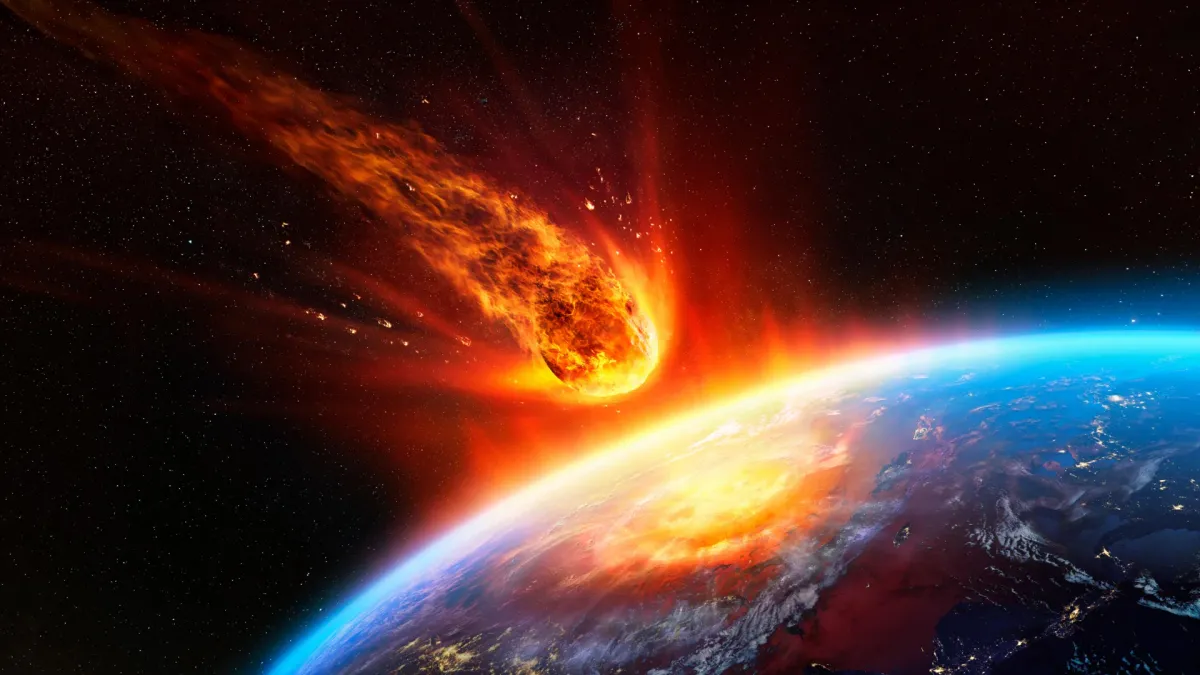
About 66 million years ago, a huge asteroid hit Earth. This event caused global fires, major climate changes, and wiped out the dinosaurs and many other species. However, new research suggests that life bounced back much faster than scientists previously thought.
Life Returns Quickly After Asteroid Impact
A new study, published in Geology, found that new species of plankton appeared less than 2,000 years after the asteroid impact. Researchers at The University of Texas at Austin led this study.
Chris Lowery, the lead author and a research associate professor at the University of Texas Institute for Geophysics (UTIG), explained that this speed of evolution is incredibly fast. Normally, new species take millions of years to form.
We're a new kind of news feed.
Regular news is designed to drain you. We're a non-profit built to restore you. Every story we publish is scored for impact, progress, and hope.
Start Your News DetoxLowery noted that this research helps us understand how quickly new species can evolve after extreme events. It also shows how fast the environment started to recover after the Chicxulub impact.
Rethinking the Recovery Timeline
Earlier work by Lowery and his team, who studied the Chicxulub crater in the Gulf of Mexico, showed that some organisms survived and returned to the area fairly quickly. Still, scientists generally believed that the first new species didn't appear until tens of thousands of years later.
This older estimate assumed that sediment built up at the same rate after the extinction as it did before. Researchers mark the start and end of the mass extinction using a global layer of debris from the impact, called the K/Pg boundary.
Lowery and his co-authors pointed out that this assumption missed big environmental changes. When ecosystems on land and in the oceans collapsed, it changed how sediments accumulated in this boundary layer.
How Extinction Changed Sediment Buildup
Many types of calcareous plankton, which usually sink to the ocean floor, disappeared during the extinction. At the same time, the loss of most plant life on land led to more erosion, sending extra material into the oceans.
These changes greatly affected how quickly sediments piled up in different areas. Because of this, just using sedimentation rates made it hard to figure out the true ages of tiny fossils in these layers.
Helium-3 Reveals a More Accurate Timeline
To get a more precise timeline, researchers used existing data on an isotope marker found within the K/Pg boundary. This marker offers a more reliable way to measure time in the geological record. It helped scientists pinpoint when different plankton species first showed up in the fossil record.
This isotope, Helium-3, builds up in ocean sediments at a steady rate. If sediment builds up slowly, there are higher amounts of Helium-3. If it builds up faster, the concentration is lower. By measuring this isotope, scientists can better estimate how much time passed as the sediments formed.
The team used Helium-3 data from six K/Pg boundary sites in Europe, North Africa, and the Gulf of Mexico. They calculated improved sedimentation rates. These measurements helped determine the age of sediments where a new plankton species, Parvularugoglobigerina eugubina (P. eugubina), first appeared. Scientists often use P. eugubina's appearance as a sign that ecosystems were starting to recover.
New Species in Thousands of Years
The researchers found that this plankton species evolved between 3,500 and 11,000 years after the Chicxulub impact. The exact timing varied by location.
They also found other plankton species that evolved during the same period. Some of these appeared less than 2,000 years after the asteroid hit. This marked the beginning of a long recovery that would slowly bring back biodiversity over the next 10 million years.
Timothy Bralower, a co-author and professor at Penn State University, said the speed of recovery shows how resilient life is. He called it "truly astounding" that complex life re-established itself so quickly. He also noted it might be reassuring for modern species facing habitat destruction.
Rapid Evolution After Mass Extinction
The study suggests that 10 to 20 new species of foraminifera appeared within about 6,000 years of the impact. However, paleontologists still discuss which fossils represent distinct species.
Overall, the updated timeline shows that evolution can happen very quickly under the right conditions. Even after a huge mass extinction, ecosystems can start rebuilding within just a few thousand years, with new species appearing much sooner than once thought.