Mars was once a warm, wet planet with a thick atmosphere. Today, it is cold, dry, and has only a thin layer of gas. Scientists believe the solar wind, a constant stream of charged particles from the Sun, caused this dramatic change. Over billions of years, the solar wind stripped away much of Mars' atmosphere, leading to lower temperatures and the disappearance of surface water.
NASA's ESCAPADE Mission to Mars
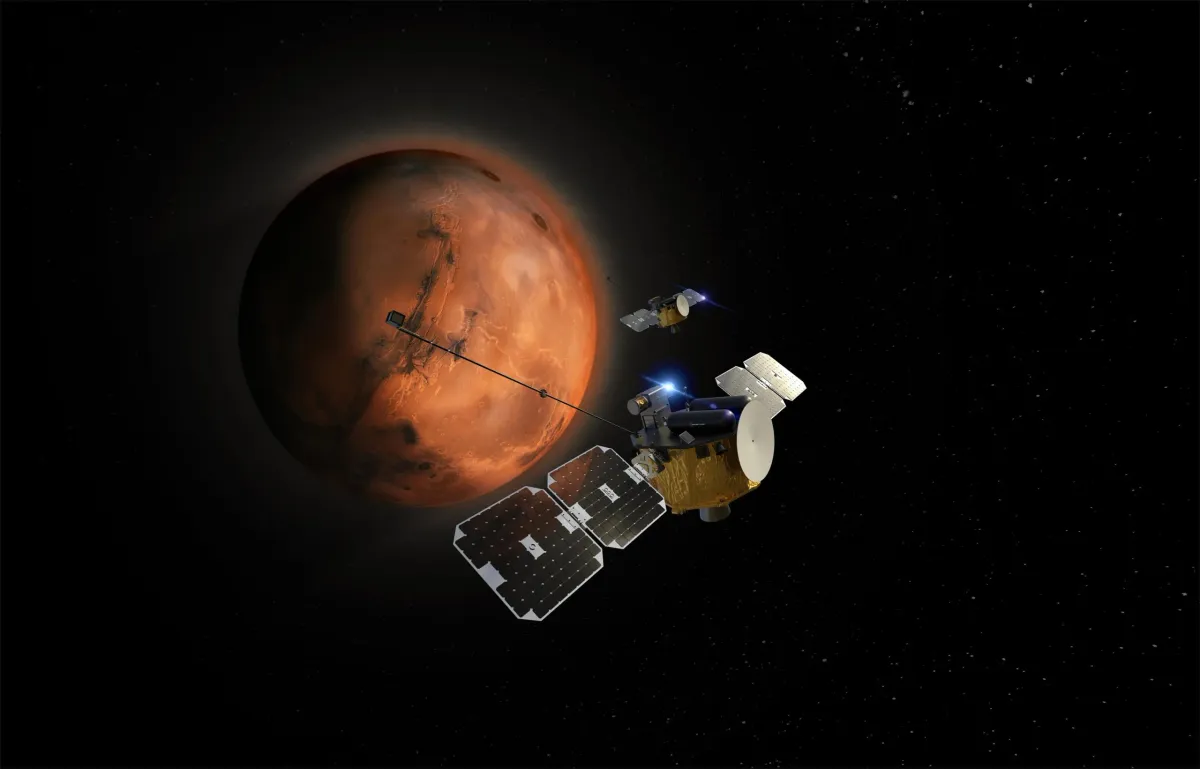
NASA launched the ESCAPADE (Escape and Plasma Acceleration and Dynamics Explorers) mission on November 13, 2025, to understand how Mars lost its atmosphere. The mission's instruments became fully operational on February 25. They will study how the Sun continues to affect Mars and collect data on space weather near Earth and during the journey to Mars.
The mission's findings could help NASA prepare for future human missions to Mars by providing a better understanding of the planet's harsh environment.
We're a new kind of news feed.
Regular news is designed to drain you. We're a non-profit built to restore you. Every story we publish is scored for impact, progress, and hope.
Start Your News DetoxJoe Westlake, heliophysics division director at NASA Headquarters, noted that ESCAPADE will investigate the Sun's role in making Mars uninhabitable. It will also help create space weather protocols for future human missions. He added that ESCAPADE will act as another "weather station" to make space travel safer.
Twin Spacecraft Offer a New Perspective
ESCAPADE is the first mission to use two spacecraft in orbit around Mars. This dual setup allows scientists to observe Mars' magnetosphere and how it changes over short periods.
Michele Cash, ESCAPADE program scientist at NASA Headquarters, explained that having two spacecraft will help scientists understand how the solar wind interacts with Mars' magnetic field.
Previous missions used only one spacecraft. ESCAPADE's two spacecraft provide simultaneous views from different positions, helping scientists connect events in various regions.
Rob Lillis, the mission's principal investigator at the University of California, Berkeley, called ESCAPADE a "game changer." He said it offers a "stereo perspective" from two different vantage points at the same time.
Initially, the spacecraft will share the same orbit, passing over the same areas shortly after each other. This helps pinpoint when and where changes occur. Lillis noted this allows measurements of regional variations in as little as two minutes, which was not possible before.
After about six months, the spacecraft will move into separate orbits. One will stay closer to Mars, and the other will orbit farther away. This five-month phase will allow scientists to observe the incoming solar wind and Mars' response at the same time.
Lillis explained that previous spacecraft could only be in the solar wind or close to the planet. ESCAPADE allows measurements of both the cause and effect simultaneously.
Why Mars is Dangerous for Humans
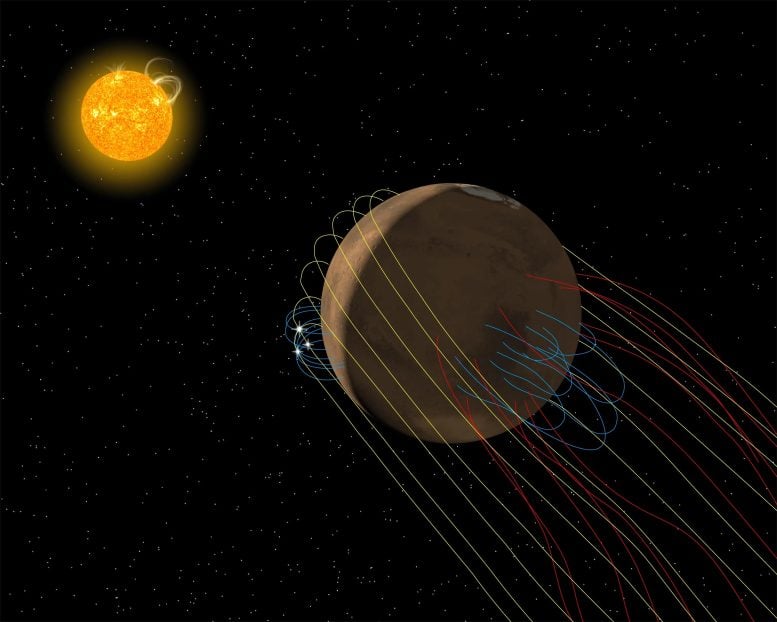
Future astronauts on Mars will face much more solar radiation than people on Earth. Earth has a strong global magnetic field that protects it from energetic particles from the Sun. Mars once had a stronger magnetic field, but it weakened long ago.
Today, Mars has scattered magnetic regions in its crust. It also has a constantly changing magnetic field from interactions between the solar wind and charged particles in its upper atmosphere. This creates a "hybrid" magnetosphere, which offers limited protection. Combined with Mars' thin atmosphere, this allows solar radiation to reach the surface more easily, posing risks to human explorers.
Cash emphasized the need to understand the environment astronauts will face before sending humans to Mars.
ESCAPADE will also study Mars' ionosphere, a region of the upper atmosphere crucial for communication and navigation signals for future missions. Lillis stated that understanding the ionosphere is essential for future GPS and long-distance communications on Mars.
A New Way to Reach Mars
Most Mars missions launch during specific alignment windows every 26 months. ESCAPADE is using a different method that offers more launch flexibility.
Instead of going directly to Mars, the spacecraft are first looping around Lagrange point 2, about a million miles from Earth. In November 2026, when Earth and Mars are better aligned, the spacecraft will return to Earth. They will use Earth's gravity to slingshot toward Mars, arriving in September 2027.
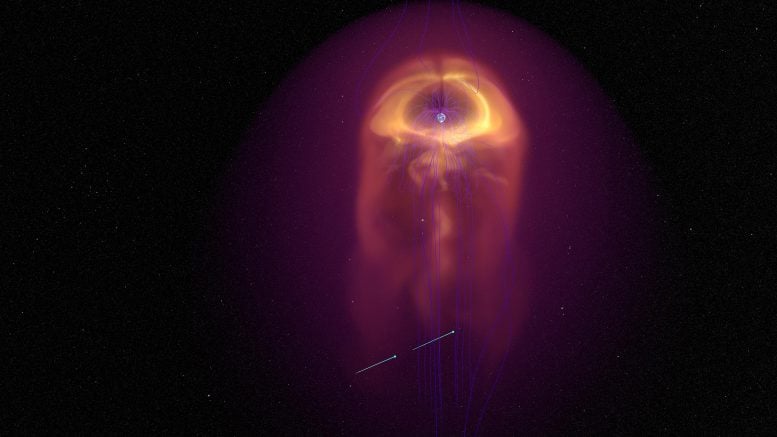
This longer path includes an orbit that reaches about 2 million miles from Earth. During this time, the spacecraft will pass through an unexplored region of Earth's distant magnetotail, the part of Earth's magnetic field that stretches away from the Sun.
Lillis said they will be doing "discovery science" as no one has measured Earth's tail this far away before.
During the 10-month journey to Mars, the spacecraft will continue collecting data on the solar wind and magnetic conditions in interplanetary space. This is the same environment future astronauts will travel through.
NASA’s Heliophysics Division funds the ESCAPADE mission. It is part of the NASA Small Innovative Missions for Planetary Exploration program. The Space Sciences Laboratory at the University of California, Berkeley, leads the mission. Key partners include Rocket Lab, NASA’s Goddard Space Flight Center, Embry-Riddle Aeronautical University, Advanced Space, and Blue Origin.