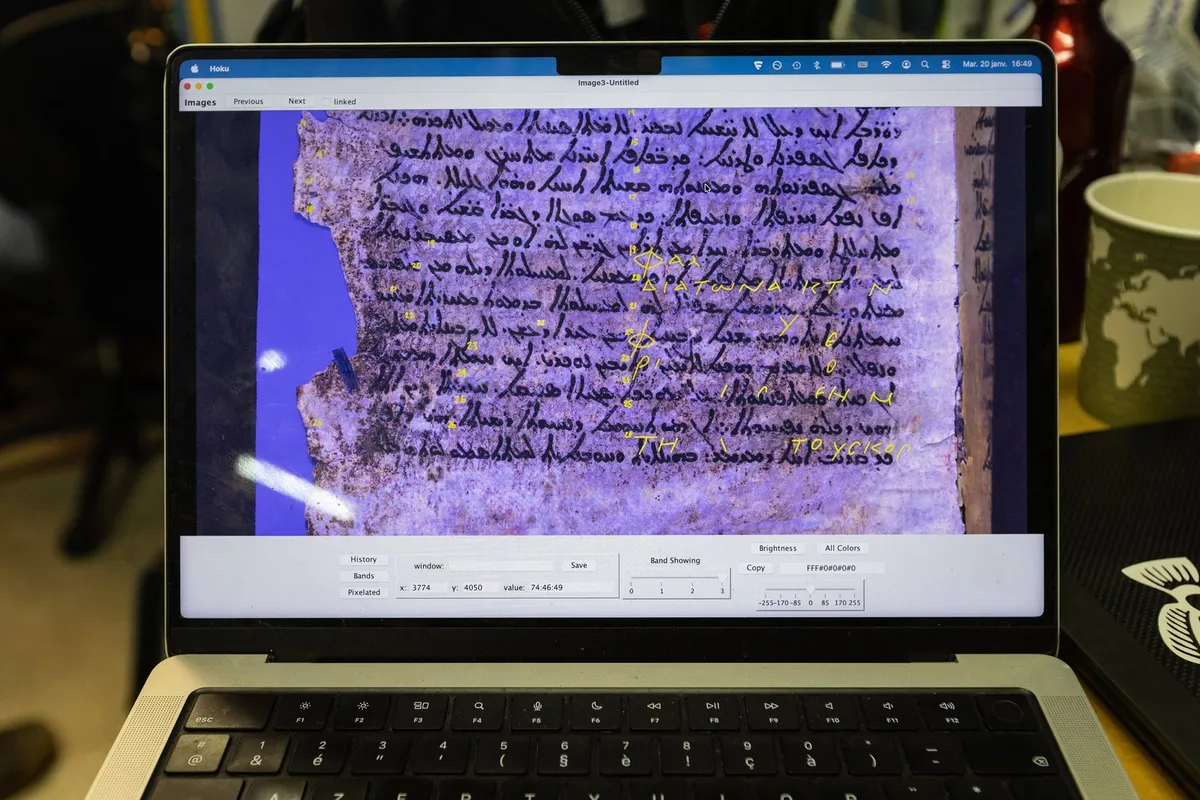
Over a thousand years ago, monks at Saint Catherine's Monastery in Egypt's Sinai desert faced a practical problem: parchment was expensive. So they scraped clean the animal-skin pages in front of them—erasing Western Palestinian Aramaic and Greek text—and wrote over them with a Syriac translation of religious teachings. What they didn't know was that they were burying a copy of one of astronomy's oldest treasures: a star catalog created by Hipparchus, the Greek astronomer who invented scientific astronomy around 129 B.C.E.
Now, researchers are using a particle accelerator to read what the monks tried to erase.
The parchments—known as the Codex Climaci Rescriptus—are a palimpsest, a document where original text has been scraped away to make room for new writing. What makes this particular palimpsest extraordinary is what lies underneath: fragments of a fifth- or sixth-century book that included transcriptions of Hipparchus' work, alongside an astronomical poem called Phaenomena. Very little of Hipparchus' original writings survived antiquity. Most of what we know about his observations comes from later authors who cited him. This hidden text could be among the oldest surviving records of his actual work.
We're a new kind of news feed.
Regular news is designed to drain you. We're a non-profit built to restore you. Every story we publish is scored for impact, progress, and hope.
Start Your News DetoxLast month, researchers at SLAC National Accelerator Laboratory in California began scanning 11 pages of the codex using the facility's synchrotron lightsource—a machine that produces intense X-ray beams. The X-rays detect trace metals left behind by the original inks, making the erased text visible on modern screens. The work has already revealed the ancient Greek word for "Aquarius" and detailed information about stars within that constellation.
Victor Gysembergh, a historian of science at the French National Center for Scientific Research leading the project, sees this as a chance to answer fundamental questions about how science itself began. "The goal is to recover as many of these coordinates as possible," he says. "This will help us answer some of the biggest questions on the birth of science: Why did they start doing science 2,000 and more years ago? How did they get so good at it so fast?"
The answer to that last question might be hiding in these coordinates. Hipparchus' measurements of star positions—made with nothing but his eyes and basic instruments—turn out to be remarkably accurate. The scribe who copied the astronomical poem onto the parchment added precise coordinates and sketches of star maps, details that align with what historians know about Hipparchus' methods. By recovering these numbers, researchers can compare them to later work by astronomers like Ptolemy, potentially revealing whether ancient scholars were recording their own observations or drawing from earlier sources.
The convergence here is striking: medieval monks trying to preserve religious texts unknowingly preserved one of humanity's earliest attempts to map the heavens with mathematical precision. And it took 21st-century particle physics to reveal what they buried. The scanning continues, with researchers still working through the remaining pages to see what other secrets the monks' ink erased.