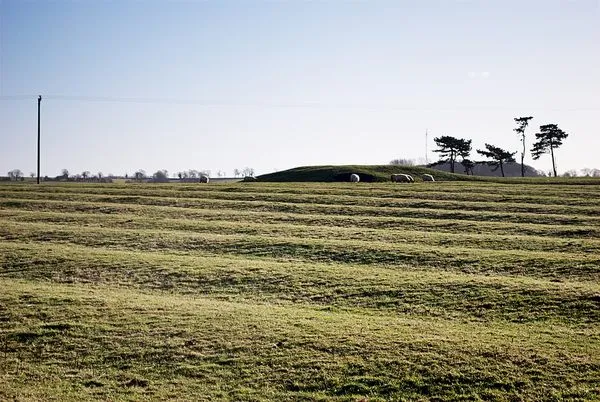
Imagine a land division system so fair, so utterly committed to resource sharing, that it involved giving everyone a long, skinny slice of everything. Not just the good dirt, but the rocky bits, the slightly soggy bits, and whatever else was on offer. Welcome to medieval strip farming in England, where the goal wasn't just to grow crops, but to ensure everyone got a truly equitable — if oddly shaped — piece of the pie.
The genius (or perhaps the deeply inconvenient truth) was that farmers received these narrow strips scattered across different sections of a vast open field. This meant no one got stuck with only the terrible soil, and everyone shared the bounty. As they plowed, the soil naturally mounded up in the middle of each strip, creating distinct ridges, with lower furrows on either side. Even centuries after the plows stopped, these undulating "ridge and furrow" patterns still ripple across the English countryside, silent scars of an ancient agricultural philosophy.
Still Kicking (Literally)
Most of the UK has long since moved on to larger, more enclosed fields, but a few stubborn pockets cling to the old ways. Laxton in Nottinghamshire is probably the most famous, still operating its open-field system complete with its own court to settle land disputes. Because apparently, some traditions are just too good to give up. Braunton in North Devon and Laugharne in Wales also keep the flame alive.
We're a new kind of news feed.
Regular news is designed to drain you. We're a non-profit built to restore you. Every story we publish is scored for impact, progress, and hope.
Start Your News DetoxBut the real surprise might be around Haxey on the Isle of Axholme. This area was once an island, surrounded by marshland for most of the year, making any dry land for crops incredibly precious. When the marshes were drained in the 17th century, most places embraced the new, larger fields. Not Haxey. The original dry parts of the island kept their medieval strips.
Why? Well, part of the theory is that it helped preserve enough common land for the annual Haxey Hood game — a gloriously chaotic, proto-football event that's been played for centuries. So, a land management system designed for food security inadvertently became the guardian of a very old, very muddy sporting tradition. Which, if you think about it, is both impressively practical and wonderfully absurd. The local government even has a cycling route dedicated to showing off these remaining strip farms. Because some history is best appreciated by bicycle.