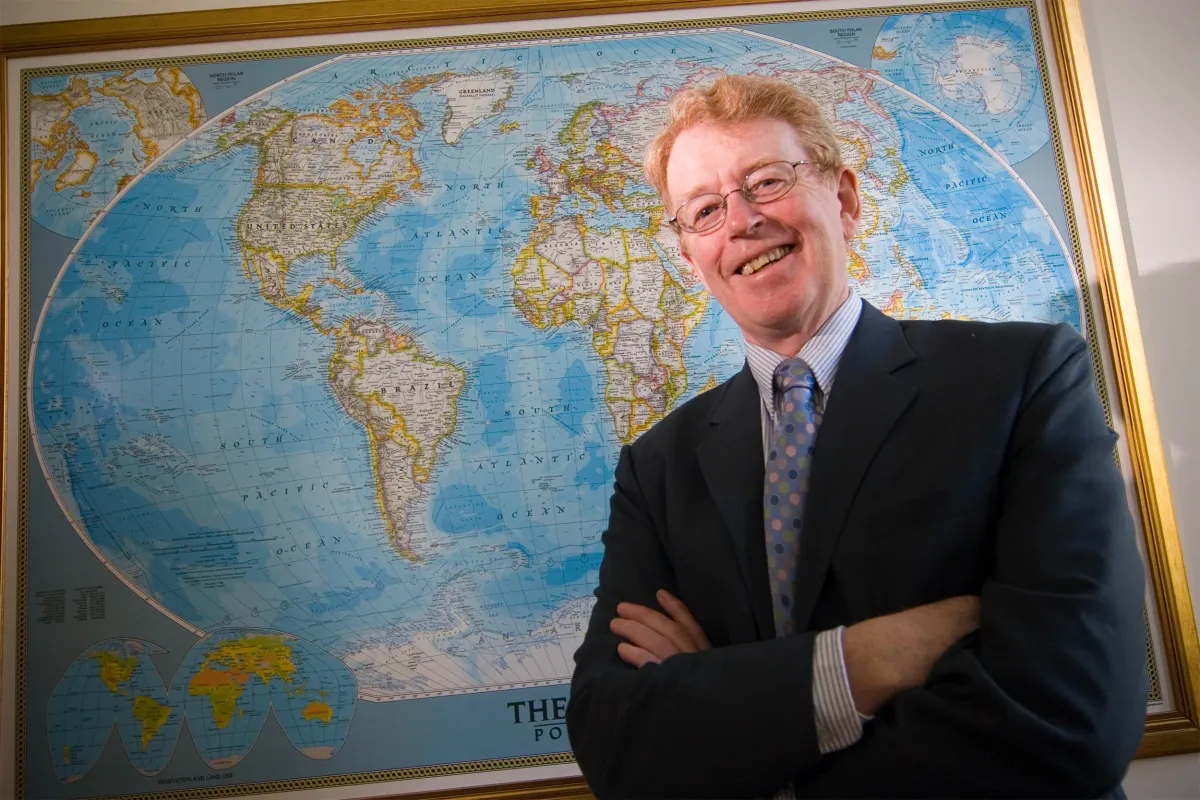
Michael B. McElroy, the atmospheric scientist whose research shaped international climate policy and influenced how we understand the chemistry of five planets, died on January 8 at 86.
He arrived at Harvard in 1970 as a young prodigy — at 31, already the author of a general theory explaining why oxygen doesn't accumulate in Venus' atmosphere. Over the next five decades, he became one of those rare figures whose work moves from the margins of scientific inquiry into the rooms where nations make decisions.
From Venus to the Montreal Protocol
McElroy was born in Ireland in 1939 and earned his Ph.D. in applied mathematics from Queens University Belfast at 23. His early work on planetary atmospheres — Earth, Venus, Mars, Mercury — earned him the James B. Macelwane Medal from the American Geophysical Union in 1968, the kind of recognition that typically marks a scientist's peak. Instead, it was just the opening act.
We're a new kind of news feed.
Regular news is designed to drain you. We're a non-profit built to restore you. Every story we publish is scored for impact, progress, and hope.
Start Your News DetoxIn the 1970s, he turned his attention to a threat much closer to home: human-made chemicals eating away at Earth's ozone layer. His research didn't just describe the problem — it helped build the case for the Montreal Protocol, the 1987 treaty that phased out ozone-depleting substances. It's one of the most successful international environmental agreements ever negotiated, and McElroy's work was foundational to it.
"His pioneering work on human-induced stratospheric ozone depletion and climate change influenced major international environmental agreements," Harvard noted in his obituary. That's the kind of sentence that hides the actual weight of what happened: a scientist's research became policy that protected billions of people.
Building Bridges Between Disciplines
In 1993, McElroy founded the Harvard-China Project to bring together experts from multiple fields — climate science, air quality, energy, economics, policy — to tackle the interconnected challenges facing rapidly developing nations. The project eventually expanded to include India and other countries. "Our goal was always collaboration," said Chris Nielsen, the project's executive director. "We wanted to build a program that was collaborative in two respects — collaborative between Harvard and China and between different disciplines."
That commitment to bridging silos, between countries and between scientific fields, became his signature move. At Harvard, he championed the creation of the Department of Earth and Planetary Sciences and became its founding chair in 1986.
In 2024, nearly 60 years after his first major award, McElroy received the AGU's Bowie Medal, the union's highest honor. He was one of only a handful of scientists to win both the Macelwane and the Bowie — a trajectory that speaks to sustained brilliance across a lifetime. One of his former Ph.D. students, Yuk L. Yung, reflected on the arc: "It is a testament to his sustained career and sustained passion that after 60 years, he arrived at the other peak of the mountain."
McElroy is survived by his wife, Veronica, their two children, Brenda and Stephen, and grandchildren Zoe and Abigail.