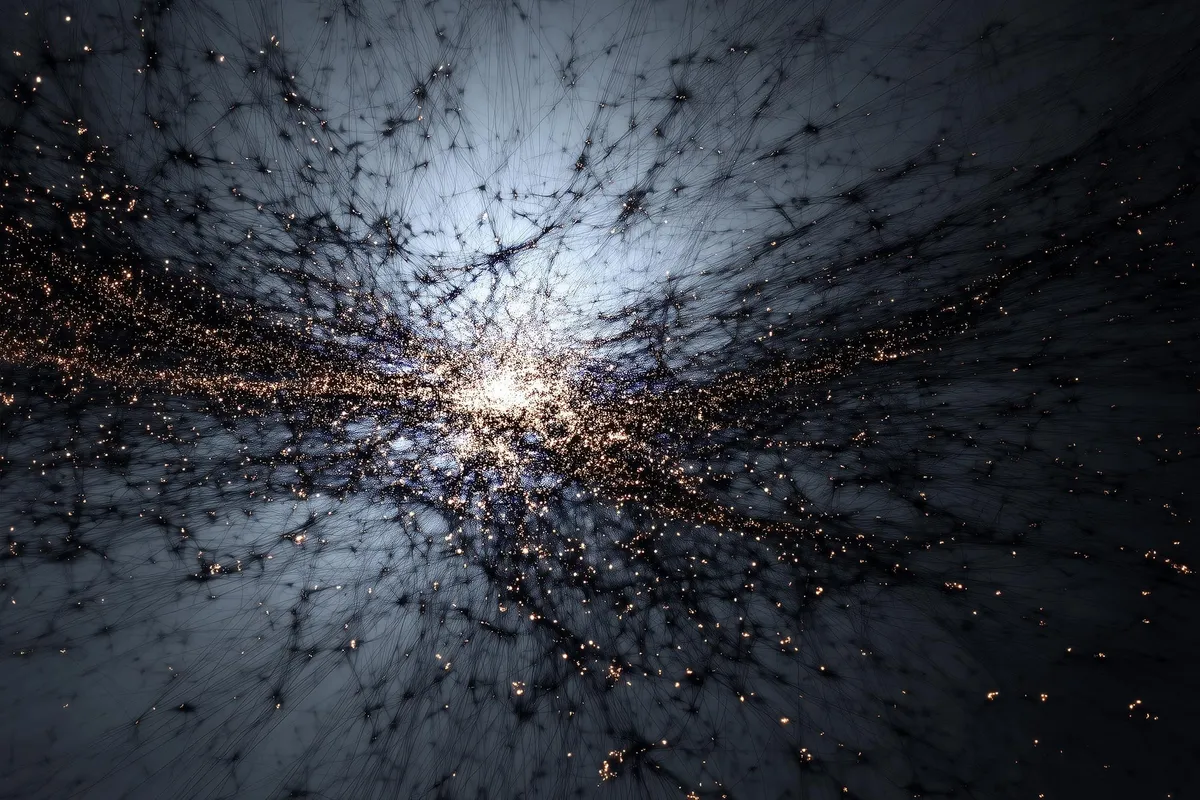
For ages, we thought dark matter was just one kind of invisible particle. Like, a single, mysterious ingredient holding the universe together. But new observations are getting super precise, and they're showing some weird stuff.
Some small galaxies have way less dark matter in their middle than expected. Then, in other spots, dark matter is packed in super tight, much denser than our old ideas predicted. It's like the universe was telling us, "Hey, you're missing something here."
Dark Matter Gets an Upgrade
Enter a clever new idea from the Purple Mountain Observatory in China. What if dark matter isn't just one thing? What if it's actually a mix of different particles, some heavier, some lighter?
We're a new kind of news feed.
Regular news is designed to drain you. We're a non-profit built to restore you. Every story we publish is scored for impact, progress, and hope.
Start Your News DetoxImagine a cosmic mosh pit where these particles don't just feel gravity. They actually bump into each other. Over time, the heavier ones naturally drift to the center of a galaxy, while the lighter ones spread out. Scientists call this "mass segregation," and it's pretty much what happens with stars in a cluster, too.
This simple shift could explain a bunch of cosmic puzzles. For instance, in those small galaxies with less dark matter in their core? The lighter particles would have spread out, leaving the center less dense. Boom. Solved.
Even cooler, this model explains why we see so many tiny "gravitational lenses." That's when gravity from a massive object bends light from something far away, making it look magnified. With heavier dark matter clumping up, it creates these super-dense spots that are perfect for bending light. It's like the universe has more natural magnifying glasses than we ever thought possible.
This isn't just some abstract theory. It helps us understand why our telescopes have been seeing more small-scale lensing events than our old models could explain. It's like finding the missing piece to a giant cosmic jigsaw puzzle.
The takeaway? Dark matter's inner life might be way more complex than we ever imagined. As our telescopes get even better, we might actually be able to test this idea and truly see if dark matter has multiple components. If it does, our understanding of the universe just got a whole lot more interesting.