For decades, fast radio bursts have been among astronomy's most perplexing mysteries—millisecond flashes of radio energy that outshine entire galaxies, arriving from unknown sources across the cosmos. Now, astronomers have found direct evidence that at least some of these bursts come from neutron stars orbiting ordinary companion stars, not from isolated objects drifting alone through space.
The breakthrough came from an unexpected signal. In late 2023, researchers monitoring a repeating fast radio burst called FRB 220529A detected something remarkable: the polarization of the radio waves suddenly shifted by more than a hundredfold, then gradually returned to normal over two weeks. This brief but dramatic change, called an 'RM flare,' turned out to be the smoking gun.
The hidden companion revealed
When radio waves travel through magnetized plasma—charged gas threaded with magnetic fields—their polarization angle rotates. By measuring this rotation, astronomers can infer what material lies between us and the source. The extreme RM flare suggested something dense and magnetic had briefly passed in front of the burst source.
We're a new kind of news feed.
Regular news is designed to drain you. We're a non-profit built to restore you. Every story we publish is scored for impact, progress, and hope.
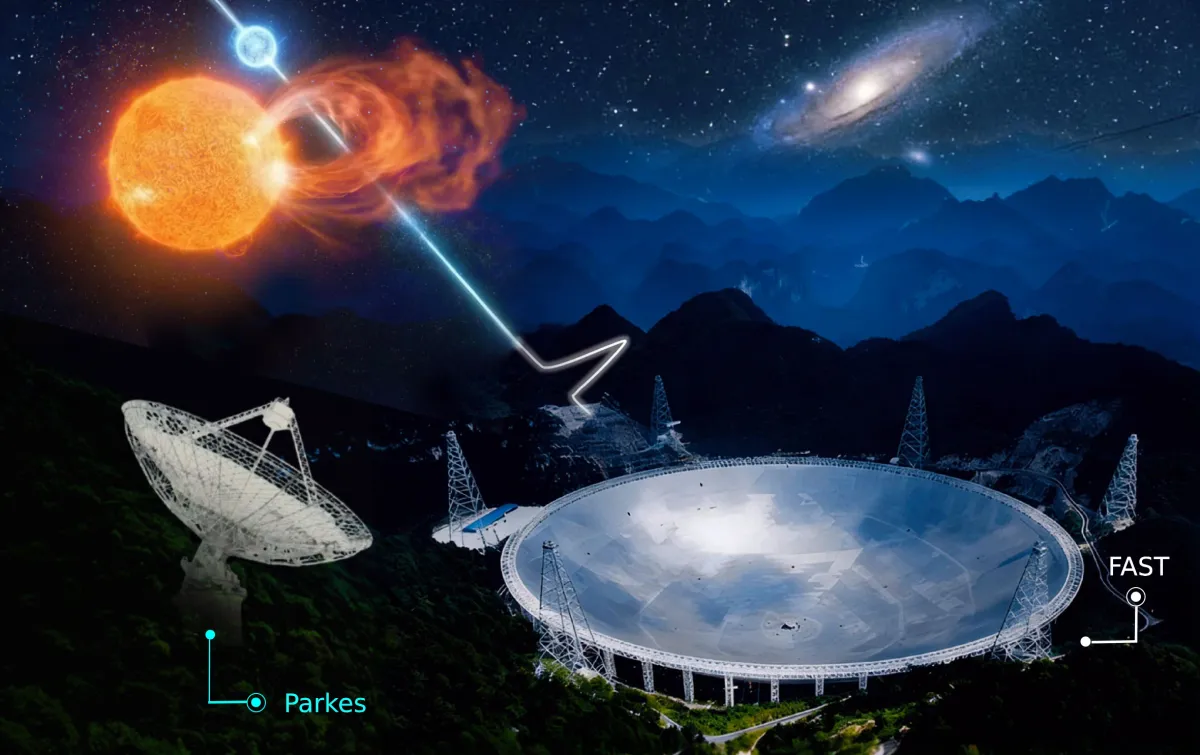
Start Your News Detox"The evidence strongly supports a binary system containing a magnetar—a neutron star with an extremely strong magnetic field—and a star like our Sun," said Bing Zhang, chair of astrophysics at the University of Hong Kong and a lead author on the study published in Science. The most likely explanation: the companion star ejected a cloud of plasma during a coronal mass ejection, the same kind of event our own Sun produces periodically. As this plasma drifted past the magnetar, it left its fingerprint on the radio signal.
The companion star itself remains invisible at such distances, but its presence was confirmed through 17 months of continuous monitoring using the FAST telescope in China and the Parkes telescope in Australia. This kind of persistent observation is what made the discovery possible—not a single dramatic moment, but the accumulated weight of careful, repeated measurements.
Fast radio bursts last only milliseconds but release enormous energy. Most appear just once, making them nearly impossible to study. The handful that repeat, like FRB 220529A, offer astronomers a rare window into their nature. By tracking these sources over months and years, researchers can watch for subtle changes that reveal the environment around them.
The finding fits neatly into a larger picture that Zhang and colleagues have been developing: a unified model suggesting that all fast radio bursts originate from magnetars, with binary companions playing a key role in determining whether the bursts repeat. Stars orbiting close enough to exchange material and energy seem to create the conditions for frequent, observable bursts.
Continued monitoring of other repeating sources should reveal how common these binary systems actually are—and whether this single discovery represents the typical origin story for fast radio bursts, or just one chapter in a more complex tale.