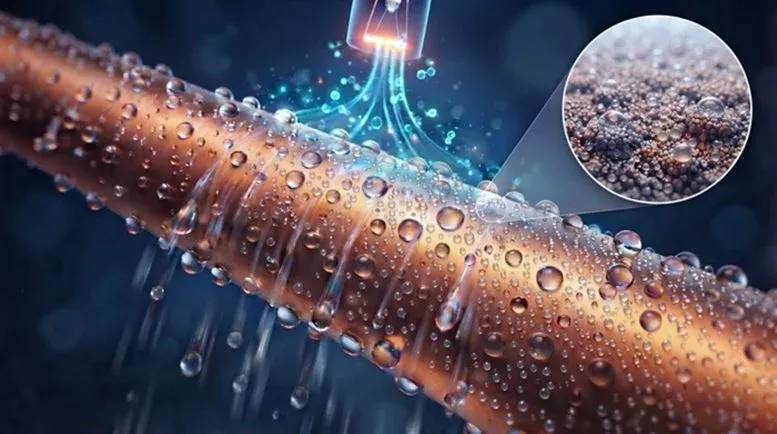
A new polymer coating helps water droplets form and detach faster. This boosts condensation heat transfer by up to 5.5 times on copper surfaces.
Water droplets on cold surfaces can either help move heat or create an insulating layer. Researchers at KAIST developed an ultrathin polymer coating. It makes droplets appear and leave surfaces more quickly. This increases condensation heat transfer by as much as 5.5 times compared to regular copper.
This method could make power plants and desalination systems more energy-efficient. It could also improve cooling for electronic devices.
We're a new kind of news feed.
Regular news is designed to drain you. We're a non-profit built to restore you. Every story we publish is scored for impact, progress, and hope.
Start Your News DetoxHow the Coating Works
KAIST announced this new technology, created by Professor Youngsuk Nam and Professor Sung Gap Im. They controlled the thickness and structure of an ultrathin polymer layer. The coating helps more droplets form as water vapor condenses. It also helps these droplets detach sooner.
Condensation is when water vapor turns into liquid. This happens in industrial systems to turn steam back into water in power plants. It also helps produce fresh water from seawater and cools electronic devices.
Efficient condensation needs water to clear from the surface quickly. On regular metal surfaces, small droplets often combine into a thin film. This film acts like an insulator, slowing heat movement.
Heat transfer improves when condensation happens as individual droplets that form and detach repeatedly. This constantly uncovers fresh surface. This process is called dropwise condensation. Droplets form, fall away, and make room for new ones, moving heat more effectively.
Previous surface designs faced a challenge. Making a surface rougher creates more spots for droplets to form. But these structures can also trap droplets, making them hard to remove. A smoother surface allows droplets to detach easily, but fewer new droplets can form.
Nanoscale "Defects" Become Useful
The researchers solved this problem using nanoscale polymer aggregates. These were once seen as "defects" in polymer coatings. They made the films using initiated chemical vapor deposition (iCVD). This process deposits gas onto a surface to create an ultrathin polymer layer.
When the film was made thinner, dense clusters of small polymer aggregates appeared. These acted as nucleation sites where water droplets could start forming. Thin films produced about three times more droplets than thicker ones.
The researchers then used heat treatment to weaken the force holding droplets to the surface. This allowed them to leave before growing too large. Making the film thinner increased the number of places for droplets to form. Heat treatment made those droplets easier to remove. This allowed them to control droplet formation and removal separately.
When one droplet leaves, another can form in its place. This fast cycle of droplet formation and removal constantly refreshes the surface. This improves heat transfer during condensation.
Testing the Coating
To test the coating, researchers applied it to copper tubes. These are common in condensers. The maximum condensation heat transfer coefficient reached about 88 kW·m⁻²·K⁻¹. This was about 5.5 times better than an ordinary copper surface with a water film. It was also more than 50% higher than a typical hydrophobic coating.
This method uses tiny surface "defects" as useful features. Nanoscale particles, usually removed from polymer films, became sites that encouraged droplets to form. This offers a new way to design condensation surfaces.
If used in power plants or industrial heat exchangers, this coating could improve energy efficiency. It could also help collect water more efficiently in desalination and water-harvesting systems. It could also speed up heat removal from electronic devices.
Professor Nam said this research is important because it uses nanostructures once seen as defects as features that help droplets form. He noted they found a new way to improve heat transfer by controlling droplet formation and removal separately. He expects this technology to be used in many energy and environmental applications.
Deep Dive & References
Rational design of polymer film morphology via structure-performance linkage for enhanced condensation performance - Nature Communications, 2026