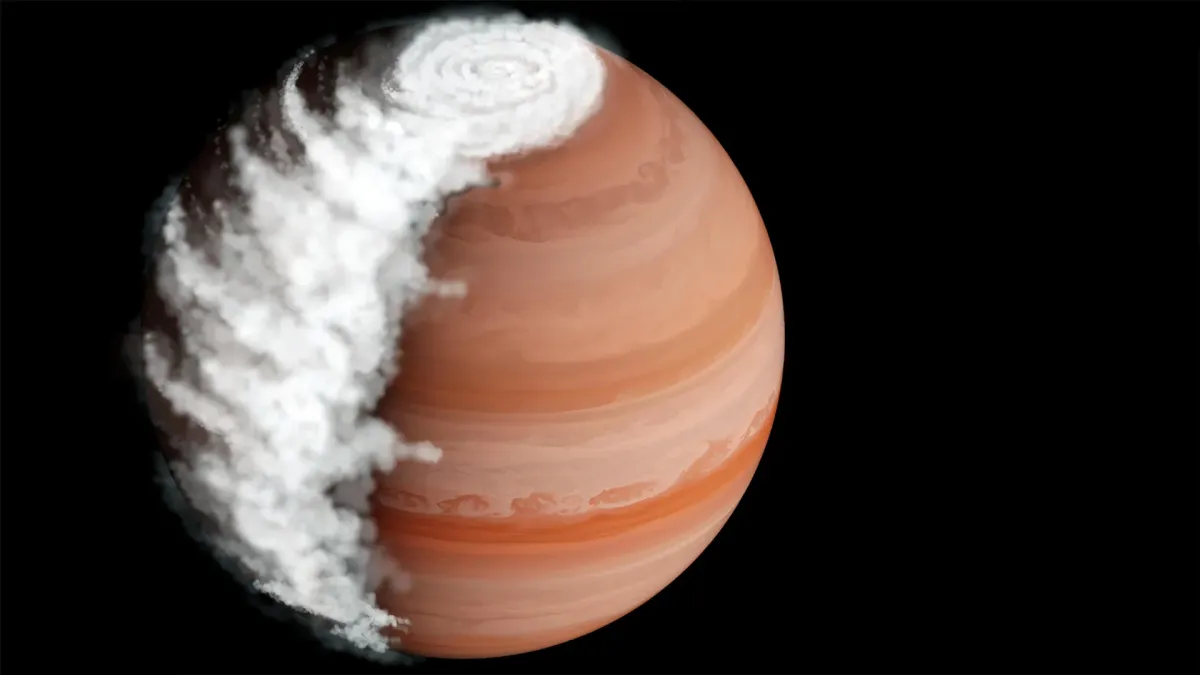
Imagine a world where the morning brings clouds made of actual rock, only for them to evaporate by nightfall. No, this isn't a prog rock album cover; it's a giant planet nearly 700 light-years away, and NASA's James Webb Space Telescope just caught it in the act.
Astronomers peering at WASP-94A b (which sounds less like a planet and more like a secret government project) discovered it has a daily weather forecast that’s, shall we say, extreme. Every morning, a thick blanket of mineral clouds — magnesium silicate, to be precise, the stuff of Earth rocks — rolls in. But come evening? Poof. Clear skies. It's like the universe's most dramatic dry-cleaning cycle.
This isn't just a fun fact for your next dinner party. This is one of the first times scientists have directly witnessed cloud cycling on a "Hot Jupiter" exoplanet. These are gas giants that cozy up to their stars, orbiting closer than Mercury does to our Sun. The heat is, understandably, intense.
We're a new kind of news feed.
Regular news is designed to drain you. We're a non-profit built to restore you. Every story we publish is scored for impact, progress, and hope.
Start Your News DetoxDavid Sing, a professor at Johns Hopkins, put it best: studying these planets with their perpetual cloud cover was like trying to see through a "foggy window." Now, thanks to Webb, they've got high-definition clarity. They can see what these clouds are made of, how they form, and how they perform their nightly vanishing act.
The Great Evaporation Act
To catch this atmospheric disappearing trick, scientists watched WASP-94A b as it transited, or passed in front of, its star. Webb's incredible sensitivity allowed them to observe the planet's leading (morning) and trailing (evening) edges separately. Think of it as scanning the planet's sunrise and sunset simultaneously.
The difference was stark. The morning side was a rocky cloud factory, while the evening side was practically pristine. The prevailing theories for this dramatic shift? Either super-strong winds are dragging the clouds deep into the planet's scorching atmosphere, or the clouds are simply evaporating as temperatures climb past 1,000 degrees Celsius. So, kind of like morning fog clearing on Earth, but with significantly higher stakes (and temperatures).
Sing called the whole thing a "huge surprise," noting that while some atmospheric differences were expected, the sheer contrast in cloud cover has fundamentally reshaped their understanding of the planet's dynamics.
Clearing Up Cosmic Mysteries
The clear evening skies offered another bonus: an unobstructed view of WASP-94A b's atmosphere. Older telescopes like Hubble could only give an average, blurry picture. But Webb, as Sagnick Mukherjee from Arizona State University explained, can focus its observations, allowing for this detailed look at the cloud cycle.
This clearer data also helped solve a long-standing chemical mystery. Previous measurements suggested WASP-94A b had hundreds of times more oxygen and carbon than Jupiter, which didn't quite fit existing theories of planet formation. The new, cloud-free data reveals it's only about five times richer in these elements, making it much more Jupiter-like. Turns out, clouds can obscure more than just the view; they can throw off your chemical analysis, too.
After this success, the team checked out eight other Hot Jupiters and found similar cloud cycling on two more: WASP-39 b and WASP-17 b. So, it seems rock clouds doing the Houdini act might be more common than we thought. Next up, a broader Webb program to study even more of these extreme weather systems. Because apparently, the universe loves a good magic show.