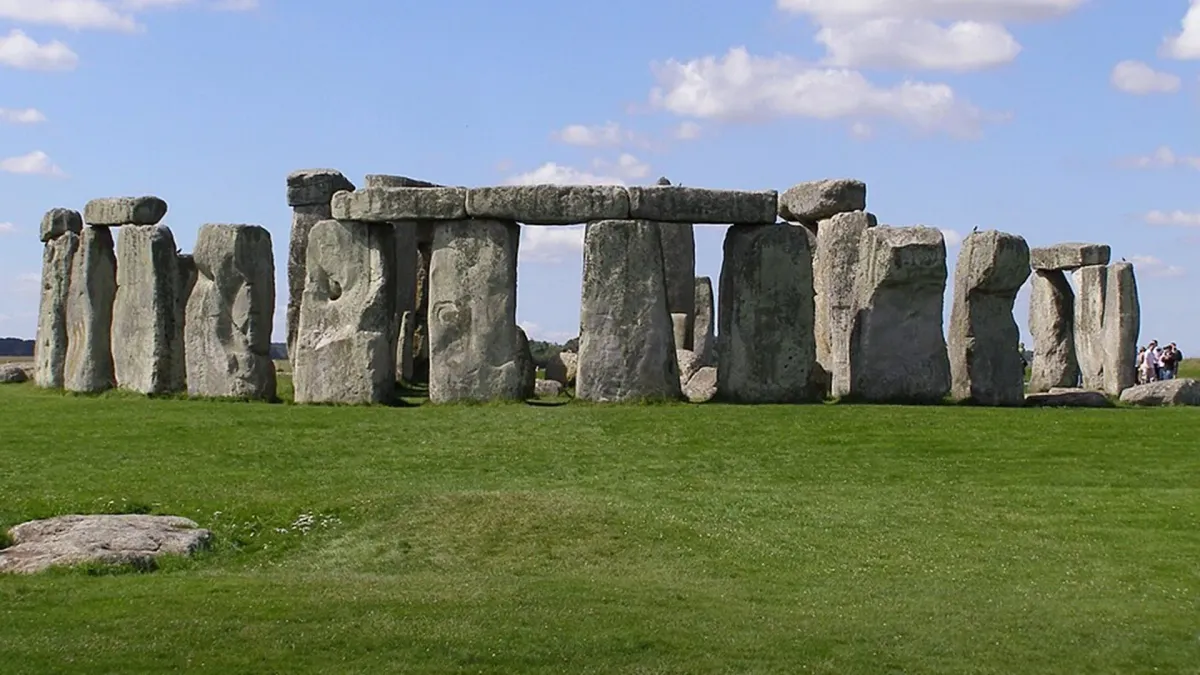
For over a century, archaeologists have debated how Stonehenge's massive stones arrived at Salisbury Plain. One theory held that glaciers, moving during the Ice Age, carried them from Wales or Scotland. New research from Curtin University has now settled the question with surprising clarity: humans did it.
The evidence comes from an unlikely source—microscopic mineral grains buried in river sediments near Stonehenge. Researchers analyzed over 500 zircon crystals, some of Earth's most durable minerals, which preserve a geological record of how rocks move across continents. If glaciers had dragged stones all the way from Scotland or Wales, they would have left a distinct mineral fingerprint on Salisbury Plain as the rocks eroded over millennia. The team found no such signature.
"If glaciers had carried rocks all the way from Scotland or Wales to Stonehenge, they would have left a clear mineral signature on the Salisbury Plain," explains Dr. Anthony Clarke, lead author from Curtin's School of Earth and Planetary Sciences. "Those rocks would have eroded over time, releasing tiny grains that we could date to understand their ages and where they came from. But we did not find any of those grains in the river sands near Stonehenge."
We're a new kind of news feed.
Regular news is designed to drain you. We're a non-profit built to restore you. Every story we publish is scored for impact, progress, and hope.
Start Your News DetoxThis doesn't tell us exactly how Neolithic builders moved the stones—whether they were sailed down river valleys, hauled overland on rolling logs, or transported by some method we haven't yet imagined. What it does tell us is that ice almost certainly played no role. The absence of glacial evidence makes human transport the only plausible explanation.
The finding reinforces a 2024 study that traced the six-tonne Altar Stone specifically to Scotland, suggesting Neolithic communities deliberately sourced and transported Stonehenge's materials over extreme distances. It's a reminder that our ancestors were far more capable of ambitious engineering than we sometimes assume.
What's striking here isn't just the answer—it's the method. By analyzing minerals smaller than a grain of sand, researchers resolved a debate that has persisted for more than a century. Modern geochemical tools have finally given us the precision to prove what the stones themselves have been trying to tell us all along.