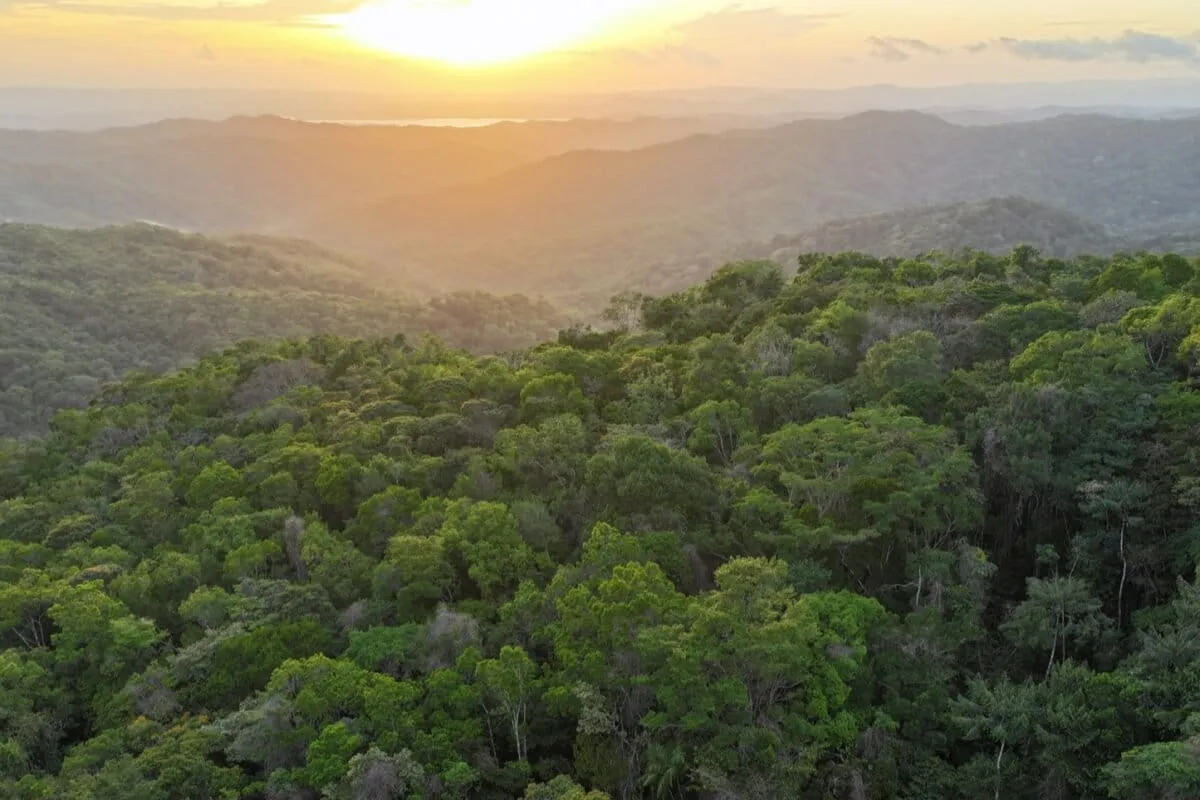
A long-term experiment in Panama has revealed something straightforward but significant: young tropical forests recovering on abandoned land grow roughly twice as fast when nitrogen is available in the soil. And faster growth means faster carbon capture — a detail that matters as the world looks for natural ways to offset emissions.
The finding comes from researchers who spent years testing how different nutrients shape forest recovery at different stages. Sarah Batterman, the study's lead author, and her team set up 76 experimental plots across recovering forests of varying ages — from recently abandoned pasture to 10-year-old secondary growth to 30-year-old forests, plus mature forest plots established in 1997.
Each plot received one of four treatments: extra nitrogen, extra phosphorus, both, or nothing. The pattern that emerged was clear: young trees responded most dramatically to nitrogen. "In the first 10 years of forest recovery, the forests grow back about twice as fast when they have sufficient nitrogen," Batterman explained.
We're a new kind of news feed.
Regular news is designed to drain you. We're a non-profit built to restore you. Every story we publish is scored for impact, progress, and hope.
Start Your News DetoxWhy this matters goes beyond just faster trees. Tropical forests are carbon sinks — they pull CO₂ from the air and lock it into wood and soil. Accelerating that process, even in recovering forests on degraded land, means more atmospheric carbon being sequestered in a shorter timeframe. It's not a replacement for emissions reductions, but it's a real mechanism at work in places where forest regrowth is already happening.
The research also hints at something more nuanced: the nutrient bottleneck shifts as forests age. Young forests are nitrogen-hungry. Older forests might be limited by other factors. Kelly Anderson, a research scientist at Missouri Botanical Garden who reviewed the work, noted the practical angle: "With this information we can prioritise management and conservation practices to maximise forest regrowth."
That could mean targeted interventions — adding nitrogen to recovering forests in regions where it's naturally scarce, for instance — or simply recognizing which landscapes are primed for the fastest carbon capture if given the right conditions.
The next phase is understanding whether these patterns hold across different tropical regions and whether nitrogen availability is actually the limiting factor in real-world forest recovery, not just in controlled experiments.