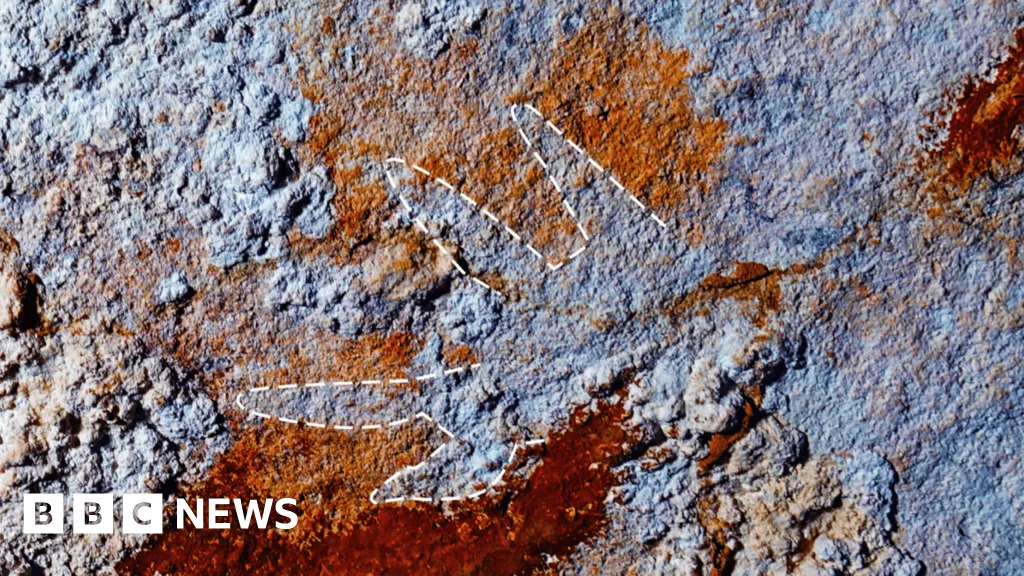
A red handprint on an Indonesian cave wall is forcing us to completely rethink where human creativity actually began.
The stencilled outline was found on Sulawesi, an island in Indonesia, and dates back at least 67,800 years. What makes it remarkable isn't just the age—it's what the hand shows. Someone deliberately reworked the fingers into a claw-like shape, a deliberate act of imagination and symbolic thinking. They weren't just leaving a mark. They were creating.
For decades, art history operated from a simple assumption: humans had a "creative awakening" in Ice Age Europe, around 40,000 years ago. Everything before that was considered pre-symbolic, pre-artistic. Europe was where we became ourselves.
We're a new kind of news feed.
Regular news is designed to drain you. We're a non-profit built to restore you. Every story we publish is scored for impact, progress, and hope.
Start Your News DetoxThe discoveries on Sulawesi are quietly demolishing that story.
The Eurocentric Argument Crumbles
Professor Adam Brumm of Griffiths University, who co-led the research, studied in the 1990s when the European narrative was gospel. "The prevailing view was that the creative awakening occurred in a small part of Europe," he says. "But now we're seeing traits of modern human behaviour, including narrative art in Indonesia, which makes that Eurocentric argument very hard to sustain."
Over the past decade, Sulawesi has yielded painting after painting—hand stencils, animal outlines, abstract designs—all pushing the timeline of sophisticated image-making further back. The latest discovery on Muna Island, off Sulawesi's southeastern coast, extends the record by at least 28,000 years compared to previous regional findings. This wasn't a one-off experiment. It was a deeply rooted cultural practice spreading across a region.
Adhi Agus Oktaviana of Indonesia's national research and innovation agency points out something else the evidence reveals: the timing matters for understanding human migration. Sulawesi sits on the northern sea route between mainland Asia and Sahul—the ancient combined landmass of Australia and New Guinea. If humans were settled on Sulawesi making complex symbolic art 67,800 years ago, they almost certainly reached Australia around 65,000 years ago, much earlier than previously thought.
Creativity Wasn't an Accident
What emerges from Sulawesi, combined with earlier discoveries in South Africa, is a different picture entirely: symbolic thinking and artistic expression weren't a sudden flicker in one corner of the world. They were fundamental to what Homo sapiens were, wherever they went.
Professor Maxime Aubert of Griffiths University frames it plainly: "What it suggests is that humans would have had that capacity for a very long time, at least when they left Africa—but probably before that." The capacity wasn't invented. It was carried. It was innate.
That claw-like hand, deliberately reimagined by someone in a cave 67,800 years ago, tells us something we're still learning: creativity didn't arrive as a European gift to the world. It was always part of being human.