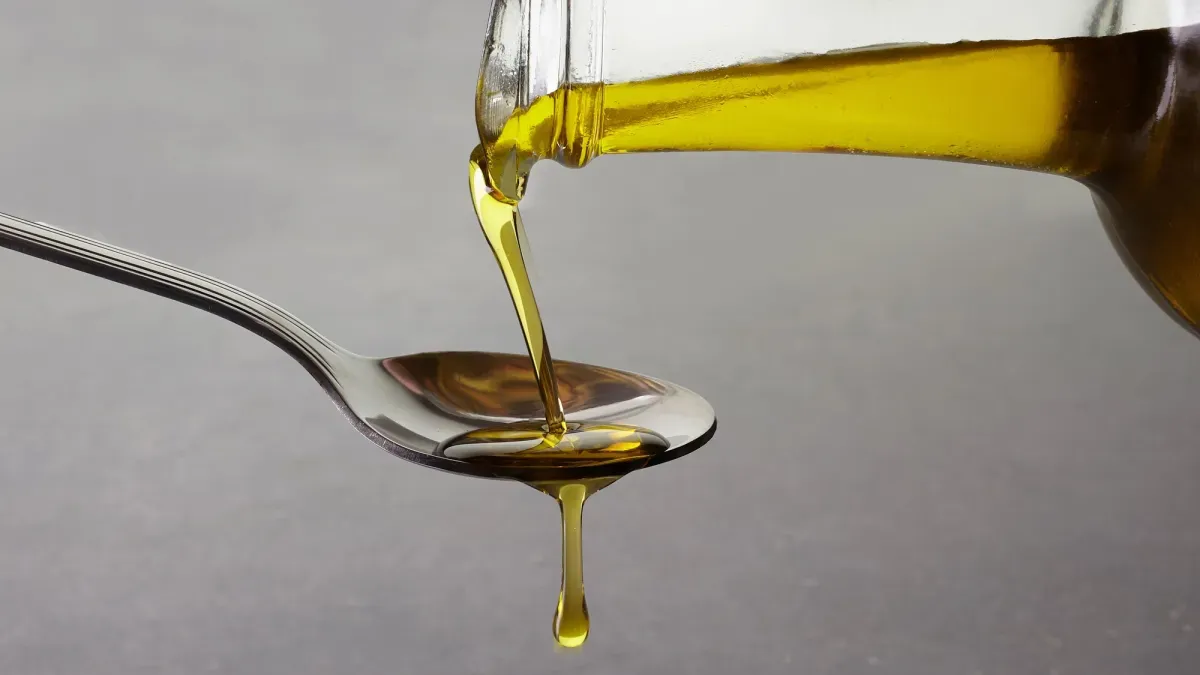
You've stood there, tilting the bottle at increasingly aggressive angles, waiting for that final drop of olive oil or maple syrup to surrender. It feels eternal. Now physicists at Brown University have done the math—literally—and can tell you exactly how long your patience should actually last.
Jay Tang and Thomas Dutta, who study how bacteria behave on wet surfaces, got curious about the everyday physics hiding in kitchen frustration. Tang's problem was his cast iron wok: he seasons it with oil but doesn't want excess liquid sitting around to cause rust. Dutta's inspiration came from watching his grandmother coax the last drops from cartons. Both scenarios involve the same hidden physics—how thin layers of liquid move down a tilted surface.
"This physics is everywhere in our main research," Tang explains. "It just happens to also be the everyday fluid dynamics of the kitchen."
We're a new kind of news feed.
Regular news is designed to drain you. We're a non-profit built to restore you. Every story we publish is scored for impact, progress, and hope.
Start Your News DetoxThey used Navier-Stokes equations, the mathematical framework that describes how fluids move based on internal friction and Newton's laws of motion. The key variable is viscosity—how thick or thin the liquid is. To test their calculations, they poured water, whole milk, clarified butter, and olive oil over a plate tilted at 45 degrees and measured how long it took each to drain away.
Water cleared in seconds. Cold maple syrup took hours. The math held up beautifully—but with a humbling twist for Tang. He'd been waiting only one or two minutes before tilting his wok a second time to squeeze out remaining oil. The equations revealed he actually needs to wait 15 minutes for the physics to do its work.
Why This Matters Beyond Your Kitchen
The real payoff isn't about kitchen efficiency—it's about having a precise mathematical tool for understanding fluid behavior on surfaces, which matters far beyond draining bottles. Tang and Dutta now use these same equations to model how bacteria colonize wet environments, how thin films behave in industrial processes, and how liquids move through porous materials. The kitchen became their training ground for equations that scale up to problems in medicine, materials science, and engineering.
This is a pattern in physics: the most useful tools often emerge from solving problems that seem trivial. The mathematics of a dripping bottle is the same mathematics that governs how water moves through soil, how oil spreads across a surface, or how biological fluids flow through living tissues. By publishing their work in Physics of Fluids, Tang and Dutta have given other researchers a validated model they can adapt for their own questions.
The next time you're waiting for that last squeeze of honey or shampoo, you're not just fighting gravity—you're watching viscosity and surface tension negotiate with physics. And now, at least, you'll know exactly how long to wait.