For fifty years, physicists have chased a question that sounds almost mythical: what happens when you cool a superfluid—a substance that flows without friction—even further. Does it simply stay frictionless forever, or does something stranger happen.
Now, researchers at Columbia University and the University of Texas at Austin have an answer. They watched a superfluid undergo a phase transition into what appears to be a supersolid—a state of matter that shouldn't exist according to the simplest physics, yet does.
The Impossible Combination
Imagine ice that still flows like water. That's roughly what a supersolid would be: a material with the fixed, orderly crystal structure of a solid, but retaining the frictionless motion of a superfluid. It's a contradiction wrapped in quantum mechanics.
We're a new kind of news feed.
Regular news is designed to drain you. We're a non-profit built to restore you. Every story we publish is scored for impact, progress, and hope.
Start Your News DetoxPhysicists have theorized about supersolids since the early 20th century, but helium—the classic superfluid—has never definitively become one. Other researchers have created supersolid-like states in laboratories, but those required lasers and optical tricks to impose structure from outside. What was missing was a supersolid that emerged naturally, without external engineering.
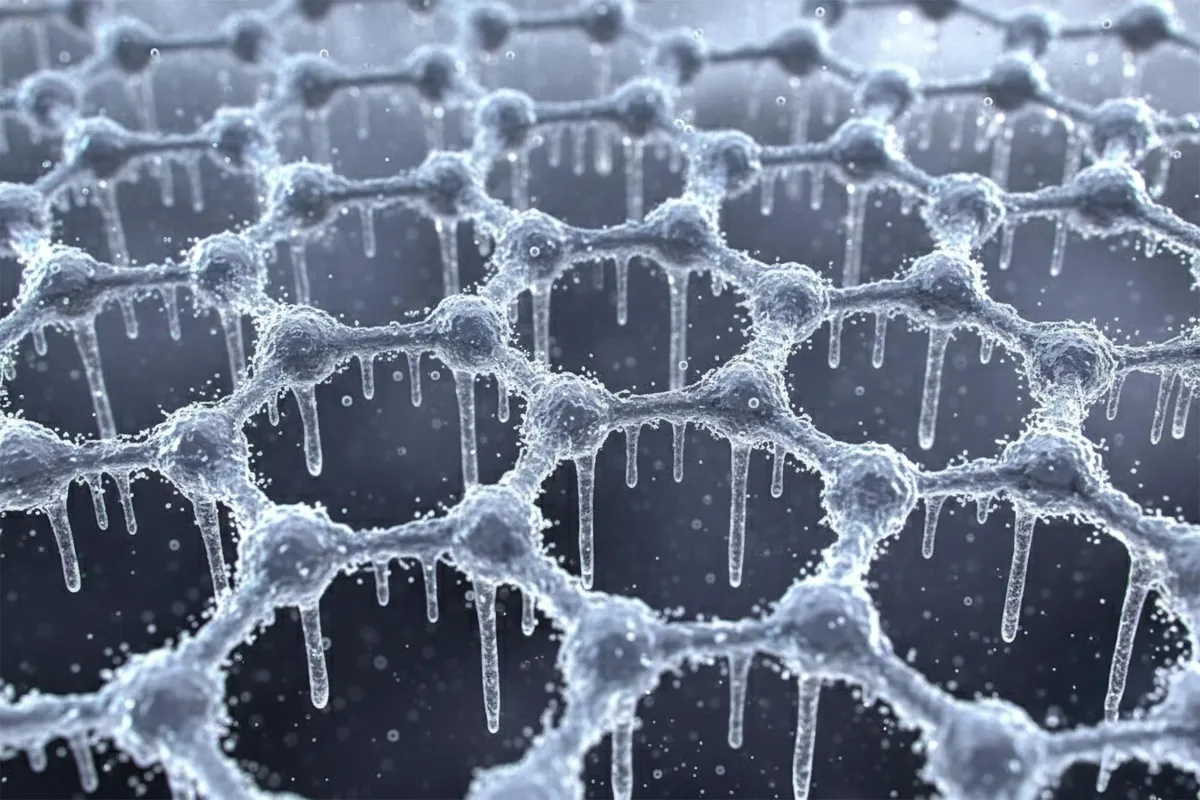
Cory Dean's team solved this by abandoning helium entirely. Instead, they worked with graphene—a single layer of carbon atoms—and created what are called excitons. These are quasiparticles that form when two sheets of graphene are stacked and manipulated so one has extra electrons and the other has "holes" (the gaps left behind when electrons move). Electrons and holes attract each other, combining into excitons. Add a strong magnetic field, and these excitons can form a superfluid.
When the researchers cooled their exciton system and decreased its density, something unexpected happened. The superfluid stopped moving and became an insulator. Raise the temperature, and the superfluid returned. It was a phase transition running backward—the opposite of what physicists usually see.
Why This Matters
The finding suggests that the low-temperature phase is indeed a supersolid, though the team can't yet directly measure it. "Our ability to interrogate insulators stops a little," Dean explained. "We're exploring the boundaries around this insulating state, while building new tools to measure it directly."
The practical implications are significant. Excitons are thousands of times lighter than helium atoms, which means supersolids and superfluids made from them could exist at much higher temperatures—potentially without needing the strong magnetic fields required in this experiment. That opens a door to quantum states that might actually be usable, rather than existing only in laboratories cooled to near absolute zero.
The team is now investigating other layered materials that might stabilize these exotic quantum phases even further. After five decades of searching, the supersolid is no longer just a theoretical curiosity. It's becoming something physicists can actually hold in their hands and study.