For three years, astronomers have been puzzled by strange radio signals arriving from space in slow, rhythmic bursts — some repeating every few minutes, others every few hours. A new study published in Nature Astronomy suggests they've finally figured out what's sending them.
These signals, called long-period transients, were first spotted in 2022. They're faint enough that they could easily be missed, yet persistent enough to catch attention when they do appear. The mystery wasn't just that they existed — it was why they behaved so strangely, arriving in patterns that seemed almost deliberate.
The White Dwarf Connection
The answer might lie in the cosmic leftovers of dead stars. White dwarfs — the dense, Earth-sized remnants left behind when stars like our sun die — have been known to emit radio pulses when they're spinning rapidly. But those are the fast ones, discovered back in 2016. What if the slow radio pulses were something different: white dwarfs spinning more lazily, paired with a companion star in a tight orbital dance.
We're a new kind of news feed.
Regular news is designed to drain you. We're a non-profit built to restore you. Every story we publish is scored for impact, progress, and hope.
Start Your News DetoxThat's where GPM J1839-10 comes in. Discovered in 2023, this long-period transient has a 21-minute pulse cycle and something remarkable in its history: radio data stretching back to 1988. For decades, it's been sending the same message to Earth, and astronomers only just realized they were listening.
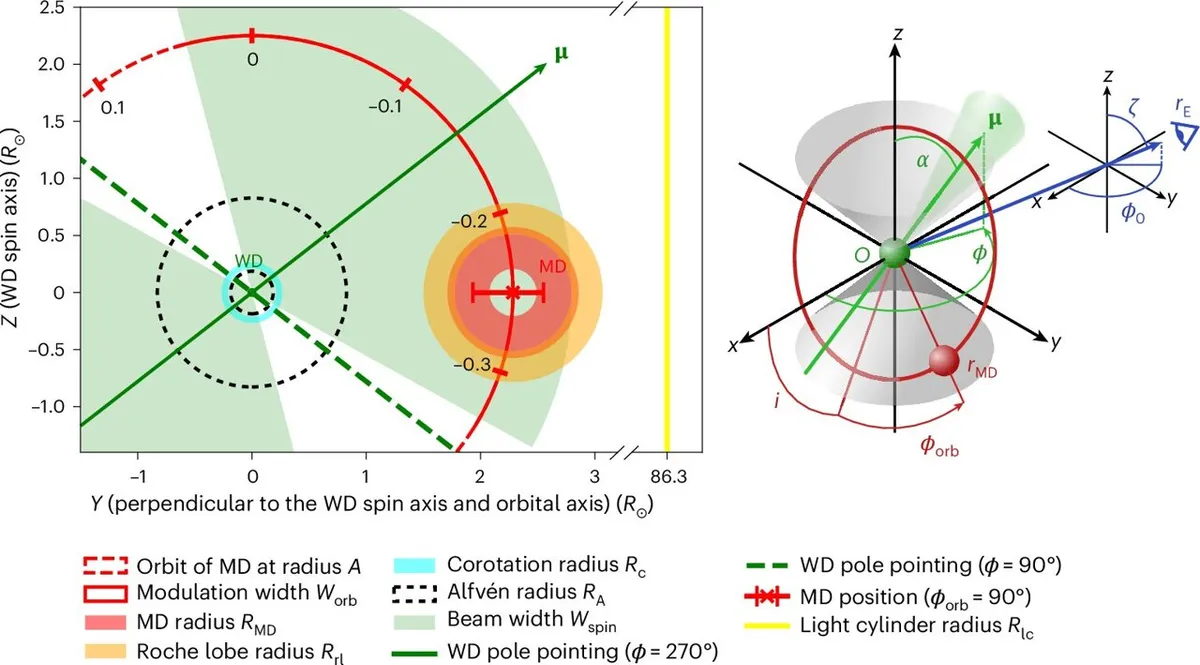
When researchers dug into the pattern, they found it wasn't random at all. The pulses arrive in groups of four or five, those groups come in pairs separated by two hours, and the whole sequence repeats every nine hours. That kind of mathematical precision doesn't happen by accident — it's the signature of two objects orbiting each other.
The researchers modeled what they were seeing: a white dwarf with a strong magnetic field, sweeping a beam of radio waves through the stellar wind of its companion star. As the two stars orbit, their alignment with Earth changes constantly. Sometimes the beam points toward us, sometimes away. The result is exactly the heartbeat pattern they observed in the data.
Other astronomers have already tested this model against optical observations — the light coming from the system — and found the same periodic variations the radio model predicted. That's the kind of cross-confirmation that turns a good idea into something closer to truth.
GPM J1839-10 might be the missing link that connects these slow radio pulses to the faster white dwarf pulsars discovered years earlier. It's not the whole story yet — researchers still need to understand the detailed physics of how the emission works, and how all the different long-period transients fit into the bigger picture. But it's the kind of breakthrough that transforms a puzzle into a solvable problem.