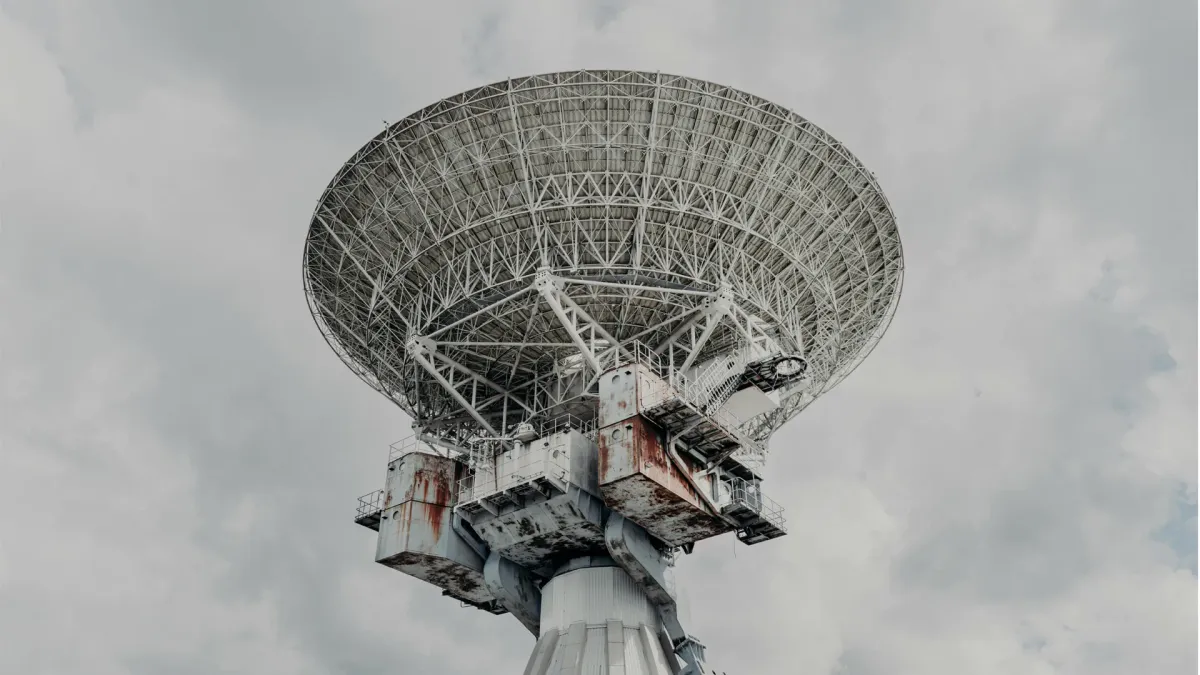
Astronomers are finding gold in old data. By reprocessing radio telescope observations collected years ago, researchers have uncovered short bursts of radio activity from nearby stars and their orbiting planets—signals that were hiding in plain sight all along.
The discovery matters because it offers a new way to study something we've never been able to measure directly: the magnetic fields of distant planets. These fields shape how planets evolve and shield them from stellar radiation, but they've remained stubbornly invisible. Until now, we've had to infer them indirectly. This new technique changes that.
A New Way to See Time
Radio telescopes like LOFAR collect enormous amounts of data, scanning wide sections of sky. But traditional analysis methods compress all that information into static images—useful for mapping distant cosmic structures, but useless for tracking how radio signals flicker and pulse over seconds and minutes.
We're a new kind of news feed.
Regular news is designed to drain you. We're a non-profit built to restore you. Every story we publish is scored for impact, progress, and hope.
Start Your News DetoxA research team developed a technique called Multiplexed Interferometric Radio Spectroscopy (RIMS) that preserves these rapid changes. Instead of flattening the data into snapshots, RIMS tracks how radio emission shifts moment by moment, and from which direction it's coming. This allows scientists to monitor many stars simultaneously, watching for the brief, intense bursts that reveal something unusual happening.
When the team applied RIMS to over 1.4 years of LOFAR observations, they extracted around 200,000 time-resolved radio spectra from nearby stars and exoplanet systems. What emerged was striking: intense radio bursts tied to extreme stellar activity—the kind of violent eruptions we see on the Sun, but happening on distant stars. Some bursts showed strong circular polarization, a signature of magnetic processes at work.
A Planet's Magnetic Fingerprint
Here's where it gets interesting. Several of these bursts matched what theory predicts should happen when a close-orbiting planet disturbs a star's magnetic field. The exoplanet system GJ 687 showed particularly compelling signals.
"Our results indicate that some of the radio bursts, most notably from the exoplanetary system GJ 687, are consistent with a close-in planet disturbing the stellar magnetic field and driving intense radio emission," said study author Jake Turner.
If confirmed, this would be a breakthrough. Magnetic fields are fundamental to how planets evolve and shield themselves from stellar radiation, yet they've been nearly impossible to study for distant worlds. Radio signals offer a practical workaround—an indirect but powerful way to probe planetary magnetism across many systems at once.
The caution, though, is real. Stars themselves generate powerful radio bursts through their own activity. Separating what a planet does from what the star does on its own requires careful follow-up observations. Turner and his team are now pursuing targeted observations to confirm whether these signals truly come from planetary interactions or from stellar behavior alone.
"A confirmed detection would provide a powerful new way to probe an exoplanet's magnetic field," Turner said.
The work, published in Nature Astronomy, illustrates something deeper: astronomy's data archives hold discoveries we haven't found yet. The tools to see them are often already in hand—we just need to know how to look.