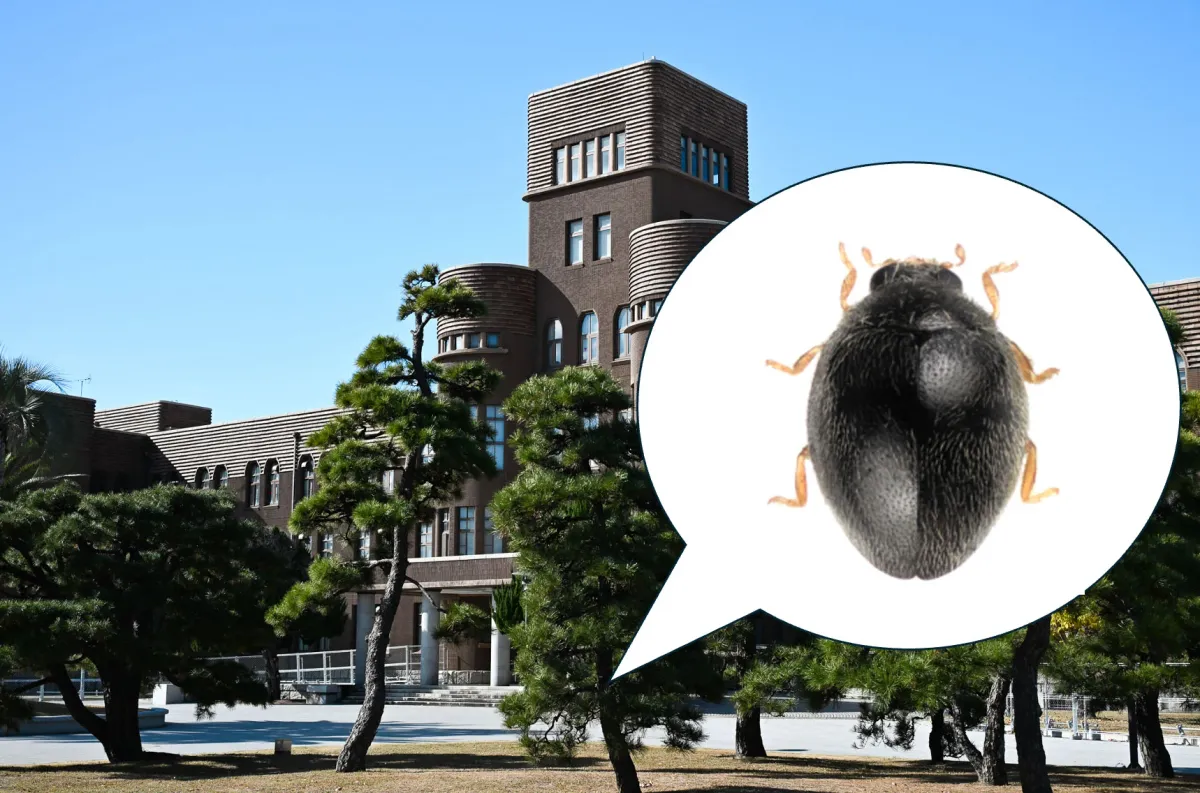
A new beetle species was found on a pine tree at Kyushu University in Japan. This discovery led to the first major update in Japanese ladybird classification in 50 years.
Researchers identified the previously unknown ladybird beetle, named Parastethorus pinicola, on Japanese black pine trees at the university’s Hakozaki Satellite campus. This shows that new biodiversity can still be found in familiar places.
The finding was published in Acta Entomologica Musei Nationalis Pragae. It came from a three-year study to reclassify the Stethorini tribe, a group of tiny ladybirds that eat spider mites. This is the first big update for this group in Japan in over five decades.
We're a new kind of news feed.
Regular news is designed to drain you. We're a non-profit built to restore you. Every story we publish is scored for impact, progress, and hope.
Start Your News DetoxRyōta Seki, a PhD student and lead author, explained that he looked on pine trees because these ladybirds often live there. He found the new species on campus. He noted that insect collectors usually don't focus on pine trees, which might be why this tiny beetle was overlooked for so long.
Parastethorus pinicola is named for its pine habitat. It is very small, just over one millimeter long, and looks like a tiny black insect that's easy to miss.
Discovery Leads to Classification Changes
Seki noted that these small black ladybirds are hard to study because they are difficult to identify. They are barely larger than a grain of sand and look alike. Telling them apart requires dissecting them and examining their reproductive organs under a microscope. This difficulty led to many past misidentifications.
To fix these classification issues, the researchers looked at about 1,700 specimens. Their detailed work showed that the species known in Japan as Stethorus japonicus is actually the same as Stethorus siphonulus. This latter species is found across a wide area from China to Southeast Asia.
During their review, the team also found another new species from Hokkaido, which they named Stethorus takakoae. Seki named it after his grandmother, Takako Ōtsuki, who encouraged his interest in insects.
Seki explained that standardizing these names helps share data and research with other Asian countries. It clarifies that this is a widespread species found from tropical to temperate Japan.
Hidden Biodiversity All Around Us
Associate Professor Munetoshi Maruyama, who oversaw the research, said the findings show how much remains undiscovered, even in everyday places.
Maruyama noted that people rarely notice such small insects. However, the study proved that unknown species live right beside us, even in cities or on university campuses. These "minor" insects support our ecosystems. He hopes this discovery will make people interested in the diverse world that exists unnoticed at our feet.
Deep Dive & References
Review of the genera Stethorus and Parastethorus from Japan (Coleoptera: Coccinellidae) - Acta Entomologica Musei Nationalis Pragae, 2025