A gentler way to engineer quantum materials
Physicists have figured out how to temporarily reshape materials by working with their own quantum rhythms instead of blasting them with powerful lasers. The breakthrough comes from using excitons — short-lived energy pairs that naturally form inside semiconductors — to nudge electrons into new configurations. The result: powerful quantum effects with a fraction of the energy, and without damaging the material in the process.
For years, one of the biggest barriers to practical quantum material engineering has been the sheer intensity required. Getting the job done meant hitting materials with extreme light frequencies — so intense that the material itself often vaporized before the effect took hold. It's like trying to reshape a piece of metal by setting it on fire rather than carefully heating it.
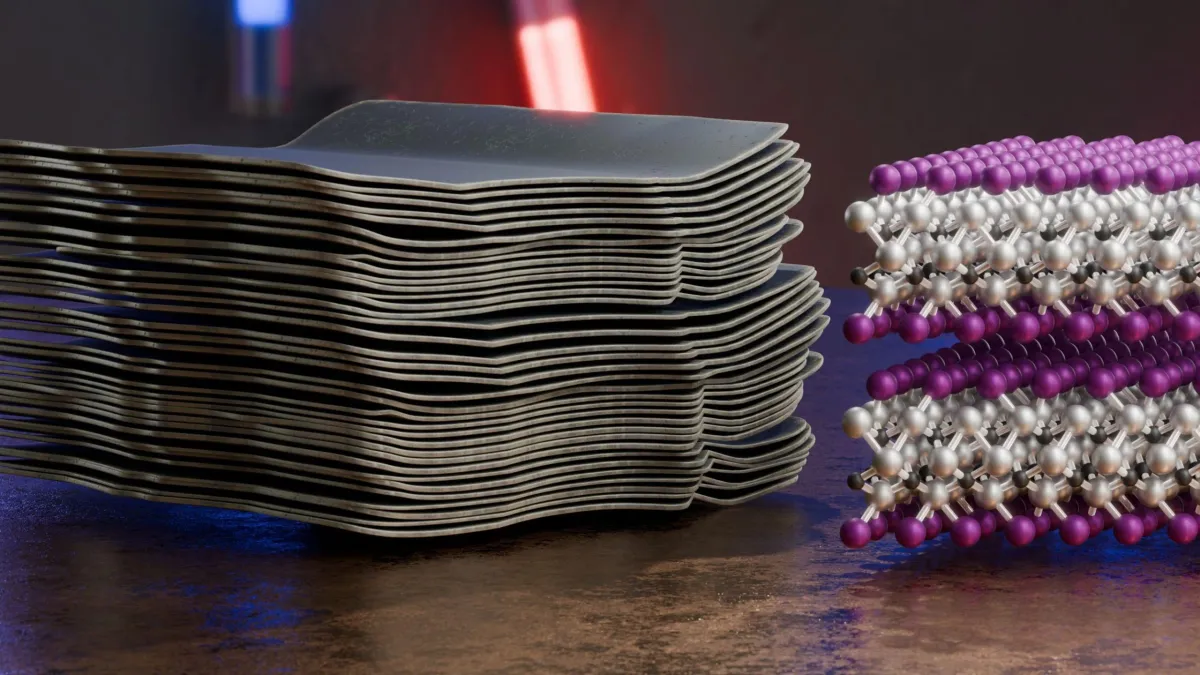
A team led by the Okinawa Institute of Science and Technology and Stanford University has now shown that there's a better path. Instead of relying on external light alone, they're harnessing excitons: pairs of electrons and electron-shaped holes that form naturally when a material absorbs energy. Because excitons originate from within the material itself, they interact far more strongly with its structure than light does. Think of it as using the material's own internal rhythm to guide change, rather than imposing change from outside.
We're a new kind of news feed.
Regular news is designed to drain you. We're a non-profit built to restore you. Every story we publish is scored for impact, progress, and hope.
Start Your News DetoxWhy this matters at the quantum level
The technique taps into something called Floquet engineering — a principle that works like this: when a system experiences a repeating influence, its response becomes more complex than the repetition itself. In quantum materials, electrons already sit within a repeating crystal lattice. When you introduce a second repeating influence (traditionally, light at a specific frequency), the allowed energy bands where electrons can exist shift and change.
By carefully tuning this periodic drive, you can temporarily create new hybrid energy bands — essentially giving electrons access to energy states they normally couldn't occupy. This reshapes how electrons move and interact, which alters the material's overall properties. It's a way to design quantum materials on demand, without having to synthesize entirely new compounds.
The problem, until now, has been energy efficiency. "Light couples weakly to matter," explains Xing Zhu, a PhD student at OIST. "You need very high frequencies — often at the femtosecond scale — to achieve the effect." That intensity tends to destroy the material. Excitons, by contrast, couple much more strongly to the material because they're made from the material's own electrons. The researchers found they can achieve the same Floquet effects with dramatically lower light intensities.
"Excitons carry self-oscillating energy," says co-author Professor Gianluca Stefanucci, "which impacts surrounding electrons at tunable frequencies." Because they originate from the material itself, they interact much more powerfully than external photons do. And crucially: it takes significantly less light to create enough excitons to drive the effect.
What comes next
The findings open a door that's been locked for years. Floquet effects aren't limited to light-based techniques anymore — they can be generated using other particles too. The team has identified the spectral signature needed to make this work in practice, which means the first real-world steps toward designing and manipulating quantum materials are now within reach. The recipe isn't complete yet, but for the first time, scientists have the tools to start writing it.