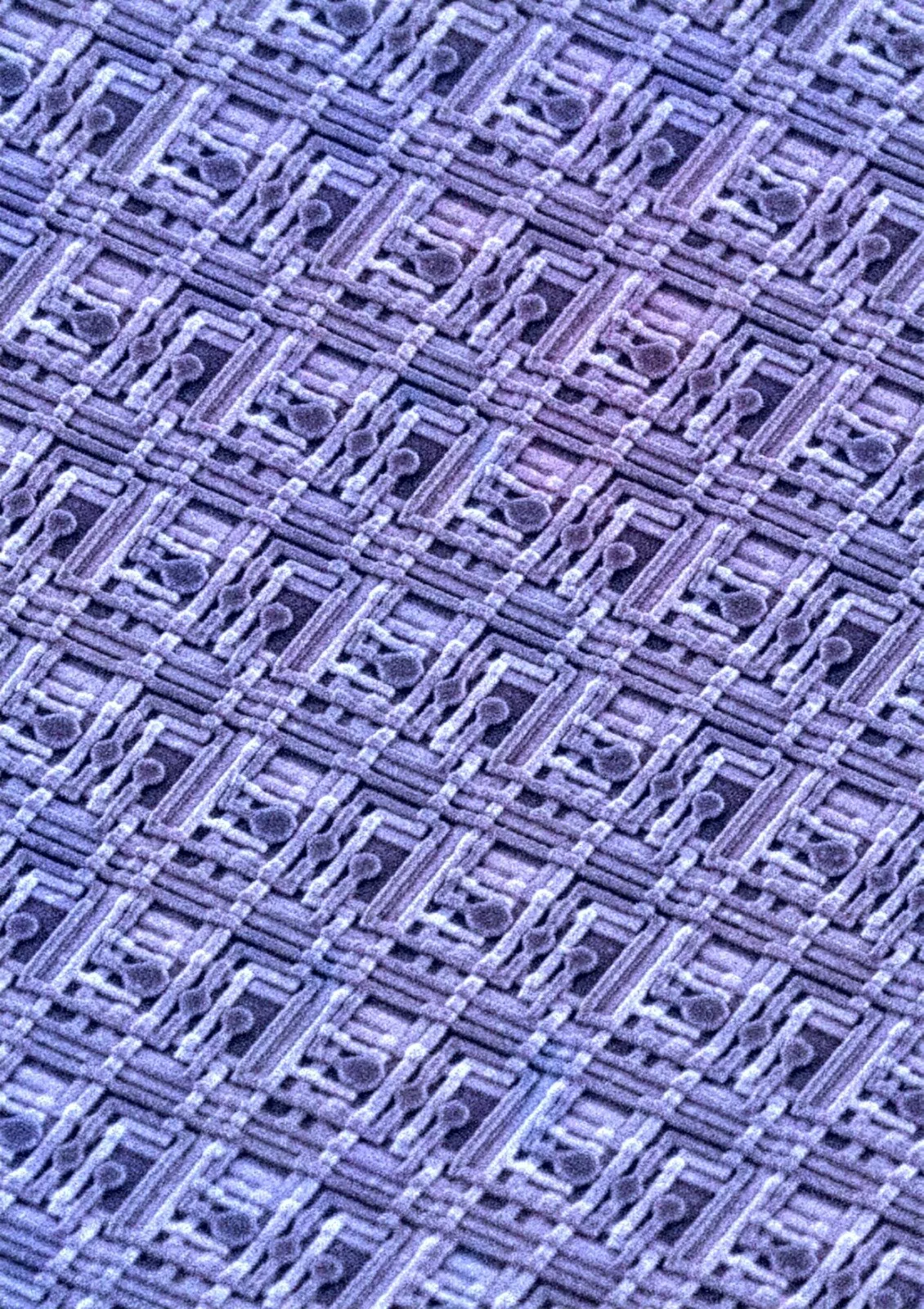
Researchers have figured out how to build tiny objects inside a living cell—and have the cell survive the process, keep dividing, and pass the structure to its offspring.
The technique, published in Advanced Materials, works like this: inject a cell with a light-sensitive material, hit it with a precisely tuned laser, and the material hardens into a custom shape. The team has already printed barcodes, geometric patterns, and even a microscopic elephant inside individual cells. Each structure measures just a few micrometers across—small enough that you'd need a powerful microscope to see it.
What makes this genuinely significant is that the cells don't just survive the process. They keep living, keep dividing, and pass the printed structure on to their daughter cells. That wasn't guaranteed. Most attempts to manipulate cells from the inside damage them irreparably.
We're a new kind of news feed.
Regular news is designed to drain you. We're a non-profit built to restore you. Every story we publish is scored for impact, progress, and hope.
Start Your News Detox"Our method provides a new tool to manipulate living cells from the inside, enabling a new approach to studying their mechanical and biological responses," says Maruša Mur, Ph.D., from the Jožef Stefan Institute in Slovenia, one of the researchers behind the work.
Right now, printing a tiny elephant inside a cell is mostly proof of concept—a way of showing the technique works and can handle complex shapes. But the real applications are starting to come into focus. Imagine printing microscopic sensors or machines directly into cells to monitor what's happening at the biological level in real time. Or engineering cells with entirely new properties by building structures that change how they respond to their environment. This could open new doors for understanding disease, designing better therapies, or even creating cells that do things nature didn't originally equip them to do.
The research is still early. The team has demonstrated the core principle works, but scaling it up, making it faster, and figuring out which real-world problems it actually solves—that's the work ahead. But for the first time, we have a working method to build from inside a living cell without killing it. That's the kind of tool that tends to change what researchers can ask.