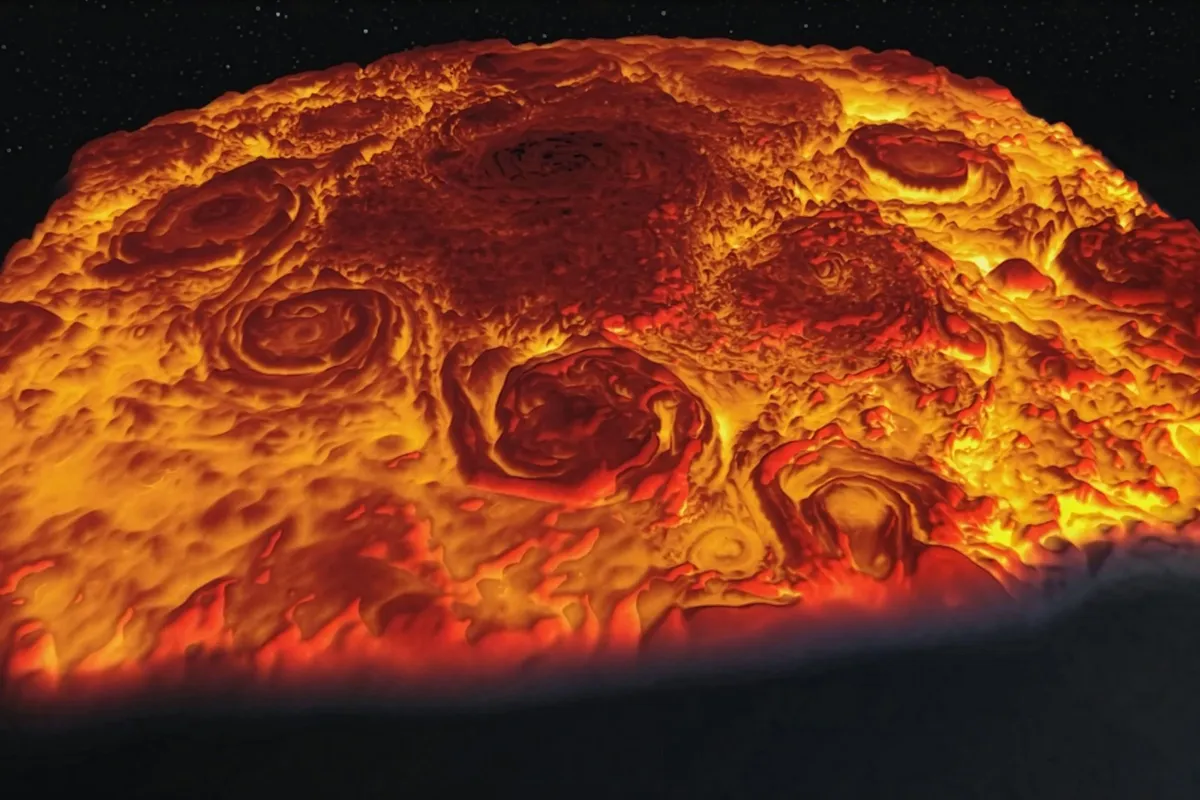
Jupiter and Saturn are cosmic twins — similar size, similar composition, both gas giants spinning in the outer solar system. Yet their poles tell wildly different stories. Saturn's north pole hosts a single enormous storm traced in a perfect hexagon. Jupiter's looks like a tightly packed cluster: one central vortex ringed by eight smaller ones, all jostling for space.
For years, scientists couldn't explain why two nearly identical planets would arrange their most violent weather so differently. Now, a team at MIT thinks they've found the answer — and it points to something hidden far below the clouds.
What's Happening Below the Surface
Using computer simulations, researchers watched how vortex patterns form and stabilize on gas giants. The breakthrough came when they realized the answer wasn't about what's visible from above. It was about what's underneath.
We're a new kind of news feed.
Regular news is designed to drain you. We're a non-profit built to restore you. Every story we publish is scored for impact, progress, and hope.
Start Your News DetoxThink of each polar storm as a spinning cylinder that extends deep into the planet's atmosphere and beyond. The key variable is what the researchers call the "softness" of a vortex's base — essentially, how dense and rigid the material is where the storm's roots sit. If that material is soft and light, a vortex hits a natural size limit. Multiple storms can coexist because none of them can grow large enough to consume the others. If the base is harder and denser, a single vortex can expand far more, eventually swallowing its neighbors until one massive system dominates.
"Our study shows that depending on the interior properties and the softness of the bottom of the vortex, this will influence the kind of fluid pattern you observe at the surface," says Wanying Kang, an assistant professor in MIT's Department of Earth, Atmospheric and Planetary Sciences. "One possible scenario could be that Saturn has a harder bottom than Jupiter."
The implication is striking: Saturn's interior may be more metal-enriched and denser than Jupiter's, providing stronger support for that singular hexagonal storm. Jupiter's softer interior allows multiple smaller vortices to maintain their independence.
Reading a Planet's Interior from Its Weather
This connection between deep interior structure and surface weather patterns opens a new way to understand these distant worlds. Spacecraft like NASA's Juno (orbiting Jupiter) and the now-retired Cassini (which studied Saturn) have captured stunning images of polar storms, but they can't directly measure what's happening thousands of kilometers below the clouds. Now those images themselves might tell that story.
The geometry and arrangement of polar storms could act as a window into a planet's interior composition — revealing how much metal-enriched material exists beneath the visible atmosphere, and how that material is layered. For gas giants we can't drill into or probe directly, that's invaluable information.
The research, published in the Proceedings of the National Academy of Sciences, suggests that the next time we look at Jupiter's chaotic polar cluster or Saturn's eerily perfect hexagon, we're not just seeing weather. We're seeing a fingerprint of what the planet is made of, deep down.