A new AI-powered model is helping scientists understand how complex magnetic patterns affect energy loss in electric motors. This breakthrough could make electric vehicles (EVs) more efficient.
Understanding Energy Loss in EVs
Electric motors lose energy, partly due to "iron loss" or "magnetic hysteresis loss." This happens when magnetic fields inside the motor's core constantly flip directions. The core is made of soft magnetic materials.
High temperatures can also weaken magnetism and make energy loss harder to control. The way tiny magnetic regions, called magnetic domains, are arranged in these materials greatly influences how they react to heat and how much energy they lose.
We're a new kind of news feed.
Regular news is designed to drain you. We're a non-profit built to restore you. Every story we publish is scored for impact, progress, and hope.
Start Your News DetoxSome soft magnetic materials have complex zig-zag patterns called maze domains. These patterns change with temperature, which affects energy loss. However, these structures are hard to study because many factors are involved, like the material's internal structure, heat effects, and overall energy stability.
A New Way to Model Magnetism
To tackle this, a team from the Tokyo University of Science, along with researchers from the University of Tsukuba, Okayama University, and Kyoto University, created a new model. It's called the entropy-feature-eXtended Ginzburg-Landau (eX-GL) framework.
Professor Masato Kotsugi explained that older simulations were too simple, and experiments showed complexity without explaining the causes. He noted that their new model uses physics and explainable AI to show how magnetization changes with temperature.
Their findings were published in Scientific Reports.
From Images to Energy Insights
The team took microscopic images of magnetic domains in a rare-earth iron garnet (RIG) at different temperatures. These images were fed into the eX-GL model.
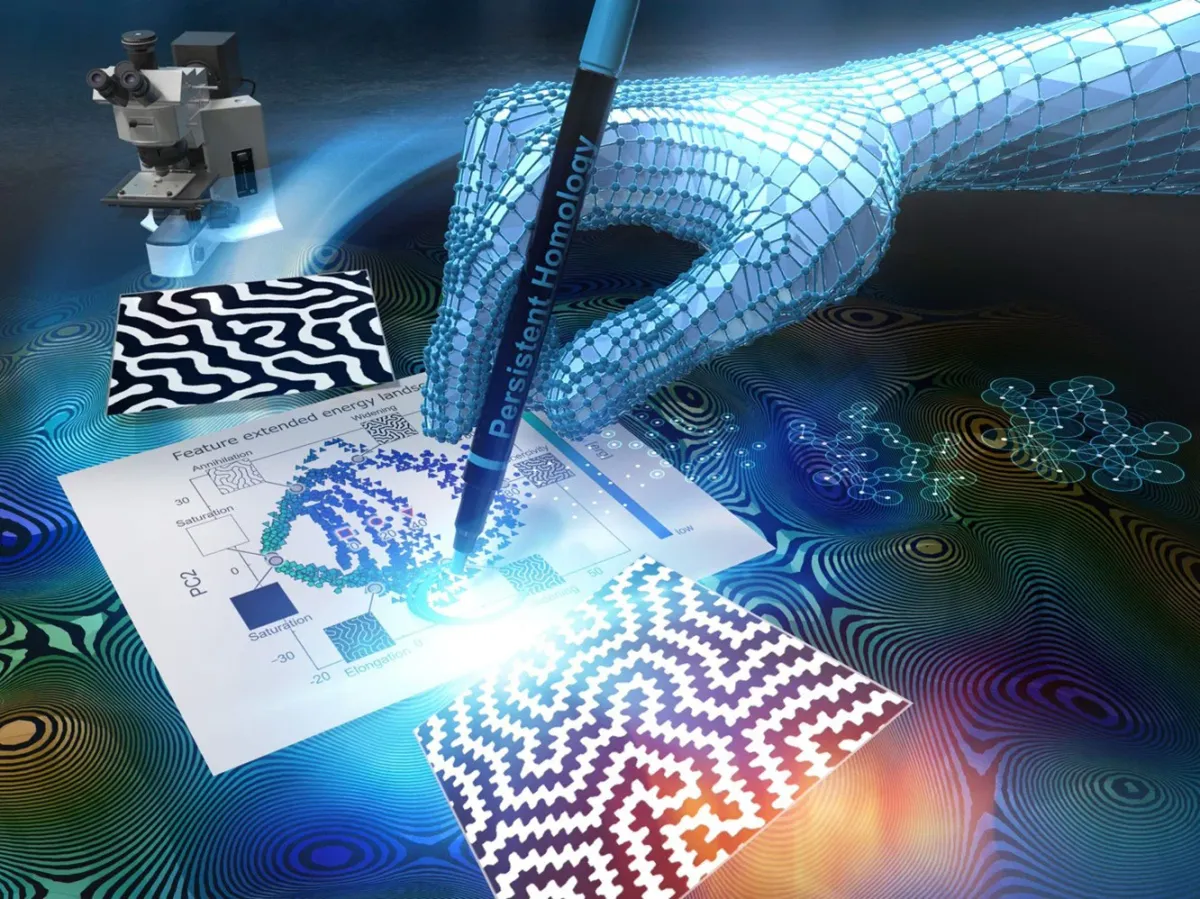
First, a method called persistent homology (PH) found patterns in the domain images. Then, machine learning highlighted the most important features. This information helped build a digital map of energy changes, showing how domain structures evolve.
Finally, mathematical analysis linked these tiny patterns to the larger magnetic behavior.
Key Discoveries and Energy Barriers
The researchers found a key feature, called PC1, that shows how magnetization reverses. By connecting PC1 to physical properties, they identified four main energy barriers that control these changes.
They studied how different types of energy interact during this process, measuring how energy moves between exchange interactions, demagnetizing effects, and entropy.
They also discovered that longer domain walls create more complex maze patterns. This is due to the interaction between entropy and exchange forces. These insights help explain how maze domains behave when magnetization reverses.
Professor Kotsugi stated that their eX-GL method automatically explains complex magnetization reversal and uncovers hidden mechanisms that are hard to see with traditional methods. He added that because free energy is a universal measure, their model can be used for other similar systems.
This study offers a clearer understanding of maze domains and provides a broader way to study complex energy landscapes in magnetic and other physical systems.
Deep Dive & References
Explainable analysis of the complex maze magnetic domain structure through extension of the Landau free energy model by adding an entropy feature - Scientific Reports, 2026