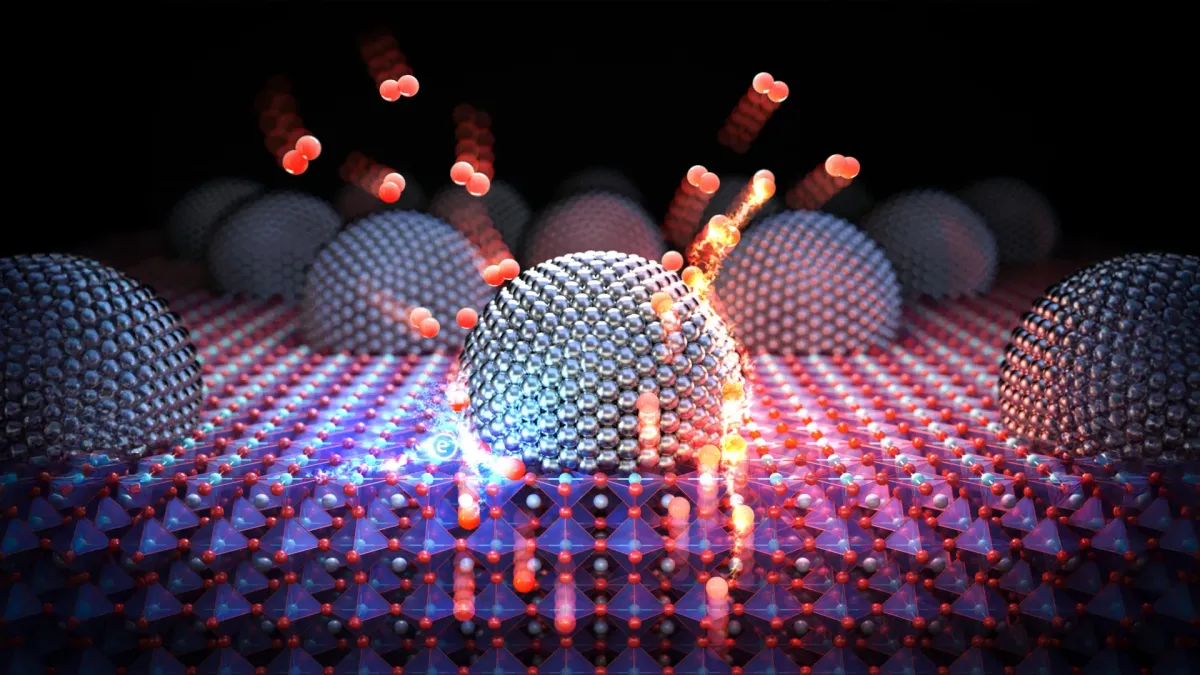
Researchers have found that silver (Ag) nanocatalysts can change where they work depending on what a solid oxide cell is doing. This discovery could lead to better designs for these energy devices. They could make electricity generation more efficient and green hydrogen production less energy-intensive.
The study was led by Professors WooChul Jung and Jeong Woo Han at Seoul National University (SNU). They worked with Professor Sang Ouk Kim's team at KAIST and Dr. Beomgyun Jeong's team at the Korea Basic Science Institute (KBSI). Their findings were published in Energy & Environmental Science.
How Solid Oxide Cells Work
Solid oxide cells use a solid material to move oxygen ions. This allows them to do two things: generate electricity or split water to make hydrogen.
We're a new kind of news feed.
Regular news is designed to drain you. We're a non-profit built to restore you. Every story we publish is scored for impact, progress, and hope.
Start Your News DetoxThis flexibility makes them important for clean energy and hydrogen use. They could be used in buildings and factories to make electricity and heat. They could also help produce green hydrogen from renewable energy.
Finding Where Catalysts Act
The speed of oxygen reactions at the air electrode affects how well solid oxide cells work and how long they last. But real electrodes are complex, making it hard to see exactly how nanocatalysts help.
Previous research showed that metal nanocatalysts improve these cells. However, it was unclear if the activity happened on the catalyst surface or where the catalyst met the electrode. Also, researchers didn't know if the same process worked for both electricity and hydrogen production.
To find answers, the team built a simple model electrode. It had metal nanoparticles of the same size and spacing in an organized pattern. This allowed them to study the catalysts more precisely.
They tested several metal nanocatalysts, including silver, cobalt, palladium, and platinum. Silver showed the most improvement in speeding up oxygen reactions.
Silver's Shifting Reaction Sites
The researchers then changed the size and arrangement of the silver nanoparticles. They wanted to see where the main reactions took place.
When the cell generated electricity (oxygen reduction reaction), faster reactions happened when the boundary between silver nanoparticles and the electrode was longer. This means the interface between silver and the electrode was the main reaction site.
But when the cell produced hydrogen (oxygen evolution reaction), reaction rates increased with the surface area of the silver nanoparticles. This showed that the surface of the silver particles themselves became the main reaction site for hydrogen production.
So, the same nanocatalyst can perform its key chemistry in two different places, depending on how the energy device is operating.
The team also adjusted voltage and oxygen concentration. They found that during electricity generation, silver nanocatalysts help transfer electrons to oxygen. During hydrogen production, silver helps oxygen atoms combine into molecules and then release them.
A Closer Look at the Atomic Mechanism
The team used advanced analysis and atomic-scale calculations. They watched changes on the electrode surface while the system was running.
The results showed that silver nanocatalysts change the electronic structure of the electrode surface. This favors oxygen reduction. For oxygen evolution, they create conditions that help oxygen atoms join together.
These observations explain why the catalyst acts differently when the cell makes electricity versus hydrogen.
A New Strategy for Clean Energy Catalysts
These findings suggest that nanocatalysts are more than just additives. Their active locations and how they work can change with the energy system's mode.
This insight offers a new way to design solid oxide cells. Instead of optimizing the catalyst as one part, researchers could improve performance by separately designing the catalyst surface and the catalyst-electrode interface. This applies to air electrodes for both fuel cells and electrolysis cells.
If put into practice, this could make electricity generation more efficient in buildings and factories. It could also reduce the electricity needed for green hydrogen production.
This approach could also help develop reversible solid oxide cells. These cells can both generate electricity and produce hydrogen. Such devices could lead to more efficient energy production and storage in homes and industries.
A Platform for Studying Other Catalysts
The model electrode developed by the researchers can also be used to study other catalysts. It helps identify where catalysts work and how they function in real energy systems.
This platform could be useful for hydrogen production devices, other electrochemical energy technologies, and oxygen separation systems.
Professor WooChul Jung said, "This research is significant because it quantitatively evaluates the performance of nanocatalysts while also identifying their actual reaction sites and operating mechanisms."
He added, "We plan to further establish this as a new design principle that can be applied to various energy conversion materials and catalytic systems."
Dr. Jinwook Kim, who led the research, will continue studying nanocatalysts and solid oxide cells. He aims to develop high-efficiency energy conversion materials and devices.
Deep Dive & References
Quantitative electrochemical evaluation of metal nanocatalysts for oxygen exchange on solid oxide cell electrodes - Energy, 2026