Turns out, your ancestors weren't just doodling on ostrich eggshells 60,000 years ago. They were, in fact, laying down some surprisingly sophisticated geometric patterns. Think less 'cave drawing' and more 'blueprint for a really tiny, egg-shaped house.'
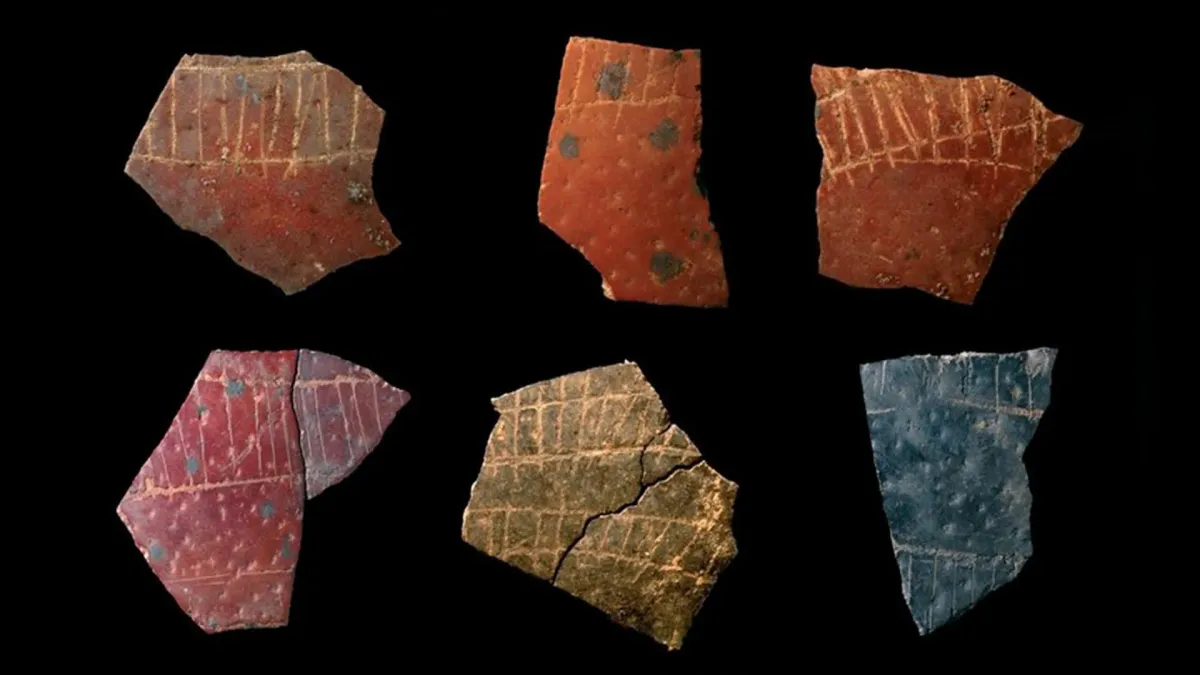
Archaeologists have been unearthing these engraved fragments for years across southern Africa, remnants from early Homo sapiens who likely used the shells to carry water. But a new study from the University of Bologna took a closer look, and what they found wasn't just lines — it was logic.
These ancient artisans weren't just scratching randomly. They were employing parallel lines, right angles, and repeating motifs. Imagine the kind of visual planning that goes into a complex quilt, but done on a curved, fragile surface, tens of thousands of years before anyone invented the protractor. "These signs show a structured, geometric way of thinking," noted Silvia Ferrara, who led the study. "It was like an early visual grammar."
We're a new kind of news feed.
Regular news is designed to drain you. We're a non-profit built to restore you. Every story we publish is scored for impact, progress, and hope.
Start Your News DetoxThe Original Graphic Designers
The research team analyzed 112 fragments from sites in South Africa and Namibia, using fancy geometric and statistical methods (the kind you definitely didn't use in high school geometry class) to map every angle and line. The results? Over 80% of the designs were strikingly consistent.
Angles hovered around 90 degrees, parallel lines abounded, and more intricate patterns like hatched bands and grids showed clear evidence of rotation, repetition, and 'embedding' — basically, building layers of signs within the same design. It suggests they had the entire image planned out in their heads before they even touched the shell. Which, if you think about it, is both impressive and slightly terrifying.
This wasn't just about making pretty patterns. The real takeaway is the mental gymnastics required. The ability to arrange shapes and lines with consistent rules is a huge leap in abstract thought, a critical step in the development of the human mind.
As lead author Valentina Decembrini put it, turning simple forms into complex systems by following rules is a key human trait. It's a trait that, over millennia, evolved from decorating an eggshell to designing skyscrapers, writing novels, and, presumably, figuring out how to assemble IKEA furniture. So next time you see a perfectly parallel line, give a nod to your incredibly organized ancestors.