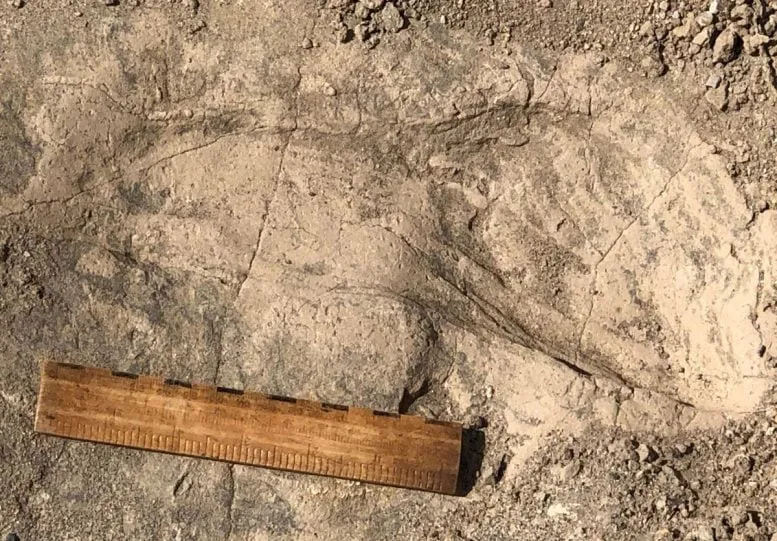
A trail of footprints, 1.4 million years old, shows that a powerful human relative grew almost as large as modern humans. These tracks were found in Kenya and suggest this ancient species may have traveled in groups of mostly males.
Eight individuals walked across wet ground next to an ancient lake. Sediment quickly covered their footprints, preserving the scene for millions of years.
Discovering Ancient Footprints
These tracks offer a rare look at several extinct human relatives moving together. Researchers believe the footprints belong to Paranthropus boisei. This species had strong jaws and lived alongside early humans but eventually died out.
We're a new kind of news feed.
Regular news is designed to drain you. We're a non-profit built to restore you. Every story we publish is scored for impact, progress, and hope.
Start Your News DetoxAll eight individuals seem to have been adults, and most were likely males. Their decision to travel together hints that Paranthropus boisei might have had a more complex social life than previously thought.
The footprints also change what we thought about the species' size. Some individuals were nearly 1.8 meters (5 feet 11 inches) tall and weighed about 75 kilograms (165 pounds). These sizes are similar to many people today.
Kevin Hatala, lead author from Chatham University and the Max Planck Institute, noted that the footprint sizes show human-like body dimensions.
Paranthropus boisei was previously known mostly from skulls, which showed a broad face, huge molars, and strong chewing muscles. This earned it the nickname "Nutcracker Man." Less was known about its body below the neck. Earlier estimates suggested it was smaller than Homo erectus, another human relative living at the same time.
New Insights into an Ancient Species
The new tracks complicate this comparison. Some Paranthropus boisei individuals might have been as tall and heavy as Homo erectus. This is despite their very different skulls, diets, and evolutionary paths.
Researchers identified the footprints as Paranthropus boisei using new methods developed in 2024. This approach compares foot shape and walking patterns to tell different hominin species apart.
Previous work in the same area found footprints from both Paranthropus boisei and Homo erectus on one ancient surface. This showed that both species used the same lakeshore environment and might have met each other.
The newly studied tracks show a different scene: a group of Paranthropus boisei moving together.
Clues to Social Behavior
The lack of young individuals or females is interesting. While footprints can't show exact relationships, this group of mostly adult males suggests a complex social structure.
Neil Roach of Harvard University, a co-author, said that eight mostly adult male Paranthropus boisei traveling together hints at a complex social life. They might have lived in large groups where males competed for mates but also cooperated for safety.
Footprints only record a brief event. Researchers can't know if these individuals always traveled together or just gathered temporarily.
Still, this discovery brings Paranthropus boisei to life. It shows them as upright-walking animals navigating a shared landscape, possibly forming organized groups.
The location of the tracks is also important. Hundreds of hominin footprints have been found at over six sites around East Turkana. This suggests that lakeshores attracted ancient human relatives for more than 100,000 years.
These environments offered water and food but also danger. Large predators and other hominins might have gathered there, making group travel helpful.
Kay Behrensmeyer of the Smithsonian Institution noted the amazing fact that similar lake margin deposits exist 40 kilometers (25 miles) apart at about the same age.
How the Footprints Were Preserved
The footprints survived due to a rare series of events. Hominins walked on soft sediment near the water. Then, new layers covered the surface before wind or animals could destroy the tracks. Over vast time, the sediment hardened, preserving their shapes.
Understanding this process could help researchers find more footprint sites. It could also explain why several hominin species returned to the lake so often.
Behrensmeyer believes that understanding the geological conditions for preservation will reveal more about why hominins kept returning to the lakeshore for over 100,000 years.
Each new surface captures a few moments. Together, they are building a record of movement, body size, habitat use, and social behavior that bones alone could not provide.
Hatala said each site is a snapshot of our past. They are quickly building a "photo album" showing hominin anatomy, movement, behavior, and environments during the Early Pleistocene.
This growing collection is turning the ancient shores of Lake Turkana into a prehistoric record of daily life. The footprints show where extinct human relatives went, how they moved, and who walked beside them.
Deep Dive & References
Insights into hominin body size, locomotion, and behavior from Early Pleistocene trackways in northern Kenya - Proceedings of the National Academy of Sciences, 2026