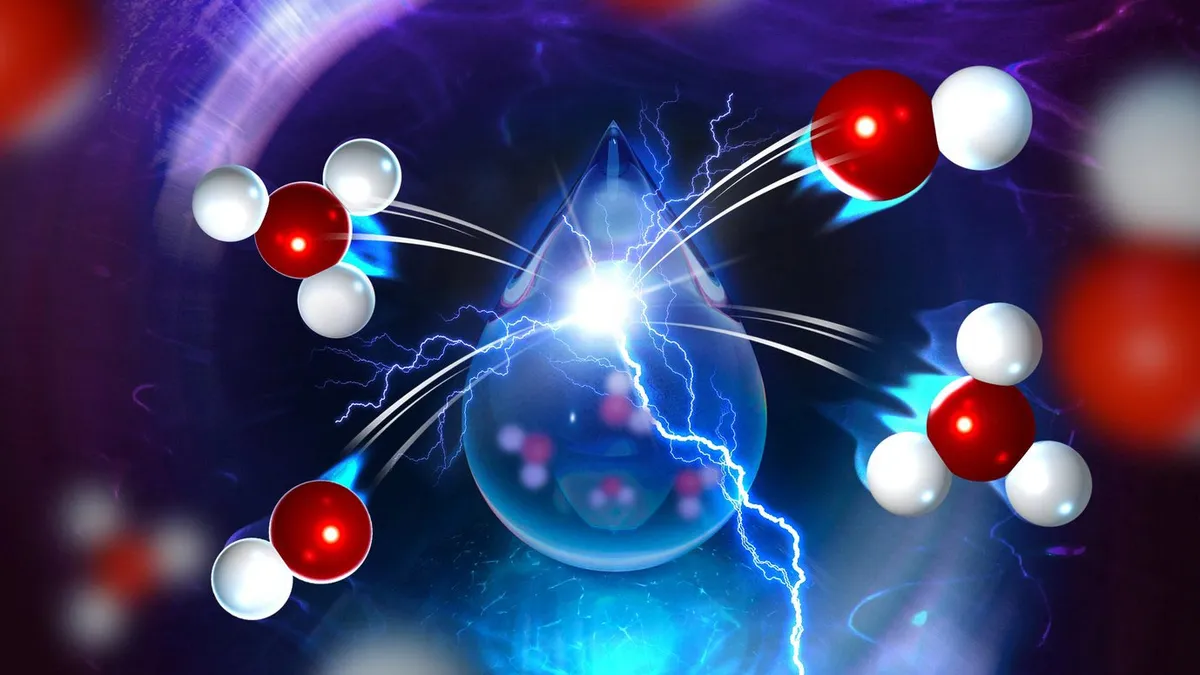
Water doesn't want to split apart. Under normal conditions, it's chemically stubborn—the reaction neither saves energy nor increases disorder, so it almost never happens. But apply a strong electric field, and something unexpected occurs: the rules flip entirely.
Scientists at the Max Planck Institute for Polymer Research and Cambridge University have just figured out why. Using molecular simulations, they discovered that electric fields don't make water splitting easier the way most chemists assumed. Instead, they completely reverse the driving force behind the reaction.
How disorder becomes the driver
At the heart of chemistry are two competing forces: energy and entropy. Reactions happen spontaneously when they either release energy or increase disorder in the system. Water autodissociation—the splitting of H₂O into hydrogen and hydroxide ions—normally fails on both counts. It requires energy input and creates more order, not less. So it stays locked down.
We're a new kind of news feed.
Regular news is designed to drain you. We're a non-profit built to restore you. Every story we publish is scored for impact, progress, and hope.
Start Your News DetoxBut strong electric fields rewrite this story. The field initially forces water molecules into a highly structured arrangement, like soldiers snapping to attention. When ions form and break apart, they shatter this imposed order. That increase in disorder—entropy—is exactly what drives the reaction forward. As Yair Litman, group leader at the Max Planck Institute, puts it: "It's a complete reversal of what happens at zero field. Instead of entropy resisting the reaction, it now promotes it."
The team's findings, published in the Journal of the American Chemical Society, overturn a long-held assumption that energy alone controlled water dissociation under electric fields. The implications ripple outward immediately. The research shows that under strong fields, water's pH can plummet from neutral (7) to highly acidic (as low as 3)—something that changes how we need to design and understand electrochemical systems.
This matters because water splitting is central to the hydrogen economy taking shape right now. If we're going to scale up green hydrogen production—using renewable electricity to split water into fuel—we need to understand exactly what's happening at the molecular level. Better understanding means better catalyst design, more efficient devices, and a clearer path to making hydrogen a practical energy carrier.
Angelos Michaelides, co-author of the study, sees the shift in thinking as fundamental: "To understand and improve water-splitting devices, we need to consider not just energy, but entropy—and how electric fields reshape the molecular landscape of water." That's the kind of insight that doesn't immediately change the world, but it quietly reshapes what engineers and chemists try to build next.