An international team of scientists has found a new way a rare plant makes food. This discovery could help researchers make crops like wheat and rice grow much better. They could convert sunlight into food more efficiently.
The research was led by scientists at the Boyce Thompson Institute (BTI), Cornell University, and the University of Edinburgh. It focuses on Rubisco, an enzyme that captures carbon dioxide from the air during photosynthesis.
Rubisco's Flaw and a Plant's Solution
Rubisco is vital for life on Earth, but it has a big problem. The enzyme works slowly. It can also react with oxygen instead of carbon dioxide. This wastes energy and makes plants grow less effectively.
We're a new kind of news feed.
Regular news is designed to drain you. We're a non-profit built to restore you. Every story we publish is scored for impact, progress, and hope.
Start Your News DetoxFay-Wei Li, a BTI Associate Professor and co-leader of the research, called Rubisco "arguably the most important enzyme on the planet." He noted its slowness and how oxygen distracts it, which limits plant growth.
Some organisms have found ways to fix this. Many types of algae, for example, put Rubisco inside small cell structures called pyrenoids. These tiny compartments gather carbon dioxide around the enzyme, making it work better.
Scientists have long wanted to put this system into food crops, which do not have pyrenoids. But moving the complex parts from algae to land plants has been very hard.
Hornworts Show a New Trick
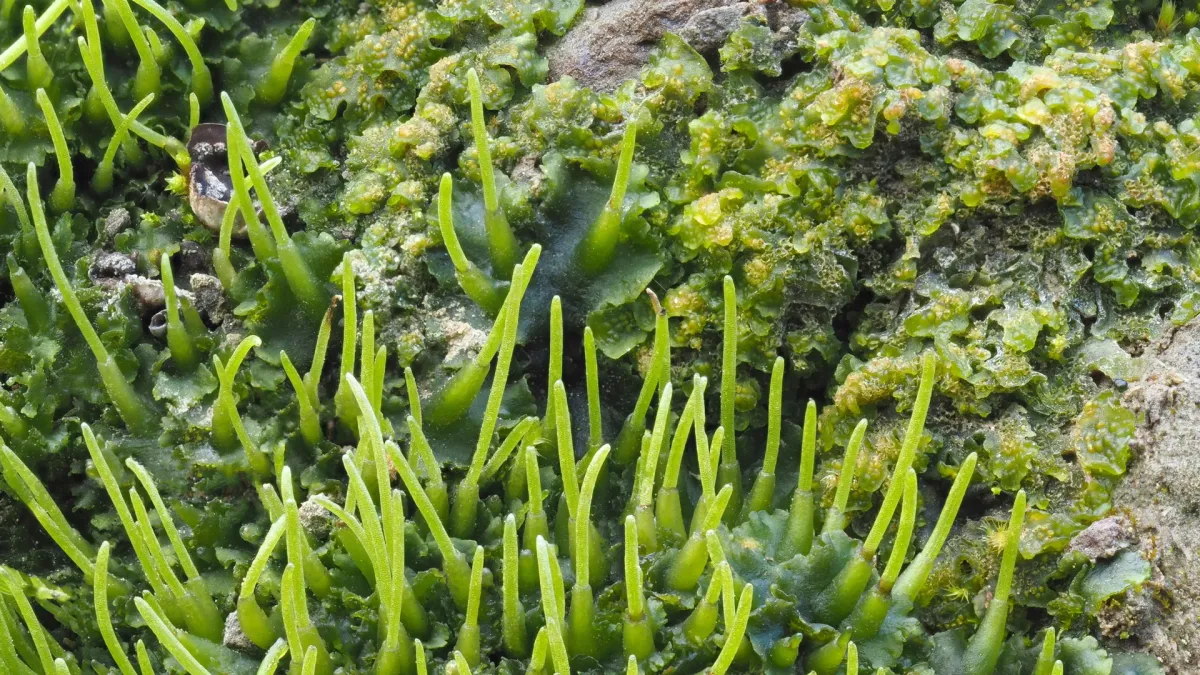
A breakthrough came from studying hornworts. These are the only land plants known to have carbon-concentrating compartments like algae. Hornworts are more closely related to crop plants than algae are. This made researchers think their methods might be easier to transfer.
What they found was very different from what they expected.
Tanner Robison, a graduate student working with Li, said they thought hornworts would use a separate protein to gather Rubisco. Instead, they found hornworts changed Rubisco itself to do the job.
The RbcS-STAR Protein
The key is an unusual protein part called RbcS-STAR. Rubisco is made of large and small protein pieces. In hornworts, one version of the small piece has an extra part called the STAR region.
This extra "tail" acts like molecular velcro. It makes Rubisco proteins stick together and form clusters inside the cell.
To see if STAR could work in other plants, the scientists did experiments. They put the RbcS-STAR part into a hornwort species that doesn't usually form pyrenoids. After this change, Rubisco grouped together into concentrated structures, like pyrenoids.
The scientists then tried the same thing in Arabidopsis, a common lab plant. Again, Rubisco gathered into dense compartments inside the chloroplasts.
Alistair McCormick, a professor at the University of Edinburgh and co-leader of the research, said they even attached just the STAR tail to Arabidopsis's own Rubisco. It caused the same clustering. This shows STAR is the main driver and can work in different plants.
A Path to Better Crops
This mechanism working in different plant species is important for agriculture. It suggests scientists might be able to make Rubisco cluster in crop plants by adding this "velcro" component.
However, more work is needed. Plants must also deliver carbon dioxide efficiently to the enzyme.
Laura Gunn, an assistant professor at Cornell University and co-leader, compared it to building a Rubisco house. She said they still need to "update the HVAC" to make it efficient. The team is now working on this challenge.
Sustainable Food for the Future
This discovery is a big step in improving photosynthesis. Even a small increase in efficiency could boost crop yields. It could also reduce farming's environmental impact. This is crucial for feeding a growing global population sustainably.
Li noted that nature has already tested solutions. He said their job is to understand these solutions to apply them where they are most needed, in the crops that feed the world.
The study was published in Science.
Deep Dive & References
The hornwort Rubisco-targeting STAR domain enables pyrenoid-like CO2-fixing condensates in plant chloroplasts - Science, 2024