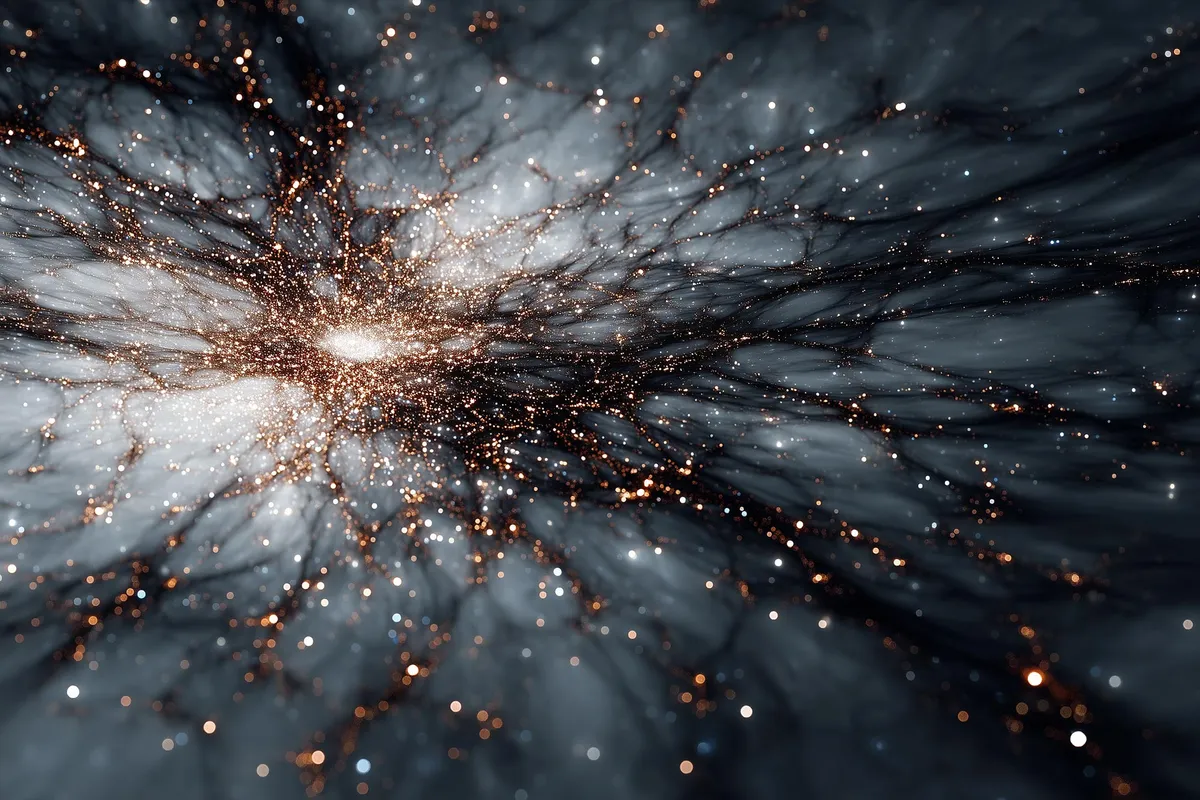
For decades, scientists have operated under a fairly straightforward assumption: dark matter and neutrinos, two of the universe's most elusive residents, pretty much keep to themselves. Dark matter, the invisible scaffolding holding galaxies together, and neutrinos, those ghostly particles zipping through everything without a care, were thought to be the ultimate cosmic introverts.
Turns out, they might just be sharing notes. New research from the University of Sheffield hints at an interaction between these two titans of the unseen, a cosmic meet-cute that could finally explain why the universe isn't clumping together quite as expected.
The Universe's Lumpy Problem
Here’s the rub: our best model of the cosmos, the Lambda-CDM, assumes dark matter and neutrinos don't bother each other. This model, built on Einstein's General Relativity, has been incredibly successful. But lately, it's been showing a few cracks, particularly when it comes to how much stuff is clumped together in the universe.
We're a new kind of news feed.
Regular news is designed to drain you. We're a non-profit built to restore you. Every story we publish is scored for impact, progress, and hope.
Start Your News DetoxMeasurements from the early universe (courtesy of the Atacama Cosmology Telescope and the Planck Telescope, which peered at the faint afterglow of the Big Bang) suggest that cosmic structures should have grown into bigger, denser lumps than what we actually observe today. Meanwhile, observations of the modern universe (from the Dark Energy Camera in Chile and the Sloan Digital Sky Survey) show matter is, well, a bit less clumpy than it should be.
It's a subtle difference, but it's enough to make cosmologists raise an eyebrow. Dr. Eleonora Di Valentino, a co-author on the study, puts it simply: the standard model isn't necessarily wrong, but it might be incomplete. The universe, it seems, isn't quite as neat and tidy as we thought.
The Ghostly Connection
Enter the idea of dark matter and neutrinos actually interacting. If these two entities are indeed swapping cosmic high-fives, it would fundamentally alter how galaxies and other large structures formed over billions of years. This interaction could be the missing piece of the puzzle, explaining why our universe is a little less lumpy than predicted.
Think about it: dark matter makes up about 85% of all matter, shaping the gravitational landscape. Neutrinos are incredibly light, almost massless, and famously ignore pretty much everything. Billions of them pass through you every second, unnoticed. But if they're subtly influencing each other, the ripple effect across the cosmos could be profound.
This isn't just theoretical hand-waving. The Sheffield team's work, published in Nature Astronomy, found actual signs of this potential interaction by sifting through data spanning the entire history of the universe. It’s a pretty clever bit of detective work, looking for cosmic fingerprints left by these elusive particles.
Future telescopes, like next-gen Cosmic Microwave Background experiments and weak lensing surveys (which map mass by looking at tiny distortions in light from distant galaxies), will be put to the task of confirming this interaction. If they do, it's not just a major breakthrough for cosmology; it gives particle physicists a concrete direction for lab experiments to finally uncover the true nature of dark matter. Because apparently, even the universe's most reclusive particles need a friend sometimes.