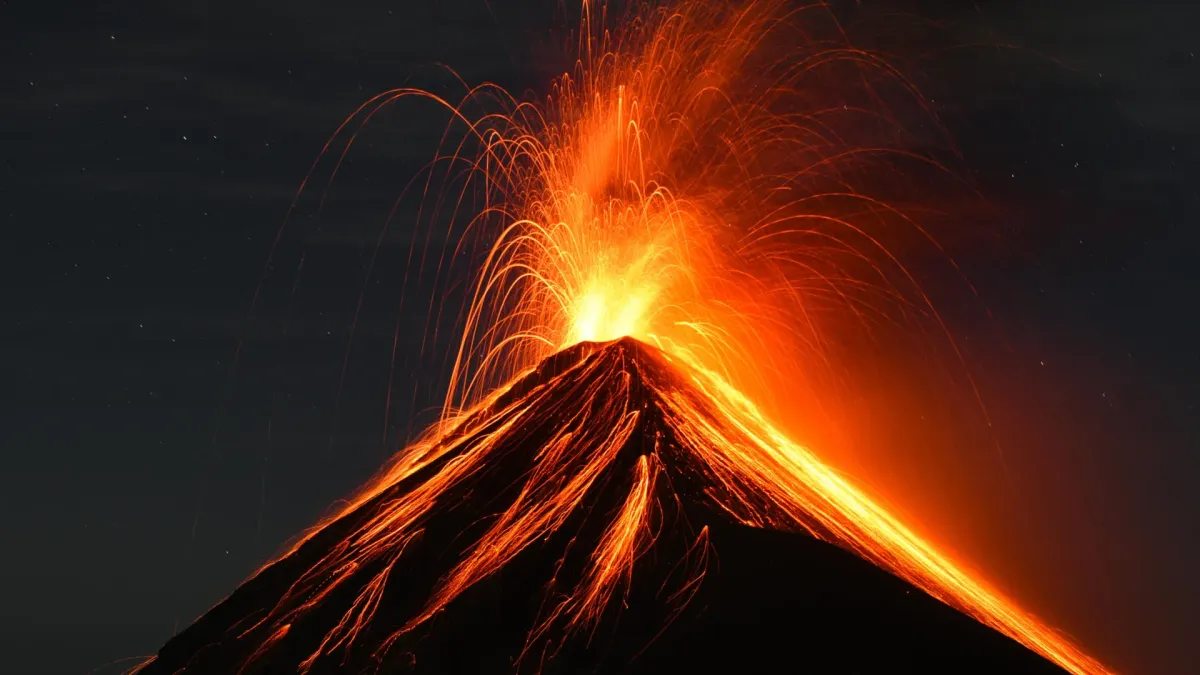
Scientists have found a tiny signal that volcanoes send out before they erupt. This new method, called "Jerk," could help predict eruptions earlier. It was developed by researchers from the Institut de Physique du Globe de Paris (IPGP) and the GFZ Helmholtz Centre for Geosciences.
The Jerk method uses a single seismometer to spot very small ground movements. These movements are caused by magma rising deep underground. These faint signals can show the first signs of volcanic activity in real time.
How the Jerk System Works
The research team tested the Jerk method for ten years on La Réunion island. During this time, the system successfully predicted 92% of the 24 eruptions that happened between 2014 and 2023. Warnings came anywhere from a few minutes to eight hours before an eruption.
We're a new kind of news feed.
Regular news is designed to drain you. We're a non-profit built to restore you. Every story we publish is scored for impact, progress, and hope.
Start Your News DetoxAbout 14% of the alerts did not lead to eruptions. However, these alerts still showed that magma was moving beneath the volcano. Because it doesn't need much equipment, the Jerk system could be a key early warning tool, especially for volcanoes that aren't watched closely.
Predicting volcanic eruptions is hard. Volcanoes often show signs like more earthquakes, ground changes, or gas changes. But it's tough to know exactly when an eruption will happen, how long it will last, or how strong it will be. False alarms are also a big problem, causing expensive evacuations and distrust.
The Jerk method looks for tiny ground motions when magma pushes into the Earth's crust. These signals are very low frequency and show up as quick, impulse-like changes in horizontal ground motion. Scientists believe these signals come from rocks breaking apart before an eruption.
These signals are incredibly small, only a few nanometers per second cubed. But a single broadband seismometer can detect them. The system also uses special data processing to correct for things like Earth tides. If the signal goes above a certain level, the system automatically sends an alert.
A Decade of Real-Time Monitoring
The system was set up in April 2014 at the Piton de la Fournaise observatory on La Réunion. It became an automatic part of the WebObs monitoring system. The first alert came on June 20, 2014, one hour and two minutes before an eruption.
Over the next ten years, the Jerk system ran continuously. It gave automatic alerts for 92% of the 24 eruptions between 2014 and 2023. Warnings came from a few minutes to 8.5 hours before magma reached the surface.
Piton de la Fournaise is one of the most monitored volcanoes in the world. This made it a perfect place to test the new method. Scientists could check Jerk alerts against other signs like earthquakes, ground changes, and gas levels. These checks confirmed that magma was moving and an eruption was likely. The system also worked with old data from 24 eruptions between 1998 and 2010.
Dr. Philippe Jousset, a co-author, noted that the Jerk method was tested in real time for over ten years. This is different from most studies that analyze data after the fact.
Understanding False Alarms
Some alerts did not lead to eruptions. These "false positives" happened in 14% of cases. But these weren't random errors. They showed real magma intrusions that just didn't erupt. Scientists sometimes call these "aborted eruptions."
Other observations, like seismic activity and ground changes, confirmed magma was present during these alerts. Jousset said the Jerk tool is a clear detector of magma intrusions, even if they don't erupt. For example, on December 5, 2025, a weak Jerk signal confirmed magma beneath Piton de la Fournaise during a seismic event.
Future Plans
After ten years of testing on La Réunion, researchers believe the Jerk system can be used for other volcanoes. This is especially true for those with less monitoring equipment.
The team plans to test the method on more active volcanoes, starting with Mount Etna in Italy. A project called "POS4dyke" will install new seismometers there in 2026. This work will also connect with the SAFAtor project, which explores using fiber optic cables for early warnings. These efforts could greatly improve how scientists detect and predict volcanic activity worldwide.
Deep Dive & References
Scientists just discovered a tiny signal that volcanoes send before they erupt - ScienceDaily, 2026