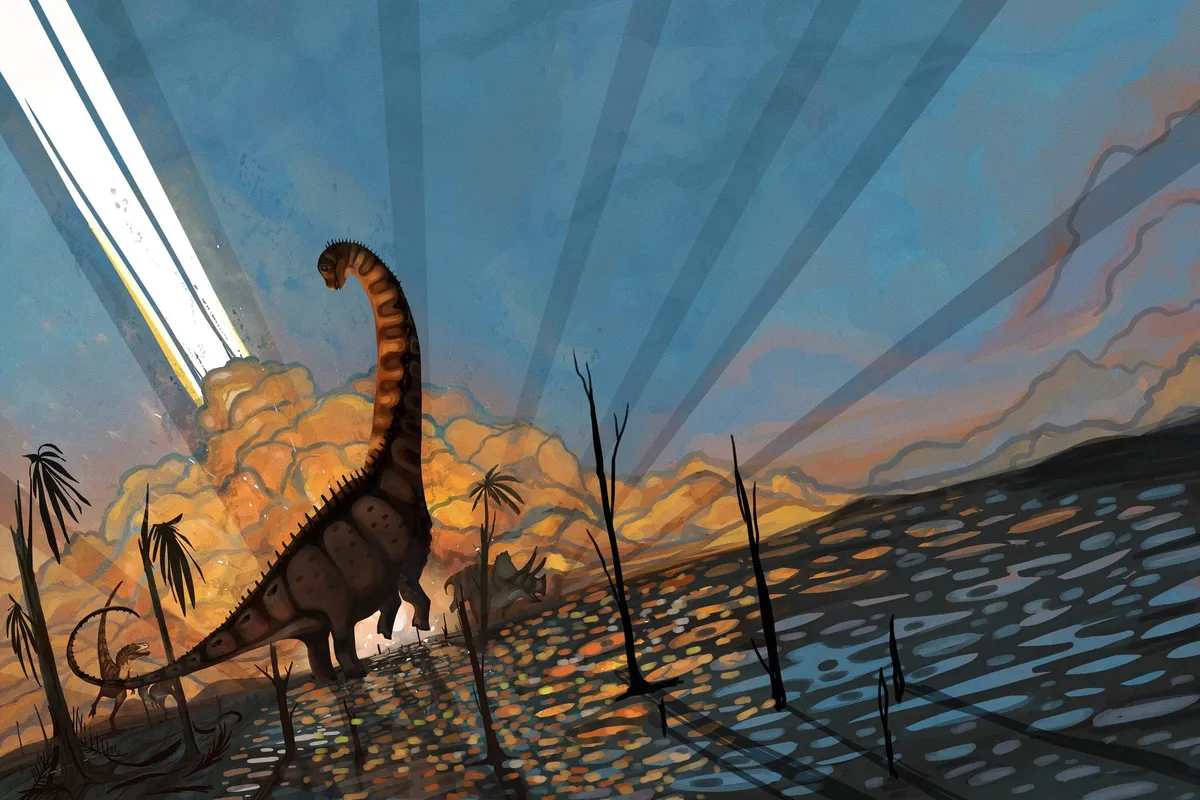
Right up until the moment an asteroid reshaped Earth's future, dinosaurs were doing fine. Not declining. Not struggling. Thriving.
That's the story emerging from fossil beds in northwestern New Mexico, where researchers have found something the textbooks got wrong: dinosaur communities were vibrant and diverse in their final millennia, contradicting decades of assumptions about a slow fade into extinction.
The last healthy ecosystem
In layers of rock called the Naashoibito Member of the Kirtland Formation, scientists identified what amounts to a snapshot of dinosaur life frozen at the Cretaceous-Paleogene boundary — the precise moment, 66 million years ago, when everything changed. Using high-precision dating, the team pinpointed fossils of Alamosaurus and other species to between 66.4 and 66 million years old. These weren't relics of a dying age. They were living, breeding, thriving in healthy, diverse communities.
We're a new kind of news feed.
Regular news is designed to drain you. We're a non-profit built to restore you. Every story we publish is scored for impact, progress, and hope.
Start Your News Detox"The Naashoibito dinosaurs lived at the same time as the famous Hell Creek species in Montana and the Dakotas," says Daniel Peppe, an associate professor of geosciences at Baylor University. "They were not in decline — these were vibrant, diverse communities."
What makes this discovery significant is what it overturns. For years, paleontologists debated whether dinosaurs were already in trouble before the asteroid impact, their diversity waning, their populations stressed. This new evidence suggests otherwise. Dinosaurs across North America occupied distinct regional ecosystems — shaped by temperature gradients rather than physical barriers — and each was flourishing in its own way.
"What our new research shows is that dinosaurs are not on their way out going into the mass extinction," says Andrew Flynn, the study's lead author and an assistant professor at New Mexico State University. "They're doing great, they're thriving, and the asteroid impact seems to knock them out. This counters a long-held idea that there was this long-term decline in dinosaur diversity leading up to the mass extinction."
The aftermath, and what it tells us
The asteroid strike was sudden and total for dinosaurs, but it wasn't the end of the story. Within about 300,000 years — a blink in geological time — mammals began to diversify rapidly, filling the ecological niches dinosaurs had occupied. Remarkably, the temperature patterns that had shaped dinosaur communities in the north and south persisted into the Paleocene, and mammals followed the same geographic divide. Populations in the north and south remained distinct from each other, unlike what happens in other mass extinctions, where life tends to homogenize across regions.
That continuity suggests something deeper: the structure of life on Earth has deeper roots than we often assume. Change the dominant players, but the underlying geography and climate still write the rules.
The research, conducted on public lands managed by the U.S. Bureau of Land Management, also demonstrates why protected areas matter. They're not just about conservation now — they're archives of how life responds to catastrophic change. As we face our own moment of rapid environmental shift, understanding how ecosystems reorganized after the asteroid impact offers an unexpected kind of clarity: life is resilient, but only if the conditions allow it. The dinosaurs weren't weak. They were simply caught in an event no adaptation could survive.
What happens next is already unfolding in the fossil record. The mammals thrived, diversified, and eventually gave rise to everything from bats to whales to us. But that's a story that only became possible because 66 million years ago, the rules of the world changed in an instant.