Researchers have cracked how tiny structural tweaks to a promising class of materials can dramatically boost their ability to turn sunlight into useful chemicals — and they've built a computational tool that lets them predict which changes will work before spending months in the lab.
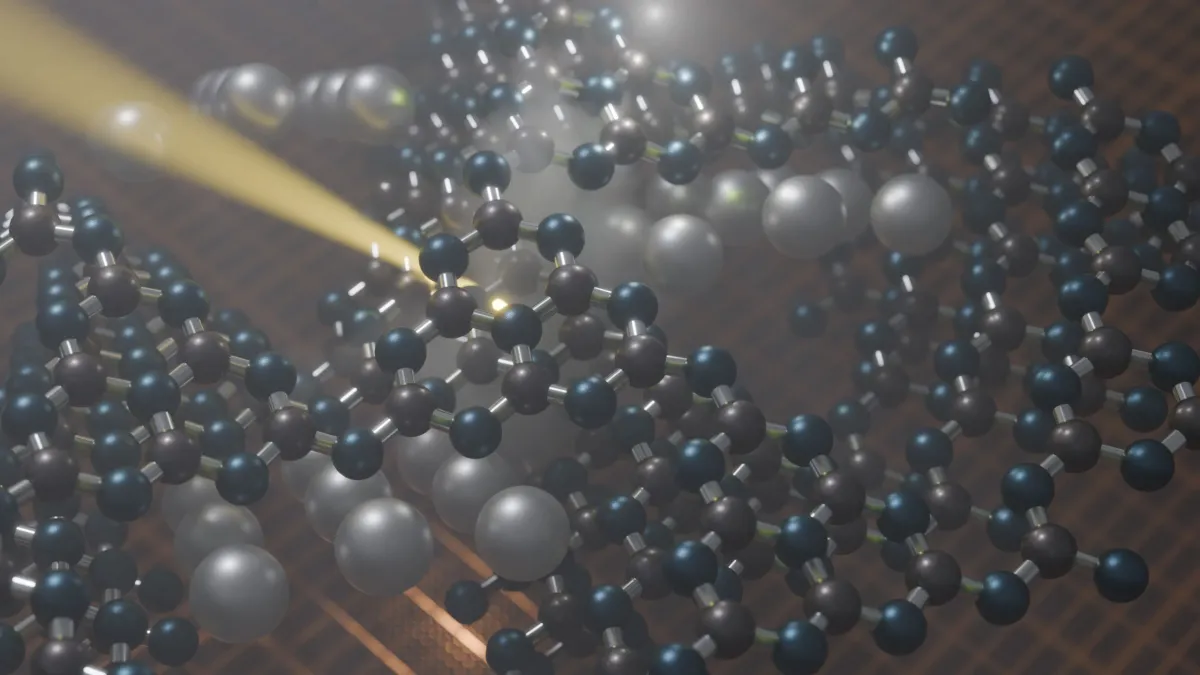
The materials in question, called polyheptazine imides, belong to the carbon nitride family. Think of them as cousins of graphene — they're layered compounds made from nitrogen-rich rings stacked into sheets. Unlike graphene, which is brilliant at conducting electricity but useless for capturing light, polyheptazine imides have the right electronic structure to absorb visible light and drive chemical reactions.
They're also cheap to make, non-toxic, and stable at high temperatures. The catch: early versions didn't work very well. When light hit them, the energy they captured would just fizzle away as heat instead of driving a reaction forward.
We're a new kind of news feed.
Regular news is designed to drain you. We're a non-profit built to restore you. Every story we publish is scored for impact, progress, and hope.
Start Your News DetoxWhy This Matters for Energy
The potential applications are enormous. If you can make these materials work efficiently, you could split water to produce hydrogen fuel, convert carbon dioxide into chemicals and fuels, or manufacture hydrogen peroxide at industrial scale. The bottleneck has always been design — there are thousands of possible variations, and testing each one in a lab would take years.
A team at Germany's Helmholtz-Zentrum Dresden-Rossendorf tackled this by developing a more accurate way to predict how structural changes affect a material's performance. The key insight: when light hits these materials, the electrons and holes it creates need to separate quickly before they recombine and waste the energy. Adding metal ions to the material's pores can dramatically improve this charge separation — but which metal ions work best, and why?
Dr. Zahra Hajiahmadi's team analyzed 53 different metal ions, systematically mapping how each one changes the material's structure and light-absorbing properties. They used an advanced computational technique called many-body perturbation theory, which accounts for how large groups of particles influence one another — something most standard calculations skip over.
The breakthrough isn't just theoretical. They synthesized eight real polyheptazine imide samples, each with a different metal ion, and tested them for their ability to produce hydrogen peroxide. The results matched their predictions with striking accuracy, outperforming competing calculation methods.
What's particularly significant here is the broader implication: this work demonstrates that you can use physics-based computational modeling to guide the design of photocatalysts rather than relying on trial-and-error experimentation. That's a meaningful acceleration in the timeline for developing new materials — potentially cutting years off the path from laboratory discovery to industrial application.
The researchers believe this framework will become a standard tool for designing the next generation of solar-powered catalysts. For a field that's been waiting for a reliable way to navigate the vast design space, this is the map researchers have been looking for.