At 10 years old, Omar Yaghi walked into a school library in Amman, Jordan, and found a book of molecular drawings. He didn't understand the structures yet, but something clicked. "I thought I discovered something that nobody has ever seen before," he recalls now.
He grew up in a single room with nine siblings, no electricity, no running water. Cattle shared their space, separated only by feed sacks. His parents had one priority: keep the children in school. Everything they earned went there.
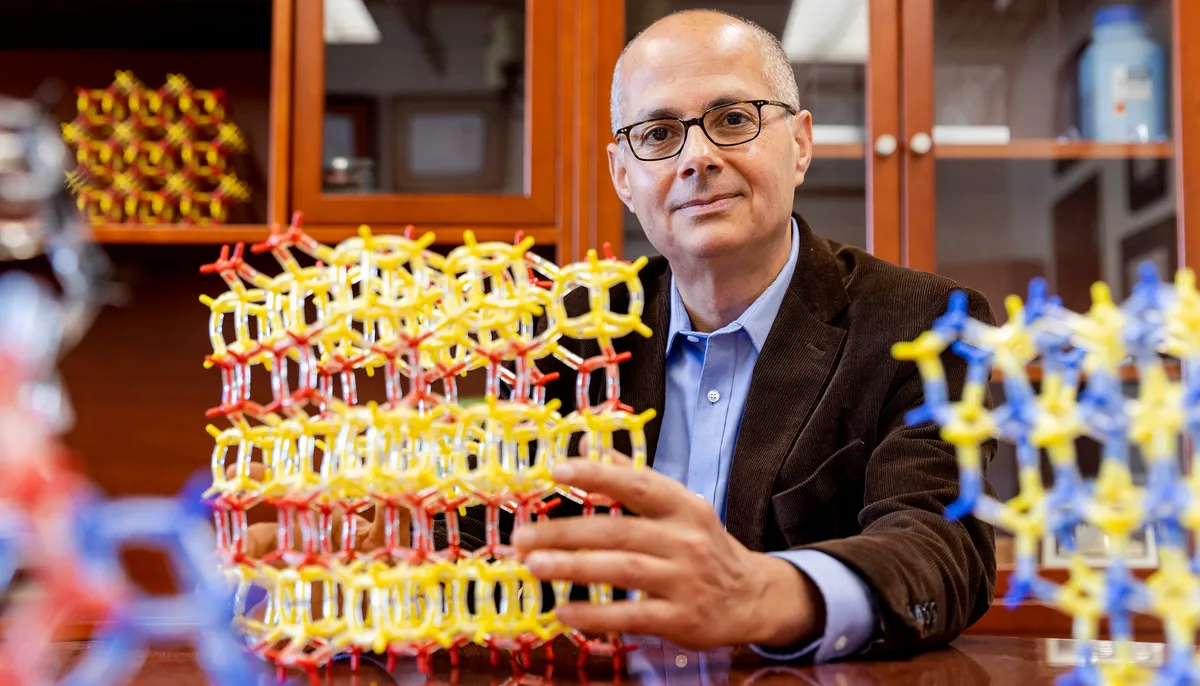
That childhood shaped everything that followed. Yaghi is now a chemistry professor at UC Berkeley, and in 2025 he won the Nobel Prize for developing metal-organic frameworks — materials so porous they work like molecular sponges. They can pull carbon dioxide straight from air and, more urgently, extract water from humidity so dry it seems impossible.
We're a new kind of news feed.
Regular news is designed to drain you. We're a non-profit built to restore you. Every story we publish is scored for impact, progress, and hope.
Start Your News DetoxThe Breakthrough Hidden in Failure
His path there teaches something important about how breakthroughs actually happen. During graduate school, a yearlong experiment appeared to fail. Instead, it produced his first major discovery: a ball-shaped molecule that became the foundation for his entire career. He learned then that setbacks in research often contain the seeds of what comes next.
That lesson mattered. It shaped how he approaches problems — not as obstacles, but as information. The same resilience that got him through childhood in scarcity became the tool he needed to solve one of the world's most pressing problems.
What makes his work remarkable isn't just the science. It's the connection between where he came from and what he's building. Growing up without clean water, he's now developing technology that can extract it from the driest air on Earth. "My dream," he says, "is for everyone to have water independence — where your water is yours, independent of everything else."
That's not poetic language. It's a specific vision rooted in lived experience. In a world where 2 billion people face high water stress and climate change is making scarcity worse, his technology offers something concrete: a way for communities to generate their own water supply without dependence on infrastructure or geography.
The work continues. His research in reticular chemistry — the study of how to design and build these porous materials — keeps pushing toward real-world deployment. The question now isn't whether the science works. It's how quickly it can reach the people who need it most.