

Imagine finding a hidden diary from a million years ago, detailing life before humans even knew what a diary was. That's essentially what a team of scientists just unearthed in a cave near Waitomo on New Zealand's North Island.
They discovered a treasure trove of bird and frog fossils, including a previously unknown relative of the famous kākāpō. This isn't just any old pile of bones; it's the largest collection of land vertebrate fossils from this period ever found in New Zealand. We're talking 12 bird species and four frog species, all living their best lives about a million years ago.
A World Before Us
Before you blame everything on humans, this discovery, published in Alcheringa: An Australasian Journal of Palaeontology, suggests New Zealand's wildlife was already in flux long before human footprints ever touched its shores. Volcanic eruptions and rapid climate shifts were regularly reshaping habitats, causing extinctions, and letting new species rise from the ashes. Because apparently that's how nature rolls.
We're a new kind of news feed.
Regular news is designed to drain you. We're a non-profit built to restore you. Every story we publish is scored for impact, progress, and hope.
Start Your News DetoxAccording to Associate Professor Trevor Worthy from Flinders University, the lead author, the fossilized bird community looks nothing like what you'd find in New Zealand today. It's an entirely new group of birds that simply didn't make it to the human-era.
Dr. Paul Scofield, Senior Curator of Natural History at Canterbury Museum, likened New Zealand's fossil record to a book with a massive missing volume. While they had a "snapshot" from 20 to 16 million years ago, these new findings fill in a gaping 15-million-year hole. Turns out, 33% to 50% of species vanished in the million years before humans arrived, thanks to those dramatic climate swings and super-volcanoes.
The Kākāpō's High-Flying Ancestor?
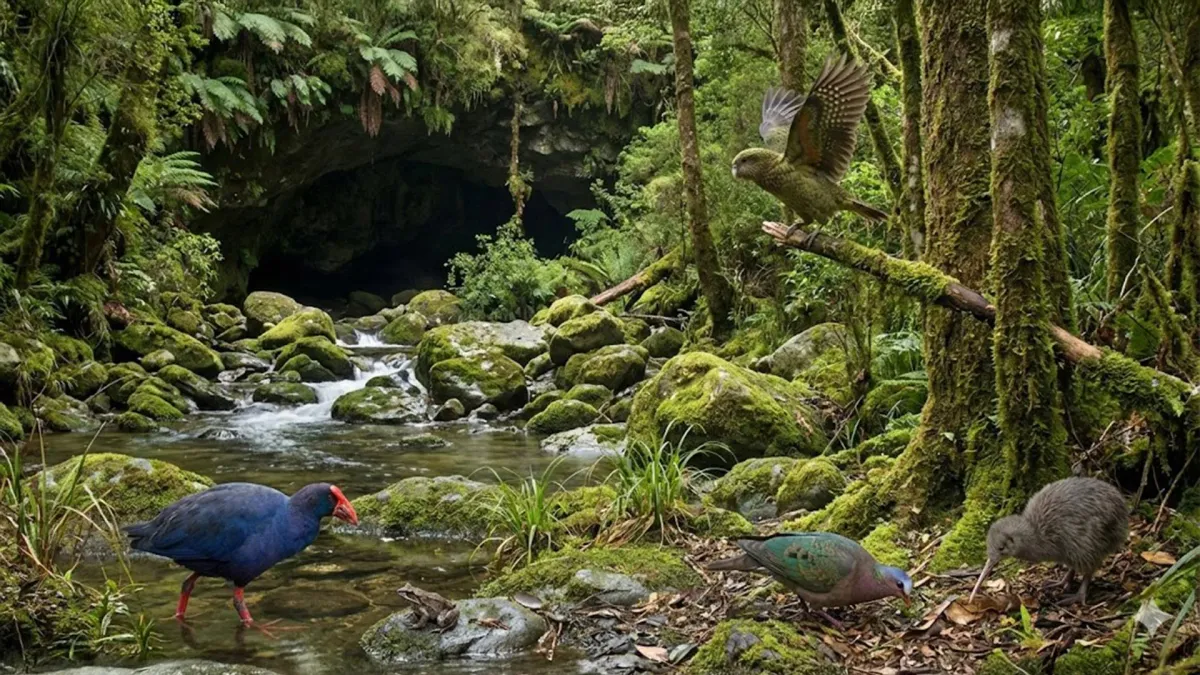
Perhaps the most charming find is a new parrot species, Strigops insulaborealis, an ancient cousin of the kākāpō. Today's kākāpō is famously flightless, nocturnal, and one of the heaviest parrots around. But its million-year-old relative? Might have been a bit different.
Fossil analysis hints at weaker legs than its modern descendant, which relies on powerful gams for climbing. This suggests the ancient Strigops insulaborealis might have climbed less and, dare we say it, possibly still flew. More research is needed, of course, but the thought of a high-flying kākāpō ancestor is just delightful.
The cave also coughed up an extinct ancestor of the takahē (another unique New Zealand bird) and a pigeon species related to Australia's bronzewings. Dr. Scofield points to changing forest and shrubland habitats as a major driver for all this avian evolution on the North Island.
The Ultimate Geological Sandwich
What makes these fossils even more special is their impeccable dating. They were found perfectly sandwiched between two layers of volcanic ash. One layer is from an eruption about 1.55 million years ago, and the other from a massive blast about 1 million years ago. This geological sandwich provides a clear, undeniable timeline for the fossils.
That younger eruption likely buried much of the North Island under meters of ash, and while most of it washed away, some was perfectly preserved in these caves. The older ash layer even makes this the oldest known cave on New Zealand's North Island. Talk about hitting the geological jackpot.
Associate Professor Worthy notes that for years, scientists focused on the changes that happened after humans arrived in New Zealand about 750 years ago. But this new evidence is a stark reminder that powerful natural forces like super-volcanoes and climate shifts were already busy shaping New Zealand's unique wildlife for hundreds of thousands of years. Humans might have sped things up, but nature had its own dramatic plans long before we showed up.





